
Life, Congealed
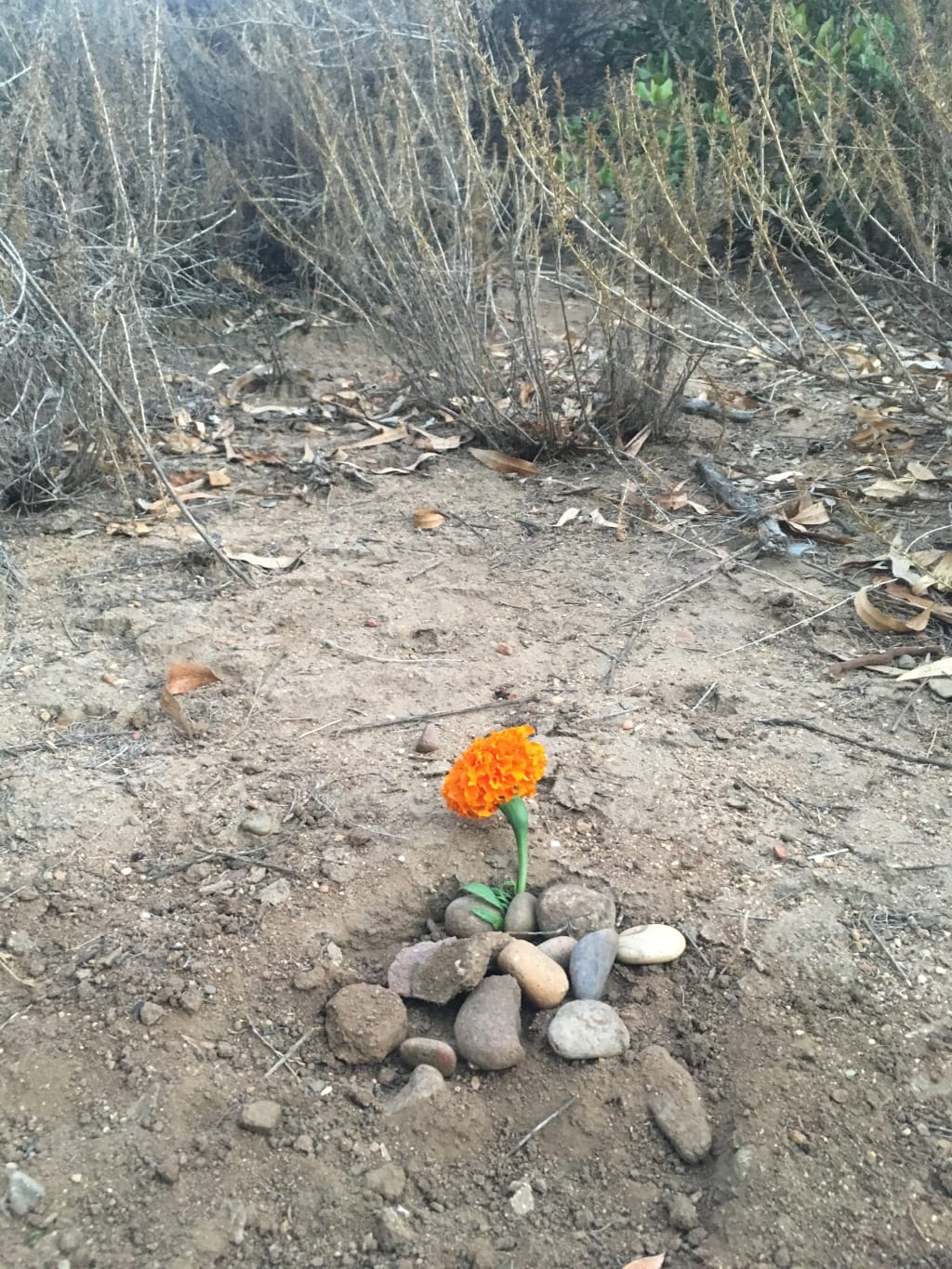
"I stand at the grave of a piece of his life... how dumb that we trade our lives for paper."
After my grandpa died, it was hard to feel right again. Losing a grandparent is the most ordinary thing in the world, as ordinary as the sun coming up, as ordinary as your heart pumping blood, as ordinary as dying, but I couldn’t warp my brain to fit the new space it’d been dumped into.
This inheritance was no consolation at all. Abue worked his life away, first to support the family he’d inadvertently started at twenty, then to keep supporting it all through his kids moving away and my grandma dying, up until the time he finally retired out to his property in the backcountry at eighty-one. I spent a lot of time with him during those last years, helping him out around the yard or in the house, driving him places, or just watching the shadows get long on the oak chaparral while we drank lemonade together on the back porch. Busy as he was with his ten children and dozens of grandchildren, I’d never had a chance to really get close to him as a kid, but I think our relationship was all the deeper for having been formed during my adulthood, after everyone else abandoned him.
I always knew his priority would be his living children, so when he died and my aunts and uncles descended from the north of the state like vultures, I was content to let them do as they pleased with what he left behind. I didn't expect or even want an inheritance. With my grandpa gone I wanted nothing more to do with my family, and for a few months it seemed like the feeling was reciprocated.
Then, one morning, my aunt showed up at my apartment. The visit was short, consisting of a few terse words and a polite invitation for coffee that she was happy to decline, but afterwards, with the sound of her footsteps in the stairwell echoing in my ears, I held a check for twenty thousand dollars.
I was happier before I got the money, I put the check in my drawer and tried to forget about it; I could use the money, I can always use money, but the idea of cashing the check, probably the last dregs of his account after my aunts and uncles scavenged it, didn’t feel right. The money was more than a TV or a lease on a shiny new car, but a piece of my grandfather’s life, his sweat, time, and love congealed into a slip of paper, and though I knew I couldn’t spend it I also couldn’t just let it sit around unfulfilled.
It bothered me so much that I’m here now at his house, the check converted to twenty thousand in hard cash. The thick stack of bills bulges uncomfortably in my pocket. I have a vague idea of trading the stack of bills in for something more precious, more concrete than a paper symbol of time and energy. I know my grandfather has plenty of treasures, most of which he never showed me. There was his old motorcycle (which I know I won’t take even if I find it), his watch collection (which I’m sure my aunts nabbed already), the mysterious box he says he found buried in the backyard shortly after he moved out here (I don’t even know what was inside it), and some old paintings by my great-grandmother (who enjoyed county-level fame).
I enter through the gate and trudge up the long, steep slope through the withered garden to the front door. My spare house key lets me in. They haven’t gotten rid of all the old furniture yet, and his possessions are still here, packed into cardboard boxes stacked in corners. Motes of dust drift lazily through the thick sunshine. I creak through the dim house, remembering, breathing deeply of the air still heavy with that musty, woody smell that I always associated with him, until finally I reach the bedroom.
I sift through some of the boxes sitting by the empty bedframe, not sure of what I’m looking for. I find a beat-up old penguin plushie, a coin collection, some novels, some loose chessmen, and a long, wooden container, shaped like a cigar box but without any markings. Could this be the mysterious buried box? I open it. To my surprise it contains only a battered black journal, of the type you’d find in a stationery store. From the thumbprints on the faded jacket and wear to the spine I can tell it’s been used frequently, whether for reading or writing. I open it and flip through it- it looks like a diary in what must be my grandfather’s hand, though having never watched him write I can’t be sure. Out of respect I only skim the first few words of every entry, but my eyes linger over the last page, where the writing ends suddenly a third of the way down the page:
I’m stopping this here. It’s too much to think right now. I don’t want to keep on living, but I don’t want to die either. I’m the last, all alone. I wish I could be an empty vessel, eyes, ears, a nose without a mind, accepting the beauty of the world without…
It must be about my grandma dying. I sigh, snap it closed, and slip it into my pocket. I take out the bills and weigh them in my hand, wondering where to put them. I don’t really want my aunts to find the money and pocket it; I want to feel that I really paid for the notebook, that those weeks of his life represented by the twenty thousand are mine in a more meaningful form.
I have an idea.
I pick up the cigar box and walk out of the house back into the lazy afternoon sunshine, making straight for his toolshed.
This comes at a bad time in my life. It’s stupid to just throw away twenty thousand dollars like this. Burying in in the ground with the weeds, when I could use it for myself or, if my aversion to spending it is really that strong, donate it to someone. Even giving it back to my aunt, who I’m sure had trouble letting go of it, would be better than just throwing it away.
So there goes twenty thousand. I guess it’ll rot away to nothing soon enough, this little piece of my grandfather’s life. How long will it take? A few weeks, at most. I stand by the grave of a piece of his life, one hand in my pocket rubbing the spine of the old black notebook. How dumb that we trade our lives for paper.
~
At the Long Slope House, the little hairy being digs in the garden. Even after the disaster the house still rises tall and incongruously peaceful, its lumpy grey walls and round windows as sturdy as ever, but the yard has gone rampant, fireweeds and rambling tangle-rose choking out the blooms. At first the little hairy being had been too numb to even lift itself out of its sleep-mat, preferring the red-leaved weeds wipe out the reminder of heartbreak that is its garden, but today the red afternoon sunlight finds it digging away at tough roots, building up a respectable pile of broken vegetation at its side. It finds the repetitive motion of breaking roots with the spade’s cutting edge and then scooping up clotted masses of dirt with the blade restful, giving its mind reprieve from grief.
It is neither the lengthening shadows nor the fluid running freely down its furry back that alerts it of the lateness of the hour, but the croaking song of bullbirds emerging from their dens by the creek down the slope. It wipes its brow and gazes at the sun, hanging red and swollen just above the horizon.
It stands to its feet, feeling suddenly the ache of squatting in the hot sun for hours. It walks gingerly back towards the tunnel leading into the dark coolness of the Long Slope House, looking forward to a juicy sling-apple while watching the sun set over the violet sea.
It freezes. It distracted itself into such complacency that now it has no defense against the torrent of memories slamming into it, memories of eating sling-apples on the patio in better days, of sunny fields filled with other beings, of nights spent wrapped in another’s arms. It cannot allow itself to feel again. It rushes back to its spade and patch of disturbed earth as if fleeing something. For little hairy beings, crying can be lethal. It digs fast and furiously now, desperately trying to rediscover that rhythm that let it forget, hacking, scrabbling, clawing into the earth, no longer even concerned with removing the weeds but digging straight down.
It hits something unexpected. It is neither friable like a clod of dirt nor hard like a rock, firm enough to resist his spade but too soft to deflect it. It wrenches his spade out of the mysterious buried material and digs around it until it reveals an oblong box, clearly something manufactured despite the accumulated grime that gives it the same color as the dirt around it. Curiosity distracting it from grief, it pries the box out of the ground and raises it to its face. The little hairy being shakes it by its ear and sniffs it, but the rattle betrays nothing about the box’s contents and all it can smell is the rich musk of the earth.
As it wipes the dirt off the box it realizes that it has hinges and a crack between two halves that must open.
It digs its claws into the gap until finally with a dry crack the bonds created after eons buried in the earth break. It opens the box.
Its eyes grow wide as it sees the box’s contents, what passes for a heart in its thick torso quickening. It cannot believe what it is looking at. It senses, compiles, understands, seeing the pattern behind symbols, the energy behind matter. In only a few seconds it absorbs the essence of what it sees in the box, connecting with another being for the first time in many cycles. In sharing its sadness its grief finally begin to ebb, revealing a landscape long hidden.
It runs back into its house. The box and its contents lie quietly in the gathering dusk, the dying sun casting its ruddy rays over the scene. It reemerges clutching a rectangular package to its chest. It’s a black leather bag full of strings of tiny beads arranged in a net that, when fully laid out on the ground, forms a pattern other little hairy beings can read. To that race, or to its last representative, the beads represent both knowledge and wealth. There is nothing more valuable to them than their memories but here and now, the little hairy being is willing to give it all up in a gesture of ultimate gratitude. It places the black leather bag into the box. It fits perfectly.
It takes a deep breath, the sun’s long light making its eyes and whiskers shine with a scarlet glint. It if was a human being tears would be falling from its eyes.
It places the box with its leather bag back into the ground and buries it, secreting away its memories just as its ancestors once did seeds, entrusting them to the Earth who will likely devour them, turn them to mulch, but which may toss them out again into the seas of time to be discovered again some time or place far away.
About the Creator
Vincent O'Hara-Rhi
My name is Vincent O'Hara-Rhi. I am of Irish, Latino and Korean descent, currently studying at SDSU. I have had an interest in creative writing since a young age. I especially enjoy the genres of magical realism and science-fiction.
Keep reading
More stories from writers in Humans and other communities.
Autonomy Is The Real Privilege
Good morning, freedom-seekers! Today we’re gonna be looking at autonomy. A strange word, I know; one many would probably look at blankly and run away from on sight. We’re gonna figure out what it actually means, consider how it’s achieved, and decipher just how deeply most of us are tangled up in dependence without realising it.
By That ‘Freedom’ Guy7 days ago in Humans
The Dangers of Not Having Your Coffee
5:30 a.m. and my husband coos at me asking if I am awake. I am now, but barely. He tells me he is off to work, checked the fire downstairs, and that is will be fine until I wake up (until 7:30 a.m.). Cool. I set my alarm for 7:30 and head back into some delicious dream, I can’t remember anymore. No I would not tell you, even if I could remember the dream)
By Alexandra Grant4 days ago in Humans



Comments
There are no comments for this story
Be the first to respond and start the conversation.