
Leave Me With This
Letters From the Dead
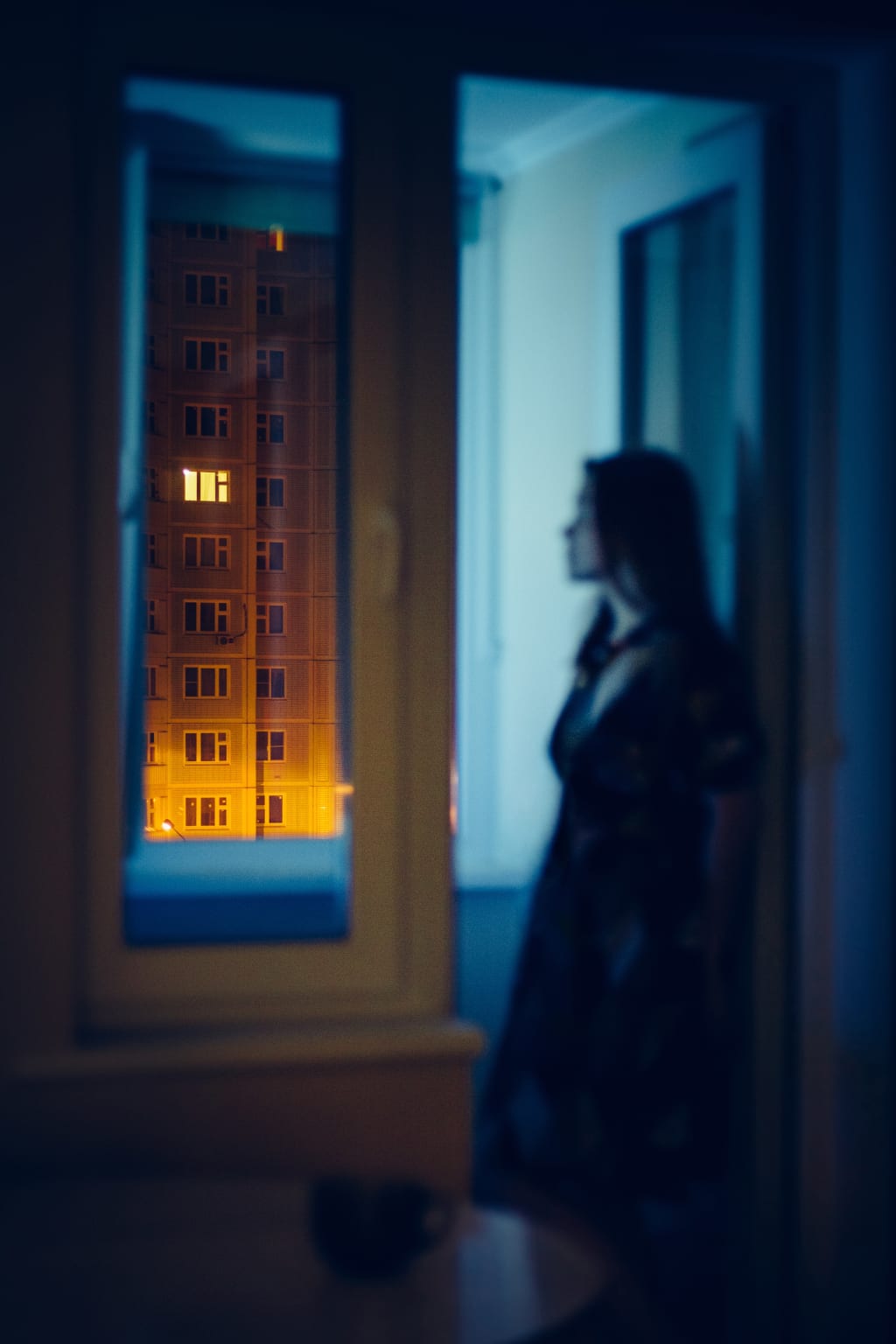
The money came during the heatwave, the fortieth suffocating day of it. Rest had become foreign to me, eyes filled with the grittiness of hours spent turning pillows, dreaming of typhoons, and tsunamis, and ice. And my father, of course. He floated into my dreams when he got the chance, hammering at the window and growling under the floorboards. It had been a year since he died, yet, still, I could smell him all around me, the scent he had in the final weeks. In the heat, I started to smell like him too, and in my delirium thought I was dying.
It was in an unmarked envelope, pushed under my door, the noise of it waking me from heat-induced dozing. I should have been finishing a portrait, a saccharine image of a toddler and his older sister, their heads pressed together, gummy smiles beaming. But instead, I was lying on the floor of the kitchen, forehead pressed against the cool tiles for relief.
I crawled to the door through the debris of paintbrushes and half-finished canvases. The envelope was thick, nearly bursting at the seams. I opened it and out it came. The money. Bills upon bills, fluttering down, the last dry, unsweating things in my box of an apartment. When it was all there I counted it. Then again. Then again and again until numbers stopped making sense. $20,000.
There was something else in the envelope too. I hadn’t realized the weight of it until it was in my hands. A notebook, black leather faded, and the borders of the pages yellowed. It smelled like something I had long forgotten. Like cigarette smoke floating through net curtains, or the scratchy acrylic wool of a sweater patterned with half-moons and stars.
I opened it slowly as if something would jump out. But it was just writing, every single page full of scrawling letters. The very first line in the notebook: Dear Gia, it’s your father, I miss you, I want you to have a good life. It’s not much, but it’s something.
I felt my chest constricting as I read. Things like this didn’t happen to people like me. Things like this didn’t happen at all. I wasn’t one to believe in anything after the sentence-ending period dot of death, but that was the before. Before the letters to me from my father. My dead father.
When he died, he told me, through barely moving lips, to have a good life. I had tried, I was painting, family portraits and murals that paid the bills. I lived alone in a nice enough, if tiny, studio. If you stood on a chair in the kitchen and craned your neck, you could see the light dance off the Hudson. It was all enough. But not what he wanted for me. He wanted art school, galleries, plaques in my name. The bright light and me, standing under it, gripping a brush. But he didn’t have to live with death. He got to leave, and I had to find a way to continue breathing in his absence.
The first night I laid out the money in neat stacks in my underwear draw. Then slammed it shut and grabbed my hair with such force I ripped handfuls out. I slept a few hours with the notebook firmly clutched in my hands. I dreamed of my father, his face at the window, his teeth chattering. He looked so cold. I woke up in a pool of sweat.
For five days, I sat unmoving at the kitchen table, the notebook shut before me. The only feeling I had of time passing was the light that streamed periodically through the skylight. The fifth night the knocking came, thudding over and over in the ceiling, eerily like my heartbeat. I knew it was him, my father, the ghost of him slamming his fists from somewhere above, demanding that I read.
The next day I opened the book, pushed the pages until I felt the spine crack, put my head on my hands, and began to read. The letters were packed into the pages, spidery handwriting progressively illegible to the end of the book. They said that he missed me, he was waiting for me, he didn’t know how to be without me. Would I come to him, he wrote, could I come to him?
It’s a feeling unlike any other, being haunted. Like frosted ice on the inside of a kitchen window, breath blown onto car windscreens, then, the finger drawing stars in the dark. All those weeks, in the rising heat, the money whispering, the letters imprinted on the back of my eyelids, my father was breathing down my back. The cold air, coming from his lips, the only chill in the room. The little hairs on my skin rising and falling with each exhale.
The knock came on the third week, the sound of it slicing through the thick silence. I thought I would open the door to my father, the ghost of him, or the decomposing corpse of him, but it was an elderly lady.
“Gia? You’re Gia?”
“Yes. I’m not working right now though, if you’re here for a painting I’ll mail it.”
“No, no, it’s for this,” she said, voice shaking like her hand as she held a piece of paper out towards me.
I noticed three things in rapid succession. One, the paper was a letter. Two, it was composed of the same handwriting, and paper, as the letters in the notebook. Three, the letter, like all the others, was addressed to me.
“Where did you get this?” I said, running my finger along the jagged, ripped edge of the paper.
“Can we sit? I think I need to explain some things.”
We sat on two little wooden chairs, surrounded by congealing paint, splintered palettes, and half-finished portraits of my father. Him, in the light. Him, by the sea. Him and I, the edges of him, the blurry features of him, melting into my own.
My guest said her name was Lila and she was the sister of Elias; the elderly man who lived above me. He was dead, Lila said, sniffing. The doorman had called her, said he hadn’t seen him, and, by the time she arrived, he had been dead for five days. In his chair still holding tea, she said, just like he had drifted off to sleep.
My head was pounding, I couldn’t remember the last time I slept more than a few fitful hours, and though I could hear what Lila was saying, I felt like there was something I was missing, something important.
“And then I found the letter, of course, and I didn’t know what to think. Gia, I thought, why was he writing to Gia? Then I realised you lived here and it all started to make sense, you see. I think he sent you others, other letters, because this one I found says why haven’t you written back to me. So I thought I must come and explain it to you, that he meant no harm.”
“I don’t understand what you’re talking about. Why would he be writing to me?”
“Oh no, he wasn’t writing to you. He was writing to his Gia, his daughter.”
“But I don’t understand, why not send them to her?”
“His Gia is dead. She’s been dead for decades. He had dementia, I didn’t know it was this bad or I never would have let him live alone here, I wouldn’t have. You look like her, his Gia, and then, I suppose he heard your name, or found it out somehow.”
“The noticeboard- I said quietly- in the lobby, I put my card up for portraits and commissions, it had my name on it, and my apartment number.”
Lila rubbed her running nose across the back of her hand and raised her head to look at me. She stared right through me, almost.
“You really do look like her, Gia.”
She left soon after she arrived. She wouldn't take the letter with her, or the notebook, said it was too painful, said reading her brother’s final mad moments on earth just made her feel guilty for leaving him here alone. I knew a thing or two about guilt, knew how it ate you up, inside out, spat you back out, quivering and bloody.
I think that’s why I didn’t tell her about the money. Or it would be nice to think that was the only reason why, because I wanted to protect her. I knew, inside, it was much more self-serving a reason than that. I couldn’t yet let go of my father, couldn’t yet watch the last dreams of his ghost fade into wisps and slip between my fingers. I had to believe he was still looking out for me.
The invitation to the funeral came two weeks later. The only witnesses were Lila, me, the doorman from the building, and the priest. I walked in, silently, sweat slicking my black dress like a second skin. It was strange, finally, seeing him. The man who had never really been my father, but still felt like it nonetheless. He was much smaller than I had imagined, but of course, death does that to a person. He was shrinking under the weight of his wrinkled suit, his mouth falling concave into toothless gums. Little white tufts of hair stuck up straight from his skull and his cheeks were rouged an unnatural shade. I brushed a finger over his forehead and then, as no one was looking, tucked it right under the collar of his shirt, fingers brushing dead, cold skin. The money. All $20,000 right next to his heart.
Outside, I watched as the casket was lowered into the ground. His strange other-daughter keeping vigil from afar. I couldn’t leave until I knew he had returned safely to the earth. Then, as I was about to walk away and return to my life, I heard it. The tapping, the tip-tapping, like my dreams of my father at the window.
But it wasn’t him, it was something more miraculous than that. Finally, the rain. Finally falling, finally, the pregnant sky split open and thunder cracked and I didn’t run for shelter just stood there, desperate, mouth-open, waiting for life again. I threw my head back and screamed, harsh, brutal wails that turned into choking, careening laughter.
From my pocket, I pulled the notebook. I could have left that too, left it to decompose along with him but there was something about his words that demanded witness. I was the only one that could do that for him. I had flipped those pages, over and over, searching for some clue of the ghost of my father. Finding him in the curves of cursive letters, the ink spills, the harsh periods. But, he was never really there at all. He had been gone for a long time. There were all gone: my father, Elias, Gia.
The two Gias. I would never be only myself. There were parts of me that now melted into the long dead body of another. I would always carry a little bit of death with me. I should have known that when I buried my father.
I flipped through the pages, backwards and forwards. I read it through eyes blurred with rain and tears as the words began to slide from the paper. There would only be minutes until the whole thing was gone. That seemed right. To let the rain take it. But until then I would read whatever remained.
Dear Gia,
Dear Gia,
I love you,
I miss you,
Dear Gia,
Where are you?
I felt you last night at my window. In the rain I heard you calling me.
Are you cold down there Gia?
I’ve memorised every feature of your face.
Come home, your dinner’s getting cold.
I miss you, little one, always will.
About the Creator
Keep reading
More stories from writers in Humans and other communities.
Time to change your life.
Is it even possible for you to change your life? A lot of people, more than there should be, are unhappy with their lives. But what are they doing about it? Usually nothing. People talk about how shitty their lives are and want change, but are they not taking the actions to change?
By Jen Phillipsa day ago in Humans
Wendy Mesley: Husband, Net Worth, Age, Children, Biography & More
Wendy Mesley is a renowned Canadian television journalist whose career spans over four decades. From her early reporting days to hosting major programs on CBC News, she has been a prominent face in Canadian broadcast journalism.
By Enoch Sagini7 days ago in Humans
Not Just For Clean Up: A History Of The MCU's Department of Damage Control
Initially an organisation that seemed to exist to help the heroes of the Marvel Cinematic Universe, from Phase Four onwards, the Department of Damage Control has shifted into a more antagonistic role. Most recently seen in the Wonder Man series, the current incarnation of Damage Control seems to target superpowered individuals, regardless of whether that person poses an active or intentional threat.
By Kristy Andersonabout 23 hours ago in Geeks



Comments
There are no comments for this story
Be the first to respond and start the conversation.