
Landslide
Life's seasons rise up against second chances

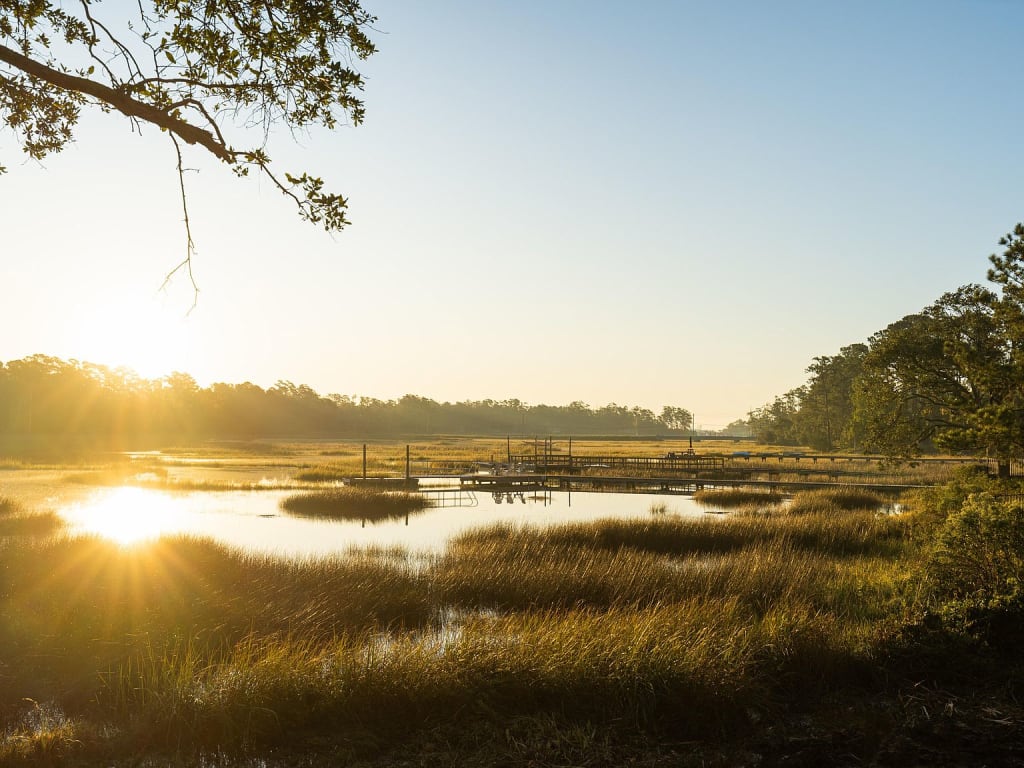
Nora Jane had roughly eight minutes to get to Bradley Creek for her final waterway sunrise. Luckily, the tide just finished spilling in, obscuring the ugly reality of pungent tidal muck and skin-slicing oyster beds slumbering below the surface. She stood, an arm slung over the open driver’s side door of the vintage Volvo V70 station wagon, looking at the brick colonial, an asylum she’d despised since the For Sale sign came down two decades earlier. Her aging coonhound, Mr. Jenkins, gawked from his post at the picture window, head tilted, clearly confused as to why the car was filled with belongings, why the hatch wasn’t open, and why he was being left behind in a quiet, dark house. The boy, a first year college student, would have been devastated to learn they were both gone. The dog would stay.
She slipped onto the seat and turned the ignition. The Wailin’ Jennys’ version of “Wildflowers” sprang from the speakers. You belong among the wildflowers/ You belong in a boat out at sea/ Sail away, kill off the hours/ You belong somewhere you feel free. With the “Parole Playlist” in motion, her secretly-planned freedom finally felt alive.
Despite a chill, uncustomary for mid-August, she opened the sunroof and rumbled out of the driveway. The main roadways hung nearly empty, not empty like during the pandemic, when things were apocalyptic and strangling and isolating, when mothers were suffocating more than usual beneath the weight of unequal obligations. With few cars around and the neighbors not yet rousing, she crept away.
I-40 out of Wilmington, North Carolina, is a 2,554-mile coast-to-coast straight shot to Barstow, California. Nora Jane was uncertain if she’d drive all the way through. Maybe she would take detours. Maybe she’d find a suitable small town, or a city where she could blend in: an anonymous gypsy. The open road gave her options. The box of dreams in the rear of the wagon would serve as inspiration. She locked away the Moleskin journals each time she filled them. Some were from before college. It would be interesting to read what the child in her envisioned life would be. Whatever hopes those pages held, there had been blindsiding, wild plot twists she hadn’t seen coming.
A turn onto Wrightsville Avenue and a peak of pink daybreak sneaking up from the horizon welcomed the throaty Stevie Nicks into the passenger seat. I took my love and I took it down/ I climbed a mountain and I turned around/ And I saw my reflection in the snow-covered hills/ Til the landslide brought me down/ Oh mirror in the sky/ What is love?
Nora Jane hadn’t been able to listen to Fleetwood Mac's “Landslide” for years. Once an award-winning crime reporter, the song played as she pulled up to a crime scene. She cut off the radio and walked up to her first murder-suicide. She hadn’t meant to come upon the couple head-on. She was around the corner when the call came over the police scanner. She beat the officers there. The scene wasn’t yet secure. The landlord left the apartment door wide open. Nora Jane had an unobstructed view.
Apparently, the woman broke off an engagement. The estranged boyfriend couldn’t live without her. He made sure no one else could live with her. Newly married and feeling a tug of possession from her own husband, Nora Jane wrote extensively on the issue of domestic violence, but every time she heard “Landslide” she saw blood spatter and the dead, open eyes of a jealous man. More recently, as her own marriage spiraled into a hurricane of control, it became an anthem. Can the child within my heart rise above/ Can I sail through the changing ocean tide/ Can I handle the seasons of my life/ I don’t know.
Nora Jane left journalism when the boy came along. The hours: too intensive. The work: too consuming. The complaints about the passion for her career burning brighter than the passion for her husband: too frequent. The barrage about balance coming daily: the twisting arm of forced guilt upon a working mother. She quit. She gave up on goals of landing a reporting job at The Boston Globe and working her way up the ranks to editor. She lost sight of Pulitzer Prizes and travelling the world on assignment. The picture of perhaps becoming a photojournalist eventually blurred to nothing more than another person’s fantasy.
At first, it was the big things in life that fell away: her career, the planned trip to Ireland canceled at the last minute, a put-off visit to the Pacific Northwest, taking the child to Disney. Then the less significant, but still celebratory pieces of life ceased: anniversary dinners, Valentine’s Day, date nights. The worst was the snuffing out of friendships, leaving Nora Jane at home, alone, most of the time.
Well I’ve been afraid of changing ‘cause I built my life around you/ But time makes you bolder and children get older/ And I’m getting older, too/ So take this love and take it down…
As the CFO of the household, she’d spent a decade skimming small sums of money out of the budget and the bank account until it became sizable, livable, an escape ticket. Nora Jane had managed to save $20,000 without the husband being any the wiser. Each time she was slighted, ignored, invalidated, she recorded the event in a little black book, tallying a growing list of resentments. Below each entry, she’d write a note about something she wished to accomplish (own a small business, find an editing job, freelance, teach, raise chickens) and an adventure she’d never possibly have under the current circumstances (a cross-country RV trip to hike national parks, tour Europe, live in Denmark).
Packing up the child for school brought an unexpected surprise. Nora Jane had forgotten about a coffee can she’d hidden in the back of the luggage closet. When she’d squirreled away the first $10,000, she split the money in the event of an exposure. She wouldn’t have to start over completely if the husband found it. She concocted lies. The discovery of the additional $5,000 put her at an even $20,000. She was out of excuses to stay.
The bridge over Bradley Creek in sight, Stevie Nicks belting out the last lines of “Landslide,” Nora Jane looked to the glove box where the $20,000 and the little black book waited dutifully to begin a new life. Distracted by daydreams, she didn’t notice the oncoming truck, surfboards loaded down in the bed, screaming passed her, toward the ocean for an early morning session.
Startled, she swerved. Driver’s Education teachers - and even when she taught her own son - warn of the overcorrection. It’s a Doomsday move. Her eyes watched in horror as her hands reacted. She looked to the creek, tide in, sun rising in the distance, over the inlet, wind blowing the high sawgrass like a conductor’s baton. The Volvo veered, not hitting the concrete rail of the bridge full on, but coming up barely short. The bump against the bridge beam and the speed sent the wagon rolling over into the thick sawgrass and intracoastal waters.
The boxes of journals and Fodor’s guide books, the suitcase of clothes - some she’d been wearing since her teen years - the mementos, drawings, photo albums and children’s keepsakes that only mothers hold dear, flipped and tumbled in the back of the wagon. Nora Jane felt the cloudy water and muck rushing in through the open sunroof. She struggled, but found her leg twisted and the steering column pinning her against the seat. The surfers rounded the bend and hadn’t seen the wreck.
The police were waiting on the porch of 114 Tara Drive when Nora Jane’s husband arrived home from dropping off his son at college. The two officers sat slumped and napping in the breezeway chairs. They’d been standing guard for hours. Various nosey neighbors came by throughout the day to inquire about their presence. What happened? Had someone broken in? Was there a fire? Was the child unaccounted for? He was supposed to have left the day before for State. Where was Nora Jane, she was always home? That hound dog had been barking incessantly since the morning, could they do something about it? Some offered their extra keys for entry. The officers maintained there was no need and politely sent the visitors on their way.
The husband pulled up and noticed the officers. His eyes shot to the rearview mirror and the rustling curtains and opening doors of their former friends across the street. The car door woke the officers, who came to attention.
“Good evening, sir. Are you the occupant of the premises? The husband of Nora Jane Burnett?”
“I am. Where is my wife?”
“Sir,” one of the officers cleared his throat. “Sir, I’m afraid there’s been an accident.”
“What kind of accident? Where is my wife?” The husband’s voice turned aggressive. “I said, where’s my wife?!”
“Sir. We’re sorry. Your wife had an accident. A fatal car accident. I know this is difficult. We’d like you to come down to the municipal offices with us. Her vehicle is at Floyd’s Towing. Most of her items are still inside.”
“Her items? What items? Groceries--”
“A suitcase. Some books and papers. Much of it is wet, sir. We didn’t go through it. We were able to get into the glove compartment, however. We found her identification, and a little black notebook containing a sizable amount of cash, sir. We think about $20,000. You’ll need to come with us to claim those items. And then there is the matter of identifying the remains.”
“Wait. Pardon me. Did you say $20,000?”
About the Creator
Keep reading
More stories from Jana Clancey and writers in Humans and other communities.
Whiskey At Dusk
Guess the whiskey was more important to you in the end, wasn’t it? It was more than the well-being of your friends; more vital than showing up to the places you promised you would and could come to; more critical of a matter than fulfilling your damn responsibilities and getting the press off your back.
By Snarky Lisa5 days ago in Humans
Subtle Signs Your Body Responds to Emotional Energy.
Emotions influence more than thoughts. They shape how your body reacts in ways you might not notice. Understanding these signals helps you recognize emotional patterns and maintain better mental and physical health.
By Wilson Igbasi4 days ago in Humans


Comments
There are no comments for this story
Be the first to respond and start the conversation.