
Indiana Under Siege: Tornadoes Tear Through Carmel and Beyond – A Community’s Resilience in the Storm
Severe storms unleash chaos across the Hoosier State, leaving a trail of destruction, heartbreak, and hope in their wake

The Calm Before the Storm
On the evening of April 2, 2025, Indiana residents braced for what meteorologists warned could be a “high-risk” severe weather event. By midnight, the skies over Carmel and Hamilton County darkened ominously, with rotating thunderstorms converging into a volatile system. The National Weather Service (NWS) issued tornado watches, but few could anticipate the ferocity of what was to come.
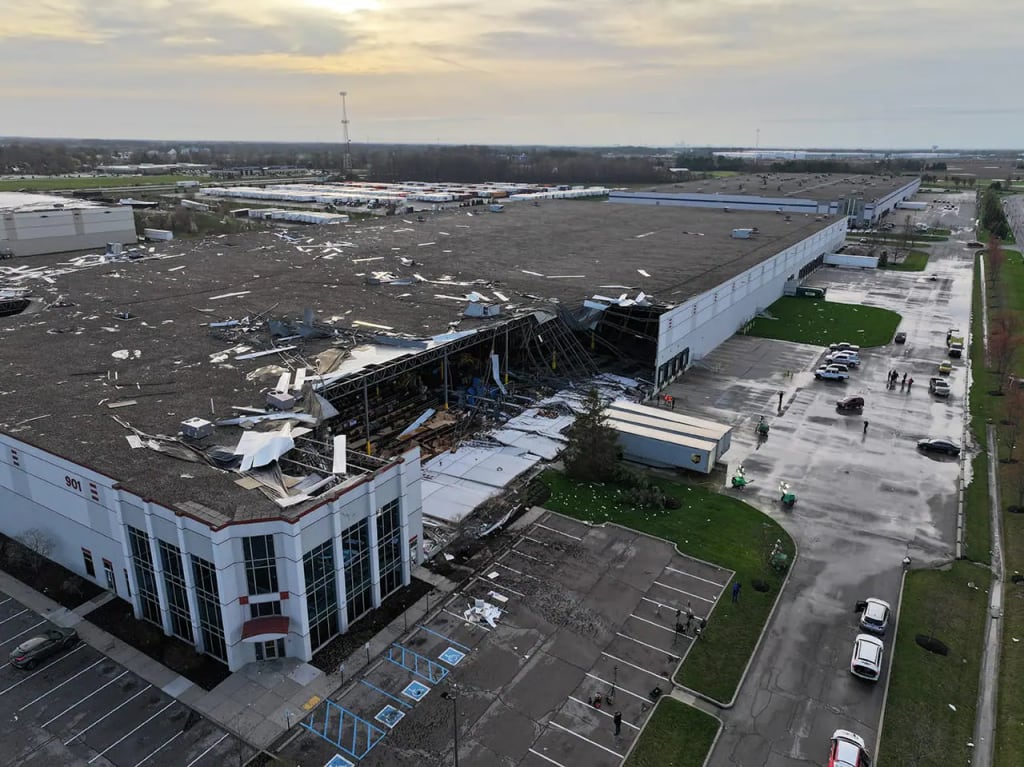
By dawn on April 3, the storm system had carved a path of destruction across central Indiana. Winds exceeding 80 mph uprooted century-old trees, peeled roofs off homes, and tossed vehicles like toys. In Carmel, an unconfirmed tornado—a monstrous wedge-shaped funnel—tore through neighborhoods, leaving a 15-mile scar of splintered wood and twisted metal.
“It sounded like a freight train roaring through our backyard,” recalled Sarah Mitchell, a resident of the hardest-hit Bridgewater community. “We huddled in the basement, praying the walls would hold.”
The Path of Destruction
The storm’s wrath was indiscriminate, but its focal point was Hamilton County, a suburban hub just north of Indianapolis. According to the IndyStar , the suspected tornado’s path stretched from Westfield to Noblesville, devastating areas near Hazel Dell Road and 146th Street.
Key Damage Zones:
1.Carmel’s Bridgewater Neighborhood : Dozens of homes were reduced to rubble, with families escaping with little more than the clothes on their backs.
2.Hazel Dell Corridor : Power lines collapsed, sparking fires that consumed three businesses, including a beloved local diner.
3.Noblesville Farms : Agricultural barns were flattened, threatening livestock and spring crops.
The WTHR weather blog mapped the storm’s trajectory, showing how it intensified over rural stretches before slamming into populated zones. “This was a textbook case of a ‘high-end’ EF-2 or EF-3 tornado,” said meteorologist Kevin Gregory. “The rotation was so tight, it’s a miracle more lives weren’t lost.”
Heroes in the Dark
Amid the chaos, stories of courage emerged. First responders worked tirelessly through the night, navigating debris-strewn roads to rescue trapped residents. In one harrowing instance, firefighters pulled a family of four from a collapsed garage just minutes before a gas line ignited.
Volunteers also mobilized quickly. At the Carmel High School shelter, teachers and students distributed water, blankets, and hot meals to displaced families. “We’re all Hoosiers here,” said volunteer coordinator Mark Taylor. “When disaster strikes, you don’t ask questions—you act.”
A Community Grapples with Loss
By April 4, the scale of the disaster came into focus:
Structural Damage : Over 300 homes uninhabitable, with $50 million in estimated losses.
Casualties : Miraculously, no deaths reported, but 27 injuries, including a 10-year-old boy struck by flying debris.
Infrastructure : 80,000 residents left without power, some for up to a week.
For many, the emotional toll was even greater. Retiree James Carter stood in front of his flattened home, clutching a photo album recovered from the rubble. “This was my wife’s garden,” he said, voice trembling. “She passed last year. Now it’s all gone.”
The Science Behind the Fury
Why was this storm so devastating? Meteorologists point to a volatile mix of atmospheric conditions:
Clashing Air Masses : Unusually warm, moist air from the Gulf of Mexico collided with cold fronts from Canada.
Wind Shear : Strong upper-level winds created horizontal rotation, which tilted vertically to form tornadoes.
Climate Factors : Rising temperatures in the Midwest may be intensifying storm systems, though scientists caution against linking single events to climate change.
“This wasn’t just a fluke,” warned Dr. Emily Torres, a Purdue University climatologist. “Indiana’s location in ‘Tornado Alley’ means these events will grow more frequent and unpredictable.”
Rebuilding and Resilience
In the storm’s aftermath, Indiana’s spirit shone brightest. GoFundMe campaigns raised over $2 million for affected families, while local contractors offered free repairs. Governor Eric Holcomb toured the damage, pledging state and federal aid. “We’ll rebuild—not just homes, but hope,” he vowed.
Residents like Sarah Mitchell are determined to stay. “This is our home,” she said, surveying her neighborhood’s wreckage. “We’ll clean up, rebuild, and be ready next time.”
Lessons Learned
The storms underscored critical preparedness gaps:
Warning Systems : While sirens blared, many residents noted gaps in rural alert coverage.
Infrastructure : Aging power grids failed under the strain, prompting calls for upgrades.
Community Networks : Grassroots aid efforts highlighted the need for formal disaster response partnerships.
“We can’t prevent tornadoes,” said NWS meteorologist Kevin Gregory, “but we can control how we respond. This event should be a wake-up call.”
Conclusion: Indiana’s Unbroken Spirit
The tornadoes of April 3, 2025, left scars on Indiana’s landscape, but they also revealed the resilience of its people. From first responders to neighbors sharing generators, the Hoosier State’s response embodied hope in the face of chaos. As cleanup continues, one truth remains: Indiana’s strength lies not in its buildings, but in its communities.
“We’ve been through hard times before,” said Carmel Mayor Sue Finkam. “This storm won’t define us. How we recover will.”
About the Creator
sondos azhari
Passionate about health and beauty products, I delve into wellness practices and skincare routines. With a focus on holistic living.My aim is to empower others to prioritize self-care and make informed choices for their well-being.
Keep reading
More stories from sondos azhari and writers in Humans and other communities.
Global Markets in Turmoil: Trump's Tariff Threats Spark Historic Sell-Off
Introduction Financial markets worldwide reeled in response to former President Donald Trump’s recent tariff threats, triggering a historic sell-off that wiped trillions off global stock valuations. As investors grappled with the specter of renewed trade wars, major indices like the Dow Jones Industrial Average, S&P 500, and Nasdaq Composite plummeted, with the Dow shedding over 1,300 points in a single session. This article delves into the causes, immediate impacts, and broader implications of this seismic economic event, drawing on insights from AP News and Yahoo Finance to unpack the crisis reshaping global trade and investment landscapes.
By sondos azhari10 months ago in Humans
I Saved My Family from a House Fire
It was November, and it had been just a handful of weeks since I’d moved up to senior school. I was only eleven and wouldn’t be twelve until the following June. I had spent the recent long summer holidays, carefree, happy, and, for the last time, playing with my old friends. But my twin brother and I were both ecstatic to have left junior school far behind us.
By Chantal Christie Weissa day ago in Humans
How to Succeed at the Benson Directory®
Congratulations and welcome to the Benson Directory® employee #22391! As our newest call handler, you will have the privilege of speaking with dozens of unique and interesting people on a daily basis as well as the opportunity to earn bonuses for high performance. Contained within this handbook you will find a set of ease to follow instructions designed to help you settle in to your new role and begin paving the way to success.
By S. A. Crawford2 days ago in Fiction



Comments
There are no comments for this story
Be the first to respond and start the conversation.