
Global Markets in Turmoil: Trump's Tariff Threats Spark Historic Sell-Off
Trump’s Protectionist Rhetoric Ignites Global Sell-Off: Markets Reel as Trade War Fears, Inflation Risks, and Geopolitical Tensions Escalate

Introduction
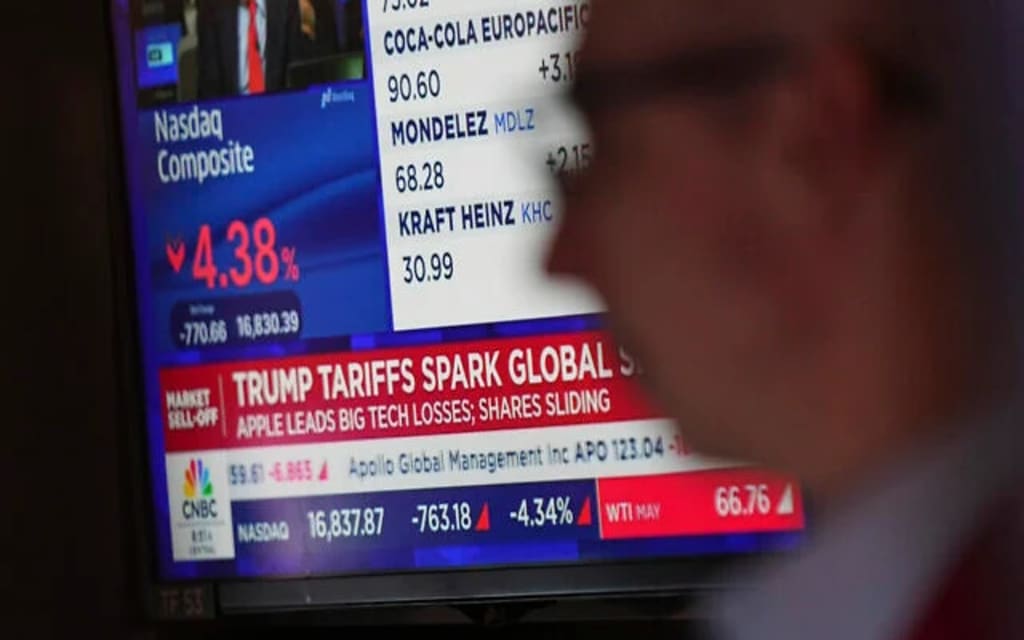
Financial markets worldwide reeled in response to former President Donald Trump’s recent tariff threats, triggering a historic sell-off that wiped trillions off global stock valuations. As investors grappled with the specter of renewed trade wars, major indices like the Dow Jones Industrial Average, S&P 500, and Nasdaq Composite plummeted, with the Dow shedding over 1,300 points in a single session. This article delves into the causes, immediate impacts, and broader implications of this seismic economic event, drawing on insights from AP News and Yahoo Finance to unpack the crisis reshaping global trade and investment landscapes.
The Catalyst: Trump’s Tariff Threats
The turmoil began when Trump, now the frontrunner for the 2024 Republican presidential nomination, vowed to impose sweeping tariffs on Chinese imports if he returns to the White House. His rhetoric echoed the aggressive trade policies of his first term, including the 2018–2019 U.S.-China trade war, which disrupted supply chains and slowed global growth. While tariffs are often framed as tools to protect domestic industries, economists warn that they risk escalating into retaliatory measures, stifling trade flows, and fueling inflation.
AP News highlighted that Trump’s latest threats have reignited fears of a prolonged trade conflict, with analysts drawing parallels to the 1930 Smoot-Hawley Tariff Act, which exacerbated the Great Depression. The uncertainty surrounding potential tariffs has already rattled businesses reliant on global supply chains, particularly in tech, manufacturing, and agriculture.
Market Meltdown: A Historic Plunge
The immediate reaction was stark. On the day of Trump’s announcement, the Dow Jones Industrial Average plummeted 1,300 points, its worst single-day drop since the early days of the pandemic in March 2020. The S&P 500 and Nasdaq Composite followed suit, falling 3.2% and 4.1%, respectively, as reported by Yahoo Finance . Tech stocks, which thrive on globalized supply chains and international revenue streams, were hit hardest. Semiconductor giants like NVIDIA and Intel saw double-digit declines, while industrial and automotive sectors also suffered.
Investors fled to “safe haven” assets, driving up prices for gold and U.S. Treasury bonds. The yield on the 10-year Treasury note fell to 3.8%, reflecting heightened risk aversion. Meanwhile, the CBOE Volatility Index (VIX), a measure of market fear, surged to its highest level in six months.
Sector-Specific Impacts: Who’s Hurt the Most?
1.Technology : Tech firms, particularly semiconductor manufacturers, faced acute pressure due to their reliance on Chinese manufacturing and exports. Companies like Apple, which assembles iPhones in China, saw shares drop amid concerns over disrupted production and higher costs.
2.Manufacturing : Industrial giants such as Boeing and Caterpillar, which depend on global supply chains, slumped as tariffs threatened to raise input costs and reduce export competitiveness.
3.Retail and Consumer Goods : Retailers like Walmart and Target, which source cheap goods from China, warned of potential price hikes, further squeezing consumers already battling inflation.
Global Repercussions: A Fractured Trade System
The sell-off underscored the interconnectedness of modern economies. Asian markets mirrored Wall Street’s decline, with China’s Shanghai Composite dropping 2.5% and Japan’s Nikkei 225 falling 3%. European indices, including the FTSE 100 and Germany’s DAX, also tumbled, reflecting fears of a global slowdown.
AP News emphasized that Trump’s tariffs could fracture the World Trade Organization (WTO) framework, encouraging other nations to adopt protectionist policies. For instance, the European Union has already signaled potential retaliatory tariffs on U.S. goods, risking a cycle of escalation. Developing economies, particularly in Southeast Asia and Latin America, face collateral damage as trade volumes shrink and commodity prices fluctuate.
The Inflation Dilemma: Tariffs and Monetary Policy
Tariffs act as taxes on imports, raising prices for businesses and consumers. Economists estimate that Trump’s proposed tariffs could add 1–2 percentage points to U.S. inflation, complicating the Federal Reserve’s efforts to stabilize prices. Yahoo Finance noted that Fed officials, already cautious about persistent inflation, might delay interest rate cuts, prolonging the era of high borrowing costs. This dual threat of inflation and elevated rates could stifle business investment and consumer spending, further dampening growth.
Political and Economic Uncertainty Ahead
The market chaos reflects broader anxieties about Trump’s economic agenda. While tariffs resonate with some voters who blame globalization for job losses, businesses and investors fear a return to the trade wars of 2018–2020. AP News cited a survey by the National Association of Manufacturers, which found that 60% of U.S. industrial firms oppose new tariffs, citing concerns over competitiveness.
Internationally, China has vowed to “resolutely safeguard its interests,” raising the specter of retaliatory measures such as restricting rare earth exports or boycotting U.S. goods. Such steps could destabilize industries ranging from electronics to renewable energy, which depend on Chinese materials.
Expert Opinions: A Divided Outlook
Analysts remain divided on the long-term impacts. Optimists argue that markets overreacted and that cooler heads will prevail, with negotiations averting a full-blown trade war. “Tariffs are a negotiating tactic, not a policy endgame,” said Diane Swonk, chief economist at KPMG. “The goal is likely to extract concessions rather than decouple economies entirely.”
Pessimists, however, warn of a “new normal” of deglobalization. “The era of free trade is over,” said Adam Posen of the Peterson Institute for International Economics. “We’re entering a phase of strategic competition where economics is weaponized.”
Investor Strategies in Volatile Times
In such uncertainty, financial advisors recommend diversification and caution. Strategies include:
Allocating to defensive sectors like healthcare and utilities, which tend to outperform during downturns.
Hedging with gold and bonds to mitigate equity losses.
Avoiding overexposure to single markets , particularly those tied to U.S.-China trade.
Conclusion: Navigating the Storm
The market’s reaction to Trump’s tariff threats underscores the fragile balance of global trade and the outsized role of political rhetoric in shaping economic reality. While short-term volatility is inevitable, the long-term consequences hinge on whether policymakers prioritize dialogue over confrontation. For investors, the episode is a stark reminder of the need for agility in an increasingly unpredictable world. As the 2024 election looms, the stakes for both markets and Main Street have never been higher.
About the Creator
sondos azhari
Passionate about health and beauty products, I delve into wellness practices and skincare routines. With a focus on holistic living.My aim is to empower others to prioritize self-care and make informed choices for their well-being.
Keep reading
More stories from sondos azhari and writers in Humans and other communities.
The Myth of "Pretty Privilege" and Why Beautiful Women Often Stay Single
Let’s cut to the chase: society loves to assume that beautiful women have it all figured out when it comes to love. They’re showered with attention, admired from afar, and treated like walking trophies in a world obsessed with aesthetics. Social media amplifies this illusion—every post is met with likes, comments, and virtual admiration. But here’s the twist: being beautiful doesn’t guarantee happiness or meaningful relationships. In fact, for many stunning women, the dating game feels less like a fairytale romance and more like navigating a maze of shallow interactions, unmet expectations, and emotional exhaustion. So why do some of the most gorgeous women remain single? The answer lies not just in societal pressures but also in how they—and those around them—navigate the complexities of attraction, objectification, and genuine connection.
By sondos azhari10 months ago in Humans




Comments (1)
The situation also raises concerns about rising inflation and its effects on the Federal Reserve's monetary policies.