
I Saw Myself in a Homeless Man’s Eyes
A brief encounter on a city sidewalk changed how I saw humanity—and myself—forever.


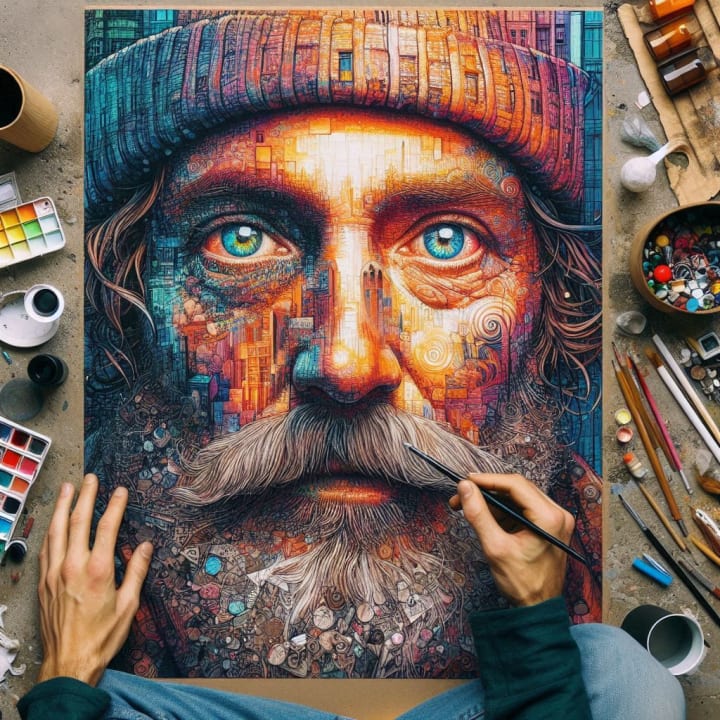
It was one of those bitter January mornings in downtown Chicago. The kind where the wind whips through your coat no matter how many layers you’re wearing. I was walking fast, as usual—late for a client meeting, coffee spilling in one hand, phone in the other, trying to reply to an email with a thumb gone stiff from the cold.
That’s when I saw him.
Curled up under the overhang of an abandoned storefront, wrapped in a threadbare sleeping bag, was a man. His face was red from the cold, beard matted with frost. He held a cardboard sign that read in shaky handwriting: "I used to be you."
I stopped walking.
It wasn’t the sign that got me. It was his eyes.
They were blue, sharp, intelligent—the kind of eyes that had seen better days and knew exactly how far they’d fallen. For a second, I couldn’t move. His gaze locked onto mine, not begging, not accusing—just knowing. As if he recognized something in me, and I in him.
The Life I Thought I Had Figured Out
At that point in my life, I thought I was doing everything "right." I had a good job in digital marketing, a small apartment near the lake, and a social circle that made me feel like I was someone. But I was also working 70-hour weeks, chasing promotions like a dog chasing cars. I was stressed, sleepless, and increasingly numb.
I often told myself that I was lucky. And I was. I had worked hard for my success, sure—but the truth was, I had also benefited from a lot of invisible safety nets: family support, stable health, college education, a few well-timed opportunities. I didn’t often think about those things.
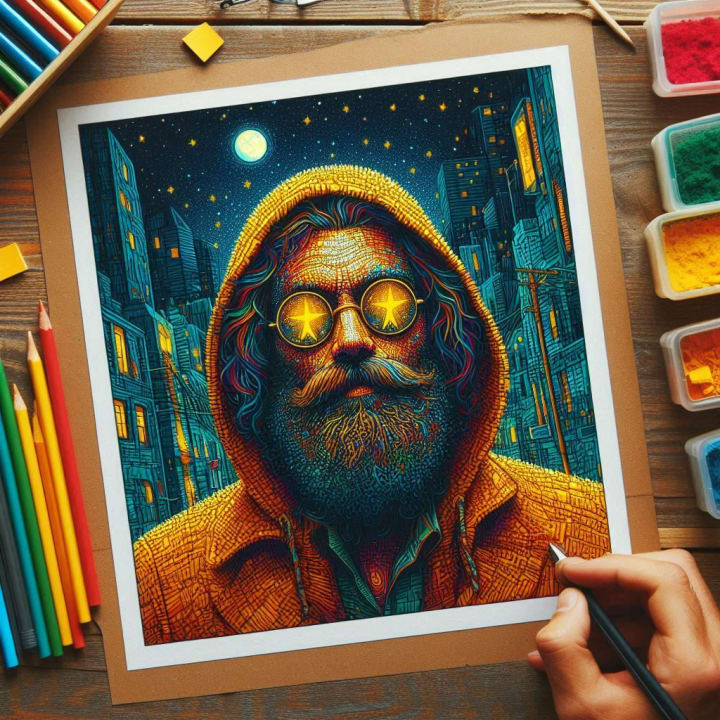
Until that day.
An Unexpected Conversation
Something made me turn back. I couldn’t go on with my day knowing I’d just walked past someone who might have been in my shoes once. I walked up and offered him the bagel I hadn’t touched.
He looked at it, then at me. "Thanks," he said. "But I’d rather have a conversation than a handout."
I was caught off guard.
He introduced himself as Malcolm. We sat down on the icy sidewalk, the rush of morning commuters swarming past us like we were invisible. He told me his story.
He had been a project manager at a construction firm. Owned a house in Evanston. Had a wife, a daughter. Then came the layoffs, the drinking, the divorce. One thing led to another. A series of unfortunate events, none big enough on their own to destroy a life, but together? Devastating.
"You think you’re solid," he said. "Until one day the ground shifts just enough under you, and you realize how fragile everything really is."
I nodded, not knowing what to say.
"I read people for a living," he added. "And I saw you rushing by. You look like you’re running from something too."
He wasn’t wrong.
The Reflection I Didn’t Expect
That encounter haunted me. I couldn’t stop thinking about Malcolm’s sign: "I used to be you."
What did it mean to "be me"? Was it my job, my clothes, my busy schedule, my curated social media profile? Or was it the constant fear of not being enough, of failing, of falling behind?
I realized that I had been measuring my success by how busy I was, how much I earned, how little I felt. There was no room in my life for empathy, slowness, or even honesty.
And yet, here was a man with nothing, offering me the most genuine human connection I’d had in months.
The Changes That Followed
I started volunteering at a shelter once a week. At first, it was a way to quiet the guilt. But over time, it became something else. I listened to stories—of addiction, mental illness, lost jobs, lost families. And I saw patterns. Many of these people had once had stable lives. What separated me from them wasn’t superiority. It was circumstance.
I slowed down. Cut back on work hours. Rekindled relationships that had gone cold. I began therapy, not because I had a "problem," but because I wanted to understand myself before I lost myself.
Months later, I saw Malcolm again. He was inside the shelter this time, sitting in on a job training class. He looked healthier. Cleaner. He smiled when he saw me.
"Told you," he said, "I used to be you. Now maybe you get it."
I did.

Moral of the Story:
Sometimes it takes seeing your reflection in someone else’s struggle to understand what really matters.
We walk through life wearing blinders, judging what we don’t understand, fearing what we don’t want to become. But behind every homeless person is a story—and sometimes, a mirror.
Empathy isn’t weakness. It’s the thread that ties us all together. And sometimes, it takes a stranger to remind us of who we are, and who we could become.
So slow down. Look someone in the eye. You never know what’s waiting there.
___________________________
Thank you for reading...
Regards: Fazal Hadi
About the Creator
Fazal Hadi
Hello, I’m Fazal Hadi, a motivational storyteller who writes honest, human stories that inspire growth, hope, and inner strength.
Keep reading
More stories from Fazal Hadi and writers in Humans and other communities.
The Guardian of Maple Street: The Bus Driver Who Trusted the Silence
The incredible true story of Harold Jennings, the school bus driver whose attention to detail and refusal to take a day off saved an elderly couple and 27 children from a catastrophic gas explosion.
By Frank Massey 3 days ago in Humans
Miss Persephone's Manual to a Seemingly Ordinary Life
Miss Persephone was found at the dining table, her blue eyes swollen, her tears arriving and retreating like the tides of the ocean. Earlier that day, her family had visited her in the retirement home where she had lived for eight years. It was her eightieth birthday.
By Imola Tóth2 days ago in Fiction



Comments (1)
Oh wow this story is so beautiful ✍️🏆🌼🌼🌼