

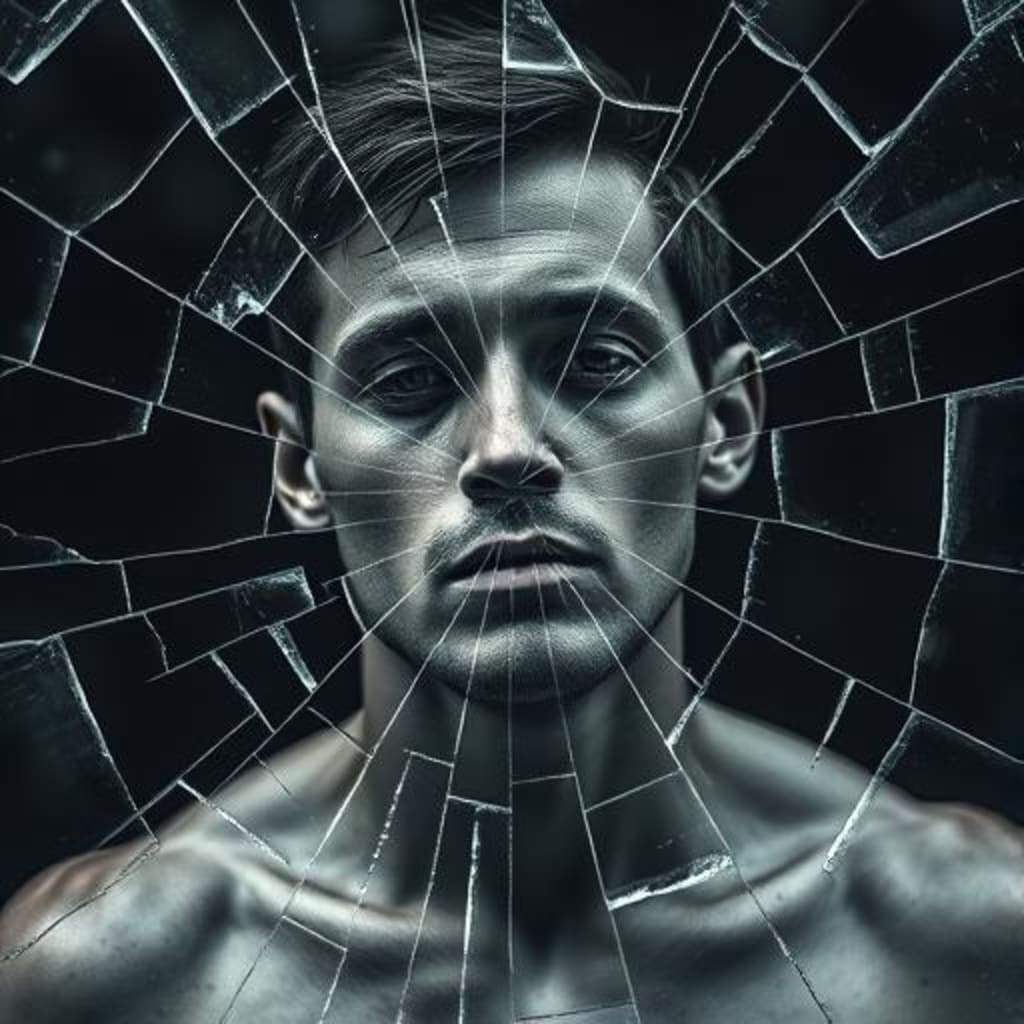
We like someone when we see how perfect they are, like gods. But we fall in love when we see how infallible and human they are. What a strange, intoxicating paradox, right? Imagine it for a second. You meet someone, and they seem like they walked straight out of a dream. They’re flawless, like the kind of person you could imagine living in some divine realm or sitting atop a pedestal. You’re drawn to them, mesmerized, infatuated, because perfection is magnetic. But it’s also distant. Cold, even. You can admire perfection, maybe you can aspire to it, but you can’t hold it. And isn’t that what love really is? Holding onto someone, seeing their cracks, their contradictions, their chaos — and loving them not in spite of it, but because of it?
I remember this one time I fell for someone who, at first glance, seemed nothing short of a hero in one of those epic tales. You ever read Homer’s Iliad? Achilles glowing in his shining armor, radiating strength that feels mythical? That’s how this person seemed to me. They had it all — charisma, talent, beauty, wit. But the more I got to know them, those divine edges started to fade away. Their battles weren’t glorious; they were awkward, self-deprecating, spilling coffee in the morning kind of battles. Aching insecurities, sarcasm as a self-defense mechanism, phone screen cracked like their carefully curated image. That was when the shift happened. I didn’t just like them anymore. I loved them — because they weren’t Achilles strutting around like a demigod; they were the Achilles quietly mourning Patroclus. We think love finds perfection, but in reality, it uncovers imperfection and says: “I see this… I see all of this… and I’m still here.”
There’s this line from Leonard Cohen’s song Anthem that stuck with me since the first time I heard it: “There is a crack, a crack in everything — that’s how the light gets in.” It’s so true. Perfect things aren’t real. They’re art, maybe, or ideals, but they don’t exist in flesh and blood. It’s the cracks and flaws that make us… well, us. A person’s imperfections let you in, like cracks in a wall letting light pour through in this gloriously imperfect way. When someone shows you their pain, their losses, their failures — don’t you just feel closer to them?
The entire theology of Christianity revolves around this radical idea of imperfection. God doesn’t enter the world as some perfect, untouchable being sitting on a throne of gold. Instead, he comes as Jesus — a human, flawed and vulnerable, who feels fear, cries in pain, suffers grievously. There’s something breathtakingly human about Jesus’ plea in the Garden of Gethsemane: “My soul is overwhelmed with sorrow to the point of death” (Matthew 26:38). How can anyone read that and not connect with it? The embodiment of divinity choosing human frailty over godlike perfection. There’s something very love-worthy in that.
Scientists have studied this concept of emotional intimacy that forms when we share vulnerability. The “liking gap phenomenon” shows that two people feel closer and more connected when they share real, raw thoughts and emotions, despite worrying they’ll be judged. It’s our humanness showing, not our superhuman façade, that bonds us more deeply. Think of that next time someone shows you their messy room or admits they have no idea what they’re doing with their life.
I think we’re obsessed with the wrong idea of love. Everywhere you look, there’s this glossy, curated version of romance that paints a picture of people who are effortlessly photogenic, endlessly supportive, always saying the perfect thing. But who is that? I mean, really? A robot, maybe. But not a human being. A human being has their foot in their mouth sometimes. A human being forgets to text back. A human being is messy, complicated, often struggling to figure things out as they go. And when you choose that — when you see the mess and embrace it — that’s what love looks like.
If you’ve ever read Rumi, you’ll know he had this incredible understanding of love in all its raw beauty. He wrote, “The wound is the place where the Light enters you.” Pain, flaws, vulnerability — they don’t just make someone human; they make them lovable. Because they remind us that we’re not alone. There’s this shared fragility that binds us, this mutual understanding that none of us are immune to the struggles of being alive. Wouldn’t you rather climb down from the pedestal and meet someone at eye level? Isn’t it better to be seen for everything you are, not admired from a distance for what you can never actually be?
This whole flawed, imperfect, beautifully human thing doesn’t happen overnight. Falling in love — that deep, all-encompassing kind of love — is gradual. First, there’s that magnetic pull of perfection — their beauty, their magic, their aura that feels untouchable. You don’t want to admit they’re human yet. That part comes later, when the perfect mirage starts crumbling. You see them stumble, you hear them cry, you notice the way their voice shakes when they’re scared or how they nervously fidget in uncomfortable moments. And instead of falling out of love, you fall deeper. That’s the real miracle. Not that we love each other’s strengths, but that we crave intimacy in each other’s weaknesses.
There’s also something deeply liberating about coming to terms with imperfection, both in others and in ourselves. Love — true, deep, and enduring love — asks us to abandon the idea that we need to be anything other than what we are. And that’s terrifying, isn’t it? When you love someone, you’re not only faced with their imperfections, but your own as well. You can spend years obsessing over keeping your guard up, keeping your flaws neatly tucked away, thinking that only this carefully controlled version of yourself deserves to be loved. And then one day, someone meets you where you are, sees all your stumbling, your shame and your scars, and loves you because of them, not in spite of them. That moment cracks something open in you, permanently. You can’t go back to playing pretend once you’ve felt that kind of love.
Have you ever noticed how people carry their old wounds into new love? I think about the ways I, and so many people I know, have inadvertently hardened ourselves after hurting or being hurt. You start building walls, thinking, if I can hide the weak, unpolished parts of me, no one can hurt me there. It’s not a false instinct — it comes from survival. But those walls keep the bad stuff out and the good. Love becomes stagnant when we try to be perfect. There’s no room for vulnerability, no room for surprises. But vulnerability breathes life into love. It’s the antidote to stagnation. Without it, you might have comfort or admiration, but you’ll never have the primal, overpowering intimacy of being seen and chosen exactly as you are.
Psychologists have even developed a term for this — “the Pratfall Effect.” The studies show that when someone who is generally competent or attractive demonstrates a small, humanizing flaw, people like them more. People feel safer with imperfect people. Think about that. The very thing we’re terrified of — our flaws being exposed — could be the thing that makes someone love us.
It’s that question — Can I show up for them fully, and can they do the same for me? — that captures the deepest truth about real love. It isn’t glamorous. It doesn’t arrive in shining armor or dance under perfect lighting to a score of swelling violins. It’s raw, unpredictable, and full of moments where you question everything — moments when you don’t feel like the best version of yourself, or when the person you love frustrates you beyond reason. But somehow, in the middle of all that imperfection, something extraordinary happens. When you choose each other, even in the chaos, love shifts from the shallow vibrancy of infatuation to something solid and rooted. It stops being a fleeting notion and becomes a quiet promise.
You see this again and again in stories of profound connection. Think of Hazel and Augustus in The Fault in Our Stars. Their love isn’t built on ease or perfection — it’s built on two very flawed, very mortal people baring their fears, their scars, their devastation, and choosing to love each other anyway. The same could be said of Frodo and Sam in The Lord of the Rings. Not a romance, but a devotion stronger than words. Sam loved Frodo through every hardship, not because Frodo was strong, but because Frodo was fragile and Sam refused to let him bear those weaknesses alone. That’s what we crave — not the perfection of heroes, but the steadfastness of someone who looks at us in our darkest, weakest moments and decides we’re still worth staying for.
And it isn’t just in fictional relationships. Look at the real moments of enduring love in your own life. Maybe it’s the friend who saw you break down in tears when you felt like you couldn’t keep going and sat there with you, letting you hurt without trying to fix anything. Or a partner who heard you confess something you were ashamed of — and who cradled your truth instead of recoiling from it. Or even moments when someone’s flaws tested your patience, yet instead of walking away, you made peace with the messiness. Those are the building blocks of love — the cracks we so often try to hide, the ones we think make us unlovable, but are actually the very places where connection solidifies.
Religion understands this, in both subtle and monumental ways. In Judaism, there’s the concept of chesed — loving-kindness. It’s not about earning love or giving it conditionally. It’s about steadfastness, showing up for the people you love, again and again, even when it’s hard. The story of Ruth and Naomi is steeped in this kind of love. When Naomi tells Ruth to leave her and start a new life, Ruth refuses. “Where you go, I will go; where you stay, I will stay. Your people will be my people and your God my God.” It’s not perfection that keeps Ruth beside Naomi — it’s loyalty through suffering, hardship, and loss. That’s what separates love from infatuation: whether you’re still there after the shine fades, when all that remains is imperfect reality.
I think of the Japanese art of kintsugi — repairing broken pottery with gold. The cracks aren’t hidden or erased; they’re celebrated, elevated. The object becomes more valuable because it has been broken, because it carries a story. What if we looked at love that way? What if we honored each other’s cracks instead of hiding them? The gold in the cracks is the evidence that the world knocked something over, but it was strong enough, and cherished enough, to be mended.
The poet Rainer Maria Rilke wrote, “For one human being to love another: that is perhaps the most difficult of all our tasks, the ultimate, the last test and proof, the work for which all other work is but preparation.” No one said loving someone else — or letting yourself be loved — would be easy. It’s slow, exhausting, awkward, full of missed signals and imperfect attempts to communicate. But that’s why it’s so powerful. It’s not easy, and yet you do it all the same. You wake up, you try again, and you keep trying, even when no one’s watching, even when it doesn’t look anything like the romance scenes that have been spoon-fed to us through pop culture.
And sometimes, the sheer humanity of it all is where the beauty lives. Picture this: someone admits that they’re scared to trust you because of a love that hurt them before, and you don’t try to fix it, but you stay. Someone forgets to pick up the groceries for the third time that week, and you laugh instead of holding it against them. Or you see someone’s shadow — the parts they’re ashamed of but can’t quite hide — and you wrap your arms around them and whisper, “I’m not going anywhere.” These aren’t movie moments. They’re not grand gestures. But they’re love. They’re the golden cracks and quiet truths that hold everything together.
Here’s something else that’s hard to accept: loving someone doesn’t mean fixing them, and being loved doesn’t mean becoming “whole.” If you’re waiting for the perfect person to save you — or hoping you can save yourself by becoming perfect — you’ll always end up disappointed. Love isn’t a cure. It’s a companion. It’s not about erasing the pain someone has been through; it’s about standing beside them through it. It’s not about fixing the things that are broken in you; it’s about letting someone touch your cracks without fear.
And yes, that means love challenges us. It holds up a mirror and reflects our deepest insecurities, our flaws, our ugliest fears. The perfection we so often admire at a distance doesn’t ask us to change. But love does. It asks us to unlearn the walls we’ve built and rebuild ourselves in connection with someone else. It asks us to accept that this will be messy, and there’s no perfect roadmap. That’s the beauty of it. Love makes you more human, not less.
It becomes strange, then, how often we fear imperfection when it’s our greatest strength. It’s how the light gets in. It’s where empathy is born. It’s where we find each other, and ourselves. Maybe, if we think of love like that — not as an ideal to aspire to, but as a slow, clumsy, intimate dance of vulnerability — we could stop trying so hard to be gods for one another. Maybe we’d finally let ourselves be human.
Read more at shownd.com
About the Creator
Ron C
Creating awesomeness with a pen. Follow me at https://twitter.com/isumch
Early March 2026: 4 Goals Accomplished
It's early March and I've now accomplished my 4th writing goal for the year of 2026. Before diving into the behind-the-scenes of it... why not tell you up front what that accomplishment was? I was published in a 2nd publication for this year. Published in Helix Literary Magazine out of Central Connecticut State University. You can read it for free right now!
By Stephen Kramer Avitabile6 days ago in Writers




Comments
There are no comments for this story
Be the first to respond and start the conversation.