
We are Gladiators in Modern Times.
Can We Act “Christian” Though?

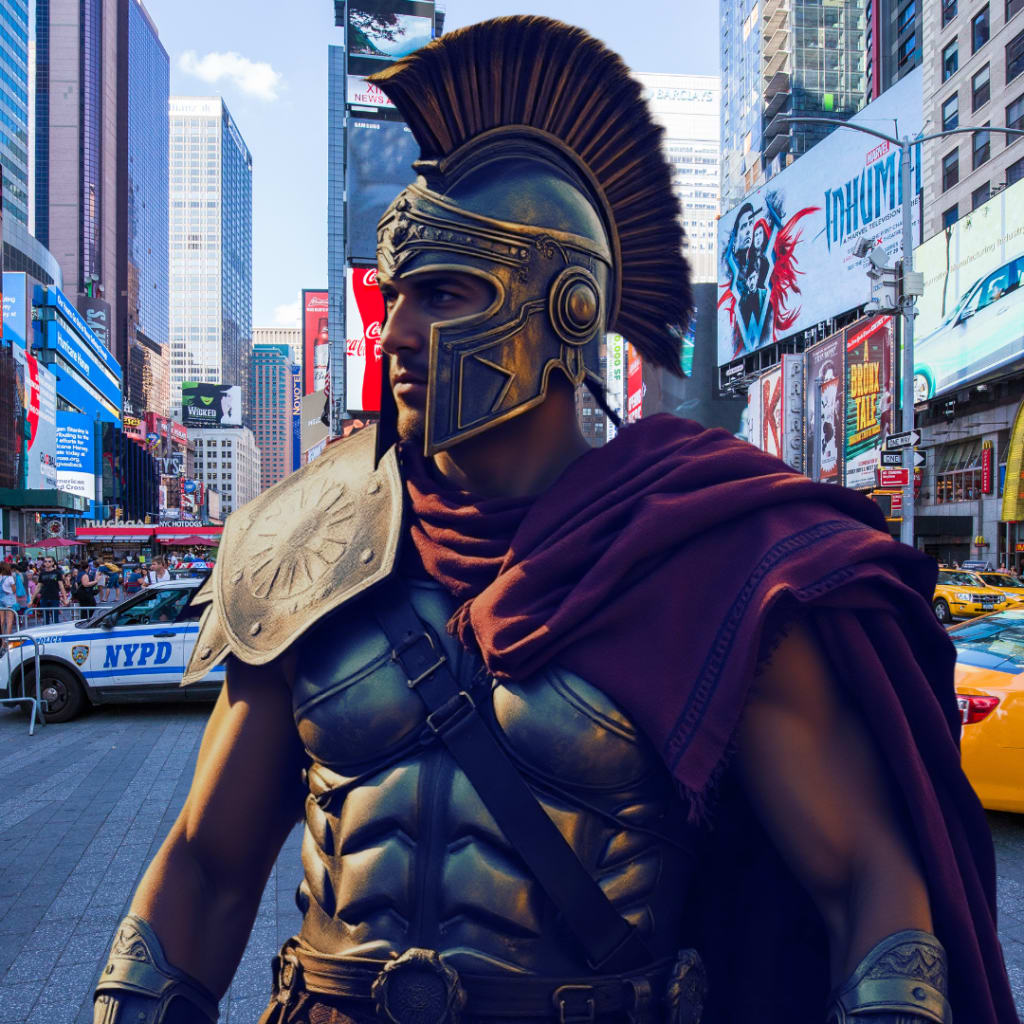
You ever feel like you’re not just living life but fighting through it? Like every day, you’re out there in the arena, trying to prove yourself — against others, against expectations, against your own damn doubts? It hit me one day, scrolling through social media, seeing post after post of people hustling, grinding, outshining, outperforming. And I thought, man, we really are modern-day gladiators. The only thing missing is the swords and lions, although the “lions” now are just deadlines, stress, debt, or whatever beast you’re facing. Pretty bleak, right?
But then — out of the blue — I remembered something Jesus said. “Love your enemies and pray for those who persecute you” (Matthew 5:44). And honestly? My first reaction was, “Seriously, Jesus? Love my enemies? Pray for the people standing in my way? How does that even make sense when every day feels like a battle to survive, to win?”
Think about it. Gladiators in ancient Rome fought for their lives. Life-or-death kind of stuff, with the roar of the crowd, their hands clutching weapons, sweat and blood everywhere. They got no choice; they’d been put there to entertain — to kill or be killed. And the crowd LOVED this violent spectacle. Even when a gladiator fought with all their heart and soul, their fate still came down to a thumbs-up or a thumbs-down from the arena’s most powerful figure. Sound familiar? Maybe not with swords and armor, but tell me social media, jobs, relationships, and success don’t have the same vibe. We perform, expected to be the best version of ourselves all the time, as if everyone is watching, judging, with their invisible thumbs up, thumbs down.
People say “survival of the fittest” is human nature. It makes sense — Darwin came up with it first, right? The strongest thrive, and the weak, well…not so much. But take a step back. Are we really wired for this endless competition? Science and evolution suggest humans survived not just because of strength but because of cooperation. Anthropologists found that early humans lived and thrived because they loved others enough to protect them, share food, care for the sick, and refuse to leave anyone behind. Kinda flips the gladiator mentality on its head, doesn’t it?
Yet somewhere along the way, society decided that compassion wasn’t “glamorous enough.” We traded kindness for the sword — and by sword, I mean ambition, ego, self-interest. And let’s not lie to ourselves. Winning feels GOOD. Destroying a rival in an argument, outperforming someone at work, or proving someone wrong? That hit of dopamine is addictive. But Jesus — radical and relentless in beliefs that often ran directly against human nature — said “What good is it for someone to gain the whole world, but forfeit their soul?” (Mark 8:36). Soul. That hit me hard. What if this constant grind to win costs us the actual reason we’re alive?
Maybe you’re asking, “But weren’t gladiators themselves heroes? Fighters against the odds?” Sure. At first glance, the gladiator image is cool. Stoic, muscular warriors living for honor. There’s a reason books, movies, video games portray us as them in modern times. Remember Russell Crowe in Gladiator? He became this larger-than-life figure because of his resilience, his grit. That final clash, when he dies standing tall, leaves you verklempt, like you just witnessed greatness. But step back, and here’s the kicker: his victory wasn’t in the killing. His victory was in his humanity. At the end, he fights not to destroy but to protect his values and to honor love over power. A gladiator in flesh, but Christ-like in spirit? That’s the heart of it.
I’ve gotta be real. Choosing to act like Jesus said — to turn the other cheek (Matthew 5:39), offer your enemy your shirt if he asks for your coat (Matthew 5:40), serve instead of strive — feels like surrender. A part of me hates it every time. You, too, right? There’s this deep urge to lash out, defend your pride, “win” at all costs. But what if victory isn’t obliterating your “enemy” but building something better for everyone, including them? It’s counterintuitive, but maybe Jesus wasn’t asking us to lose the fight — he was asking us to redefine the fight entirely.
If life is an arena, our “gladiatorship” is all about choice. Whether to conquer others, or to conquer ourselves. There’s a Buddhist proverb I read once: “Conquer yourself and you will conquer the world.” That stuck with me. Gladiators fought external enemies, but the greatest battle fought is always within — between anger and forgiveness, pride and humility, hate and love.
Loving others is HARD. Loving your enemies? Unnatural, right? Yet there’s this scene in Les Misérables where Jean Valjean (Hugh Jackman nailed it in the movie, by the way) steals from a bishop. He’s caught, dragged back, but the bishop lies to the cops, saying he gave Valjean the silver. “But remember,” the bishop says, “you must use this silver to become an honest man.” That act of kindness changes the guy’s life forever. No sword fights, no revenge — just leaving the world better than you found it.
So what does this mean for us? If we’re gladiators, do we fight fire with fire? Eye for an eye? Because honestly, that just leaves everyone blind. The alternative? Fight the temptation to destroy others or glorify ourselves. Fight with love. Scrape away the ego until the only thing left in you is goodness.
Easier said than done, right? I’m not sure I’ve nailed this myself. There are days I wake up and feel like just getting through the day is all I can do. But hey, maybe that’s okay. Every time we make even the smallest choice to love rather than lash out, to forgive rather than fight, we move the needle. One inch, one moment closer to what Jesus was talking about.
And really, what’s more epic than a gladiator who chooses not to destroy but to heal?
But, you know, the question keeps nagging at me: If we’re modern-day gladiators, is it even possible to live the way Jesus said? I mean, look around. The world isn’t exactly set up to reward people who live selflessly. You’d be forgiven for thinking kindness and goodness are weaknesses in the arena of life. If you’re too nice, people take advantage of you. If you’re too forgiving, you’re seen as weak. How do you even balance survival and selflessness?
Here’s where I get stuck. There’s this part of me — call it instinct, call it survival, maybe even pride — that wants to fight back. It whispers, If someone pushes you, push harder. If someone hurts you, hurt them worse. That little voice has been with me since I was a kid. Maybe you’ve heard it too? Thinking back, I can see how society feeds that mindset. It’s in how we praise the “strong” who never show vulnerability. It’s why revenge flicks like John Wick pull in millions at the box office. It’s why reality TV thrives on drama and savagery — people tearing each other down just to win.
But here’s the kicker: glorifying that version of strength, of winning at all costs, leaves us emptier in the end. There’s an African proverb I once read that says, “If you want to go fast, go alone. If you want to go far, go together.” It pulls me back to something deeper — a sense that the arena isn’t about beating the “other guy” but about lifting each other up, even when it’s hard.
And damn, it’s hard. If I’m honest, it feels unfair sometimes. There’s a part in The Sermon on the Mount where Jesus says, “Blessed are the meek, for they will inherit the earth” (Matthew 5:5). Meek? Really? In a society that teaches us to be bold, brutal, and unrelenting, meekness feels like the road to nowhere. Yet it points to something countercultural, almost rebellious: strength that doesn’t need to roar. A kind of confidence so unshakable, it doesn’t yearn to dominate, but to serve. Imagine that — a gladiator standing in the arena, staring down their fiercest enemy, and calmly putting down the sword. Is that weakness? Or is that the strongest thing anyone could ever do?
A part of me wonders if this idea is what Martin Luther King Jr. meant when he talked about “the weapon of love.” Amid hatred and violence, he chose to fight a different way, following Jesus’ words to turn the other cheek — not out of passivity, but as a form of defiance. It’s like saying, “I see your hatred, but I refuse to stoop to it. I will endure it, not because I’m weak, but because love is stronger than hate — and I’m in this fight for the long game.”
But how do we do that in our regular lives? Sometimes the enemy isn’t someone wearing armor or holding a sword; it’s the jerk who cuts you off in traffic, your boss who micromanages, or even someone close to you who just won’t see your side. Those are the battles where it’s so tempting to lash out, to prove yourself. But, for me, when I’ve resisted that urge — even grudgingly — it’s in those moments I’ve felt the most…I don’t know, free. Like not fighting back gave me a power that retaliation never would.
There’s an experiment I read about years ago that blew my mind. It was about forgiveness. Researchers studying emotional health found that people who actively forgave their “enemies” reported lower blood pressure, reduced anxiety, and overall better well-being. Think about that. Forgiveness doesn’t just feel good morally; it physically heals you. Science is literally telling us that Jesus wasn’t messing around with his advice — it’s good for our soul and our body. Makes you wonder — what are we doing to ourselves every time we cling to anger, resentment, and this need to win?
One moment that always gets me is when Jesus is on the cross. He’s literally hanging there, dying, and instead of cursing or blaming, he says, “Father, forgive them, for they know not what they do” (Luke 23:34). Who says that in the middle of unbearable pain? If anyone had a right to rage, to lash out, it was him. But he didn’t. And that single act of mercy — of refusing to fight fire with fire — might be the greatest display of strength the world has ever seen. It’s honestly hard to wrap my head around that kind of love.
But here’s the thing: choosing love, forgiveness, and selflessness doesn’t mean rolling over and letting people walk all over you. That’s a huge misunderstanding. Gandhi, who was deeply influenced by Jesus’ teachings, fought oppression with nonviolence. He didn’t pick up a sword, but neither did he back down. His fight for justice came from a place of stillness, a refusal to let anger or pride take control. That kind of strength is rare — it’s the strength to say, I will stand firm in what’s right, but I will not let hatred turn me into what I’m fighting against.
Sometimes I feel like this whole “modern gladiator” thing — the constant grind, the fight for survival — is just exhausting. We’re all just trying to make it, you know? But maybe part of the answer is realizing that we don’t have to fight the way the world tells us to. Real strength isn’t about crushing others. It’s about breaking the cycle — turning swords into plowshares, as the Bible puts it (Isaiah 2:4). Helping someone instead of tearing them down. Choosing peace over pride. Placing love above ego. That’s the fight that matters, isn’t it?
So yeah, we’re gladiators. But if we really want to be brave, to live in a way that shakes the world, don’t we have to fight how Jesus said? Maybe that’s what it means to truly win.
Read more at shownd.com
About the Creator
Ron C
Creating awesomeness with a pen. Follow me at https://twitter.com/isumch
Why Didn't Anyone Tell Us
Men, move along. This is not for you. This is for the women. I was forty-five when I began menopause. It is pretty young for that to be going on in a woman’s life, but I had undiagnosed PCOS, my entire life. Thank you to all the gynecologists I had seen my entire life. That in itself should encourage women to keep seeking second opinions, especially when you are not getting correct answers or any at all.
By Alexandra Grant2 days ago in Humans
The Empty Chair
There is a chair in our living room that no one sits in anymore. It’s not broken. The wood is still strong, the cushion still soft enough to be comfortable. From the outside, it looks like just another piece of furniture in the house. But for me, it means something entirely different. It is the empty chair. And every time I see it, a flood of memories comes rushing back.
By Shoaib Afridia day ago in Humans
Worth the Wait: Puerto Viejo, Costa Rica
Beach bumming in a small Caribbean beach town sounded like a perfect way to end our 6-month trip through Mexico and Central America. Or so we thought. The foul, fishy stench of rotten seaweed hit our nostrils as we stepped from the cramped bus and looked out at a rather depressing, empty, and underwhelming black sand beach. It was pouring with rain, and we had to quickly fish out our ponchos. We thought, this couldn’t be it, could it?
By Sh*t Happens - Lost Girl Travel6 days ago in Wander




Comments
There are no comments for this story
Be the first to respond and start the conversation.