
He Died for the Country — But the Country Forgot Him
The Hero Who Wore a Uniform, Then Disappeared into Silence

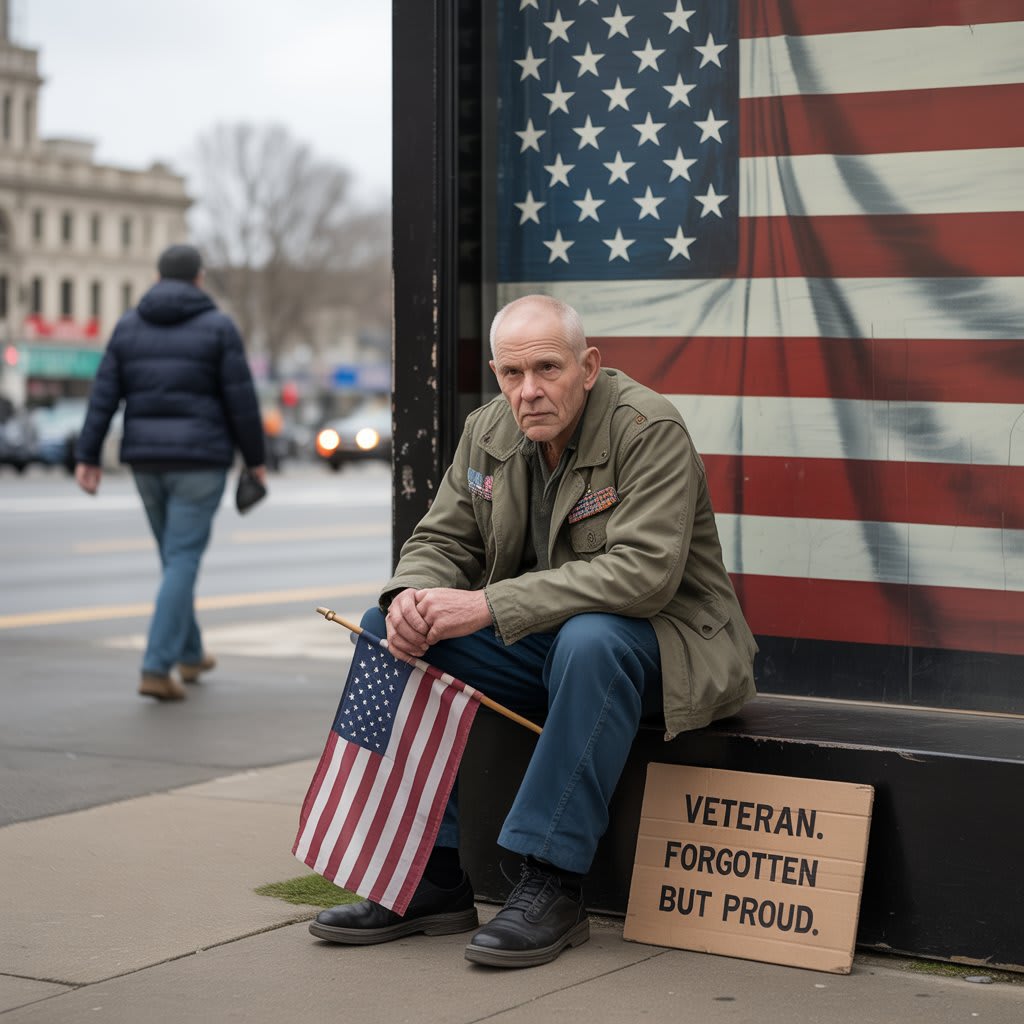
The cardboard sign read, “Army Vet. Anything Helps. God Bless.” Most drivers waiting at the red light didn’t notice him. Some avoided eye contact. A few gave a polite nod or tossed a few coins into his cup. His name was Michael Boone—once known proudly as Sergeant Boone, a decorated U.S. Army veteran who had served two tours in Iraq. He had fought in dusty streets, crawled through ruins under gunfire, and pulled wounded friends out of chaos. Now, he sat quietly on a freezing Missouri street corner, invisible to the very country he had once sworn to protect. No one asked who he was. No one knew what he had given up. They just saw another homeless man.
Michael had enlisted right after high school, driven by the stories of service from his father and grandfather, who had both worn the uniform before him. For him, it wasn’t just duty—it was pride, sacrifice, and the dream of making a difference. He stood tall, proud of the patch on his shoulder, believing he was part of something greater than himself. His first tour changed him. He saw friends die, villages crumble, and nightmares that would never leave his head. On his second tour, he was injured in an explosion, but he still carried his fellow soldier to safety—earning a medal that no one would ever see hanging on his chest again.
When he returned home, everything felt... different. The town he loved moved on without him. His mother had passed away while he was overseas, and his father, now deep in alcoholism, had vanished without a word. The government system designed to help him was too broken, too slow. Appointments were missed, benefits were delayed, and his condition was labeled with complicated terms like “chronic PTSD.” Michael tried. He really did. He applied for jobs, but the anxiety and nightmares made it impossible to hold them. The kind of war he was now fighting wasn’t with weapons—it was with memories, silence, and loneliness.
With nowhere left to go, he began sleeping in his broken-down truck. When it was towed away, he moved to the alley behind a gas station. Everything he owned fit inside a worn duffel bag: a photo of his platoon, his military ID, and a pocket-sized American flag. He was ignored, labeled as lazy or unstable by strangers who didn’t know that he once risked his life for their safety. He often sat in the cold for hours, replaying missions in his mind, wondering if the country he fought for even remembered his name. His days blurred together, broken only by the occasional warmth of a stranger’s smile.
One morning, a local blogger named Clara Evans noticed him. She often passed by, but something about his quiet gaze stopped her. She brought him coffee, asked his name, and listened. He spoke softly, but with dignity, telling her bits and pieces of his story. Clara wrote an article called “The Soldier on 4th Street,” which gained attention online. For a short time, people brought him food, blankets, and offered shelter. But like most viral moments, it faded. The world moved on again, leaving Michael in the cold hope flickering out like a dying flame. Clara visited often, but she could see the light in his eyes was growing dim.
A few weeks later, Michael was found lifeless behind the same gas station—his final resting place a piece of frozen pavement. The folded American flag was still in his lap. The cause of death was hypothermia. Only four people came to his funeral—Clara, a fellow veteran, and two shelter workers. There was no trumpet, no honor guard. Clara brought his medals and placed the picture of his unit beside him. In the silence of that small funeral, a once-decorated hero was buried without the recognition he had earned. But Clara didn’t stop. She launched #RememberBoone, a campaign that told his story nationwide. Today, a mural of Michael in uniform watches over the very street where he once sat. Below it reads: “A nation is judged by how it treats its heroes.” He died for his country—but it took one voice to make sure he was never forgotten.
About the Creator
Musawir Shah
Each story by Musawir Shah blends emotion and meaning—long-lost reunions, hidden truths, or personal rediscovery. His work invites readers into worlds of love, healing, and hope—where even the smallest moments can change everything.
Keep reading
More stories from Musawir Shah and writers in Humans and other communities.
I Love My Mom ❤
🌼 The First Embrace From the very first moment I opened my eyes, she was there. I didn’t know what love was, but I could feel it — in the way her arms cradled me, the way her eyes softened every time they met mine, and the way her voice became my first melody. My mom wasn’t just the person who brought me into this world. She became the world itself. Every memory I have, every lesson I carry, begins and ends with her. Her love was not something she needed to say aloud; it was in everything she did — the warmth in her hug, the care in her touch, the calm in her voice.
By Musawir Shah6 months ago in Humans
Autonomy Is The Real Privilege
Good morning, freedom-seekers! Today we’re gonna be looking at autonomy. A strange word, I know; one many would probably look at blankly and run away from on sight. We’re gonna figure out what it actually means, consider how it’s achieved, and decipher just how deeply most of us are tangled up in dependence without realising it.
By That ‘Freedom’ Guyabout 9 hours ago in Humans
Two Farmers Unearth a 17th-Century Silver Treasure While Working Their Land: A Remarkable Discovery
In a discovery that feels lifted straight from the pages of a historical novel, two farmers recently unearthed a 17th-century silver treasure while working their land. The find, consisting of coins, jewelry, and small silver artifacts, provides a fascinating glimpse into the region’s past and has ignited interest among historians, archaeologists, and the local community. Beyond the monetary value, this discovery underscores the enduring stories buried beneath the soil, waiting for chance and circumstance to reveal them.
By Salaar Jamali4 days ago in Humans




Comments
There are no comments for this story
Be the first to respond and start the conversation.