
He Carried a Wrench, Not a Childhood
When a Boy’s Silent Struggle Ended in Society’s Loud Betrayal
Part 1: The Weight of a Silent Dream
In a forgotten Pakistani village between dry farmland and interior Pakistan's feudal territories, a boy named Ikram lived with hopes bigger than his shoulders. He was not quite 12, but his face was already skilled at holding down hurt. He had worn through his slippers, his father's extra-large shirt over his own size, and eyes that would beg anybody to show clemency without words.
His father, once a hearty man who worked in the fields, was inert on a creaky charpai, his kidneys fighting him and society much too busy to worry. His mother, Hajra, crouched over in the scorching sun of the native wadera's agricultural field, earning barely enough to keep embers burning underneath the cooking pot. The villagers all knew that she was a widow waiting to happen — but stomachs weren't filled with sympathy.
Ikram went to a small government school in the morning. He loved those hours like holy breaths — pages of Urdu verses, science drawings, and his dream of becoming one day a schoolteacher. But dreams do not fill one’s stomach.
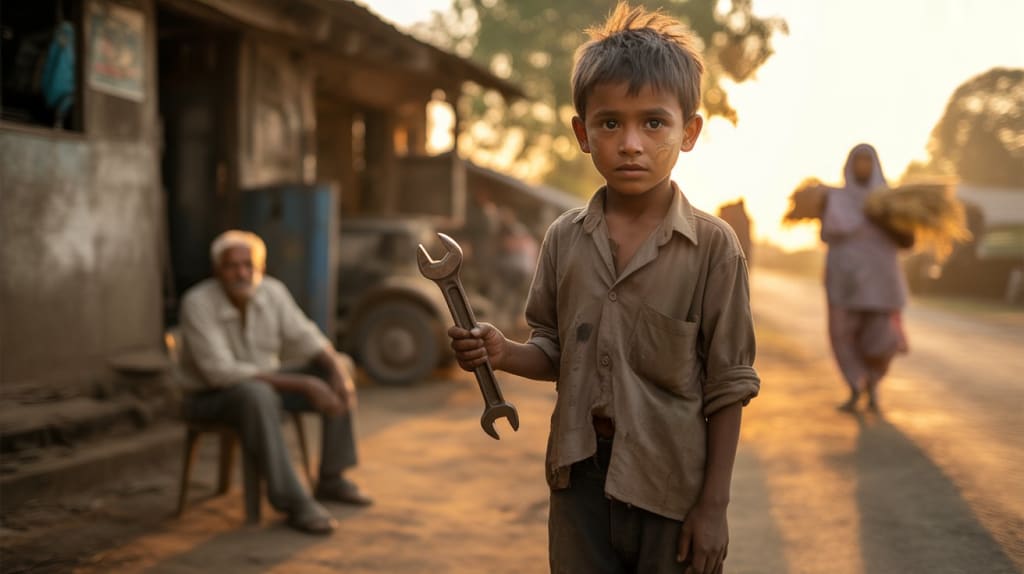
He used to go every afternoon after school to the only mechanic workshop in his area. He did not receive a rupee. Zero. “You’ll learn work," growled the mechanic on his first working day. It was three years ago. Akram had since hauled tools, swept the floor, carried tyres heavier than his limbs, and meekly endured a shower of abuses — and, occasionally, slaps.
But he stayed. Not for school — but because one couldn't go anywhere else.
Part 2: A Mother's Hands and a Father's Silence
Hajra's hands were cracked with dryness from working in pesticide-laced fields. In the morning, she swept the house of the wadera with a broom. By noon, she swept up after sprinkling wheat, fetched water, and cleaned animal enclosures. Once, she had imagined Ikram growing up to wear clean shalwar kameez and earn respect. But such aspirations withered with every insult hurled upon her for “having a useless son.”
Nevertheless, she never let Ikram see her breaking. She breastfed him with her hands, kissed his forehead, and sewed his torn shirt late into the night hours. But she couldn't protect him from society — and in her silence, it heard implied consent.
Saleem, Ikrama's father, a man broken not just by disease but humiliation, had gone mute. He sat with his eyes focused on the ceiling, blinking alone. The people in the villages despised Hajra: “Why can't you bring your husband to the city for dialysis? Or to a shrine?” Hajra struggled to smile feebly and moved off. She knew that to beg was to lose what little pride she had left.
Part 3: Bruises That Books Couldn’t Heal
The mechanic was known by no other name than “Ustad.” He was a bitter 50-year-old who never had children of his own. Perhaps that was why he knew no mercy.
Once, after Ikram had casually laid down a wrench in a pan of grease, Ustad went ballistic. He threw a hammer near the boy's leg and yelled, “Stupid? Good for nothing like your sick father?” Ikram stood paralyzed, tears rising but not spilling over. “I’ll fix it, Ustad,” he said in a low tone.
He scribbled that night in his worn notebook:
“Soon enough I'll sort people out just like I sort out my bike. I'll be somebody. But for the moment I'm just a ghost in the world.”
He never showed it to anyone. To his mother, to his teacher. It was his soul’s journal — maintained between oily hands and roughened palms.
Part 4: The Last Evening
The summer evening was sticky. Electricity was off. Mosquitoes buzzed in the garage like moments of guilt. Ikram had arrived 15 minutes late — his teacher at school had made him stay after class to discuss a mathematical law. But Ustad did not complain.
"You think it's a madrassa?" he shouted.
Ikram explained, but the slap was too quick. Then another one. And then a kick. A metal rod was lying around — and it sailed across Akram’s back before he could get out of the way. He fell down. Ustad yelled again, not knowing the boy was not getting up.
By the time alocal merchant rushed in, Ikram was out of senses.
Part 5: A Death Too Heavy for the Village
The villagers gathered outside the mechanic’s shop. Hajra, carrying a bundle of dry chapatis, arrived breathless.
She dropped to her knees beside the corpse of her deceased son, screaming "Ya Allah, not my only son!" and cradling him with his blood soaking into her scarf, as neighbors turned away — some out of embarrassment, most in silence.
Ustad said that he “didn’t mean it.” It was “an accident.” The police arrived but took bribes and shrugged and left. After all, it was just a poor boy. Who worried?
Ikram was buried two days later. His grave was dug beside a small mango tree he once sat under while solving math problems. His father, too weak to walk, was carried there by neighbors who finally remembered he existed.
Part 6: A Community of Bystanders
One Friday at that mosque, the imam talked of sin -- but did not mention Ikram.
In school, children whispered tales. A few wept. The majority just forgot come Monday.
Back in their rural village, their elders talked of giving Hajra charity. A few of them said that she “should have disciplined him better.” Some said, “Now at least she doesn’t have to worry about him.”
No one mentioned justice.
Part 7: The Neglected Ayah
Islam doesn't hesitate to safeguard children.
“Do not kill your children for fear of poverty. We provide for them and for you.” — Surah Al-Isra, 17:31
The Prophet Muhammad ﷺ kissed children, used to play with them, and warned of severity. He said:
“He is not of us who is not merciful to our young ones….” — Tirmidhi
But in Ikram's village, these words never transcended the minaret. Feudalism, poverty, and blind traditions muted the message.
Part 8: Hajra's Unfinished Prayer
Now, Hajra passes by the mechanic shop with sullen eyes. Ustad still owns it. Still yells at boys. Nobody complains. People say, “Let it go. What’s done is done.”
But Hajra doesn't forget.
Evening arrives, and she spreads out her prayer rug and prays, “Ya Allah, give Ikram what the world took from him: tranquility, love, and justice.”
From time to time, she speaks to his tomb: “You never did get to enjoy your childhood, my son. Perhaps in Jannah, you can have toys, books, and a benevolent teacher.”
Final Message: Don't Let Another Ikram Die
It is not a boy's story, it is a failed society that failed a boy.
Ikram did not die from abuse alone. He died from:
Our silence.
Our apathy.
Our hesitation to call injustice by its name.
Child labor is no opportunity. It's theft — of time, of health, of innocence, of life.
About the Creator
Shehzad Anjum
I’m Shehzad Khan, a proud Pashtun 🏔️, living with faith and purpose 🌙. Guided by the Qur'an & Sunnah 📖, I share stories that inspire ✨, uplift 🔥, and spread positivity 🌱. Join me on this meaningful journey 👣
Keep reading
More stories from Shehzad Anjum and writers in Humans and other communities.
Big Toys, Small Joys: A Walk Through the Past
It was a regular Tuesday morning when Claire wrapped her scarf, slipped on her coat, and stepped into the crisp hush of early autumn. The city hummed its usual tune — cyclists rattling past, café spoons clinking against cups, children skipping with juice boxes in hand.
By Shehzad Anjum5 months ago in Humans


Comments
There are no comments for this story
Be the first to respond and start the conversation.