
Big Toys, Small Joys: A Walk Through the Past
A Western woman’s quiet reflection on childhood, contentment, and the emotional cost of modern desires.

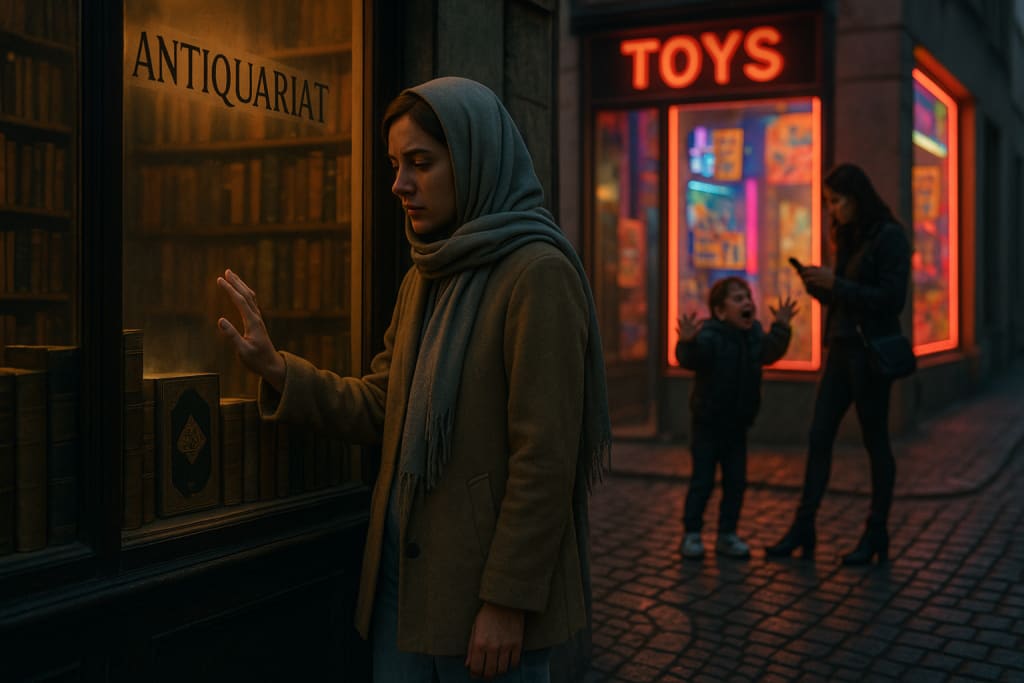
It was a regular Tuesday morning when Claire wrapped her scarf, slipped on her coat, and stepped into the crisp hush of early autumn. The city hummed its usual tune — cyclists rattling past, café spoons clinking against cups, children skipping with juice boxes in hand.
Claire was walking toward her favorite secondhand bookstore. But today, it wasn’t just about books. She needed space, the kind only cracked spines and the smell of old paper could offer. Something unspoken had been stirring in her chest for days — a quiet ache she couldn’t name.
And that’s when she saw her.
The Girl at the Toy Store
On the corner of Maple Avenue, a little girl no older than six stood frozen in front of a glittering toy store. Her tiny fists were clenched, her face red with frustration.
“I want the new MegaGlide Hover Scooter! You said I could pick anything! Why can’t I have it? It’s not fair!” she wailed, tugging at her father’s hand.
Behind the glass display, the scooter gleamed with neon edges and a shiny $499.99 price tag. It had voice control, AI features, even a built-in screen.
Her father tried to soothe her. The mother, in designer boots, barely looked up from her phone.
“You already have the MaxPad and GlimmerPets,” she sighed. “That one’s for your birthday.”
But the girl wasn’t having it. She stomped and cried louder than the street itself.
Claire didn’t stare. She didn’t judge. She simply walked on. But the scene cracked something open inside her — a floodgate of memory she hadn’t planned on visiting.
The Toys That Weren’t Toys
Suddenly she was nine again, in her grandmother’s attic. The room smelled of dust and old wood. Her toys were mismatched puzzles, rag dolls with button eyes, a teddy named Elliot whose stuffing leaked from his side.
None of them talked. None of them flew. None of them cost $499.99.
But they were enough.
She remembered patching Elliot with tape, pretending to be a doctor. She remembered Christmas mornings when her parents — both teachers with small salaries — wrapped secondhand books in old newspapers and placed them under the tree like treasure.
There were no tantrums. No towering wish lists. Just joy that came from being loved, and from knowing how to make a small thing feel big.
“In our time,” she thought, “happiness was large and toys were small.
Now toys are large… and happiness feels missing.”
Screens Without Souls
At the bus stop, another sight caught her. A boy sat with a tablet glued to his hands. His mother offered him a sandwich, but he didn’t look up. His eyes were locked on the glowing screen, his little fingers tapping in frantic delight.
Simulated joy. Not the kind that stays.
Claire remembered her own childhood afternoons — climbing trees, turning sticks into swords, laughing with neighborhood kids until the sky turned orange. No battery required. No internet swallowing the hours.
And she wondered: What will this boy remember when he grows old?
Not scraped knees. Not dirt-stained palms.
Maybe only screen time statistics.
The Price of Everything
Above her, a billboard flashed an ad for the same hover scooter:
“Unleash Fun. Unleash Power. $499.99.”
She almost laughed. That was more than her father earned in a week when she was young. Yet somehow, she had never felt deprived.
Her mind drifted to the memory of the state fair. Her father saved for months just to take them. They couldn’t afford the rides, but he bought one cotton candy and a single lemonade to share. That day, she felt like the richest child alive.
Back then, wealth wasn’t counted in gadgets but in wonder.
Today, she thought, love often comes wrapped in boxes, purchased with urgency, offered in place of presence. And still — the children cry.
Silent Lessons
Claire didn’t blame the little girl she’d seen. She was too young to know the weight of her demands. And she didn’t blame the parents entirely either. They were caught in the same trap: measuring worth in things, not in warmth.
But she grieved. Quietly.
Grieved for children who knew how to swipe before they learned how to share. Grieved for families who replaced stories under blankets with Netflix autoplay. Grieved for a world where joy is sold, not taught.
The Mirror in the Bookstore
When Claire reached the bookstore, her own reflection in the glass startled her. Older now, yes. Tired, perhaps. But holding a cloth bag with a $2.50 used book inside — and feeling a quiet thrill about reading it.
She smiled, not sadly, but with gratitude.
Her life had never been luxurious, but it was full. She didn’t own hover scooters or MaxPads. She had memories. Roots. Meaning.
And for her, that was wealth enough.
Final Thoughts
Claire stepped inside the bookstore, the scent of worn paper wrapping around her. But the image of the little girl stayed with her — a small face pressed against glass, demanding something she couldn’t yet understand.
That night, Claire didn’t write a blog or post a tweet about what she’d witnessed. She simply carried it with her, like a truth too delicate to shout.
“We live in a time where toys are bigger than ever,” she thought,
“and yet they can’t hold the size of joy we once knew.”
She hoped, quietly, that one day parents would remember that presence matters more than presents. That children would learn again how to chase kindness, not gadgets. That joy would return to the small things.
Until then, she walked on, with her book in her bag and her memories in her heart — both equally priceless.
About the Creator
Shehzad Anjum
I’m Shehzad Khan, a proud Pashtun 🏔️, living with faith and purpose 🌙. Guided by the Qur'an & Sunnah 📖, I share stories that inspire ✨, uplift 🔥, and spread positivity 🌱. Join me on this meaningful journey 👣
Keep reading
More stories from Shehzad Anjum and writers in Humans and other communities.
I am not alone.
Billu Bhai’s Realization Category: Human Interest / Life Lessons His real name was Bilal, but everyone in the village called him Billu Bhai. He was the eldest child in a large family, with parents, siblings, and relatives all living together. Growing up, Bilal had been quite weak, both physically and mentally. His childhood was marked by illness, which affected his ability to concentrate in school. Learning was a constant struggle, and he barely managed to complete his education up to the tenth grade. Now, at twenty-five, Bilal was hardworking, reliable, and always willing to help others. His father had given him a rickshaw, which became his source of daily income.
By Sudais Zakwan3 days ago in Humans



Comments
There are no comments for this story
Be the first to respond and start the conversation.