

Dylan’s heart was still racing. His mind had just figuratively exploded within the confines of his skull and was currently incapable of any conscious thought apart from registering the sequence of numerical digits that stamped through his grey matter.
24,651 dollars and 28 cents. The 28 cents was all but ignored by Dylan, however. As recent as yesterday, those numbers had been figures of great importance to him. He had learned long ago that keeping track of the nickels and pennies in your bank account made all the difference in being able to afford both groceries and rent at the beginning of the month. In the past, those two numbers after the decimal point in his bank statements had been just important as the ones that preceded it.
But right now, Dylan gave them no thought at all. He was somehow twenty thousand dollars richer. He wouldn’t have to worry overly much about pennies for quite some time.
Approximately one minute had passed before Dylan’s mind regrouped, the total sum in his bank account finally digested by his consciousness. His brain then made up for its lapse in functionality by going into overdrive.
Dylan stood on shaky legs as he silently asked himself how something like this could have happened. More accurately, what had happened? It must have been a mistake. He had no relatives, recently dead or alive, that were in a measurably better financial spot than he was. He had no friends who could even scrape that sum together. The most reasonable answer was that the bank must have made an error and put some random stranger’s money into his account.
Twenty thousand dollars? Dylan was still reeling with that knowledge and the reality of having that much money in his possession. For now, at least. The excitement and exultation that he had for a brief moment was now souring, decaying into dejection. The mistake would be caught and the bank would return the money to its rightful owner.
Back in the doldrums, Dylan slowly sank back down into his worn chair and continued to stare at the numeric figures on his phone screen. He felt as if he was being taunted. A miracle was being dangled in front of him, but he could do nothing to actually touch it. If he attempted to withdraw the money or spend it, he would be arrested. If he did the right thing and contacted the bank, they would give him a pat on the head before righting the wrong that they had made. His upstanding example and admirable sense of civic duty would do nothing to convince his ruthless landlord that he deserved a roof over his head and food in his belly on the sole merit of being a decent human being. It wasn’t fair.
Sadness and self-pity were caught up in the cinders of indignation as a burning crept up from Dylan’s belly into his chest, where it became a full on conflagration. A silent rage began to consume Dylan. This. Wasn’t. Fair.
Some rich asshole had lost $20,000. Big deal, they’d be fine for it. Dylan wouldn’t be fine if he allowed the bank to take back their money. It was in that moment that a spark of ingenuity leapt from the fire in his heart and seared itself into his mind. His thoughts turned to action and all of his energies were now devoted to solving the problem of how to get what he was owed. How could Dylan keep the $20,000 that now belonged to him?
The timing for this unexpected windfall could not have been more fortuitous. It was Friday evening. The banks would be closed until Monday morning. Did that even matter? Didn’t they have people working on the weekends looking for these sorts of mistakes? Or weren’t there robots fact-checking all the deposits over the past week? After some superficial research, Dylan discovered that those things didn’t in fact exist. In fact, he learned that banks in general had ten business days to investigate any possible errors on their end. Dylan doubted that the bank would be ignorant of their mistake for such a generous period of time. However, Dylan possessed one advantage.
Even if the intended recipient contacted the bank about the absent transfer, the bank was closed for the weekend. Dylan knew that the only 24/7 emergency line for his chain of banks was exclusively meant for lost or stolen credit cards.
That left him the weekend to come up with a plan and execute it if he was going to keep the $20,000. By Monday, all bets were off.
He glanced at his phone. It was currently 7:11 and it was going to be a long night. Dylan got up from his seat with a sense of urgency to fetch some necessary materials. He stopped first at his fridge to grab an IPA from within. He then went into his bedroom and began rummaging through drawers and piles of random things to find an old and tattered journal that he had been given as a graduation present, back when he had held grand designs of going to college. After several minutes, he found his prize.
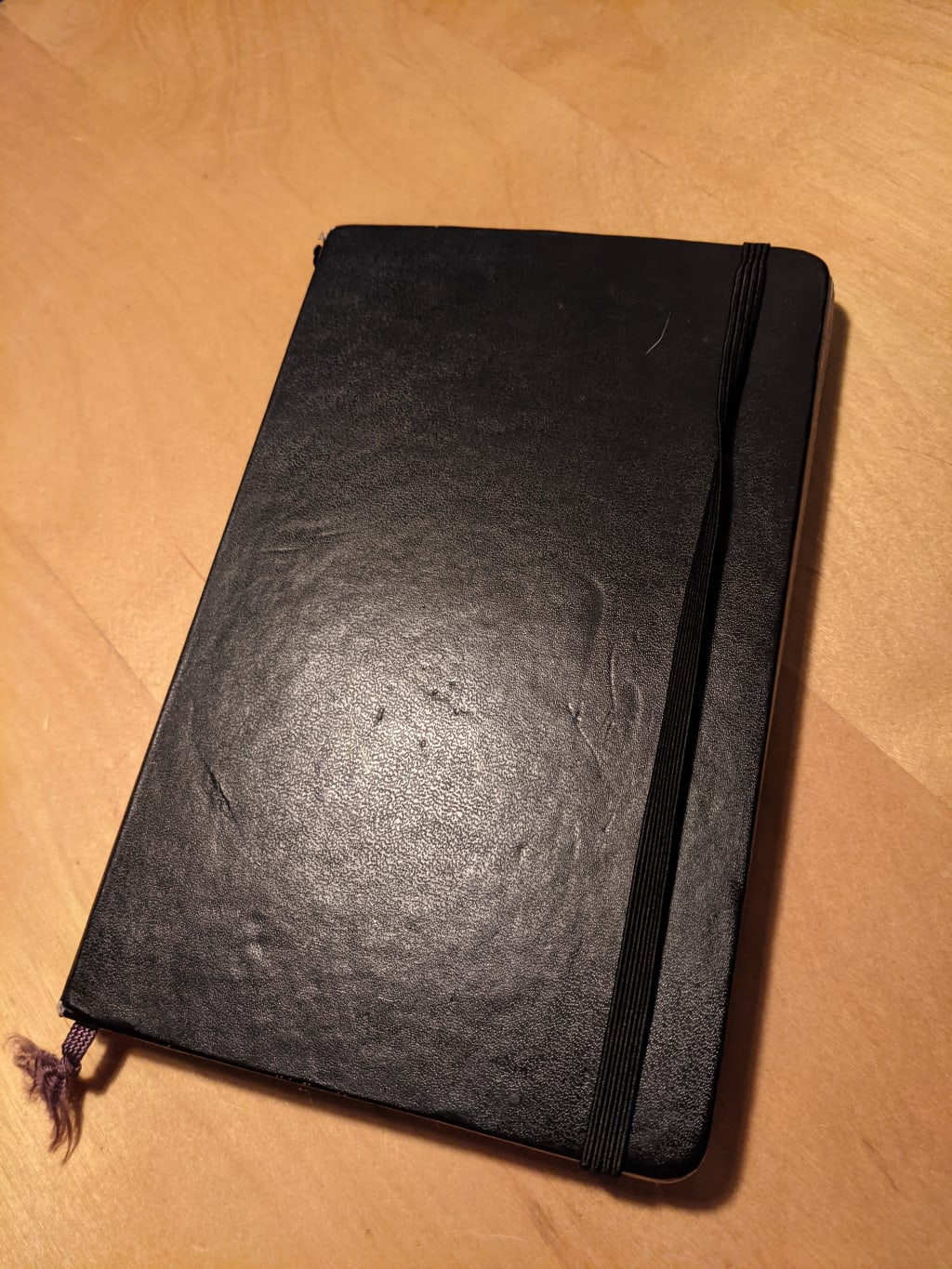
It’s hard and black cover was dimpled and dented from having been carelessly and improperly stored time after time. The spine’s edges were worn and frayed, and the pages were brown around the edges, despite Dylan having never made a single inscription within. The black elastic band that was meant to keep the notebook closed hung a little loosely, but still kept the book shut. Time was of the essence, yet Dylan caught himself examining the journal for longer than he had meant. Nostalgia and memories rushed through him as he remembered the exact moment that he had received it as a gift.
It had been a present from his grandmother on his mother’s side. He had been slightly disappointed that it wasn’t money, but he had understood that his grandmother had not been a woman of means. She had given what she could, and she had been quite proud of herself for having been able to give her grandson a gift that she felt was of exceptional quality. Dylan remembered trying his best to be charitable when she had presented the notebook to him. He had verbally remarked how professional and sleek the notebook appeared. His grandmother had beamed. That small comment went a long way to reassuring her that she had not misspent her money. Dylan found himself admiring the notebook even now. It still had a sharp edge about it, despite having been abused through neglect for the better part of a decade.
Breaking from his reverie, Dylan grabbed a cheap ball-point from his cluttered desk and returned to the living room with his beer in one hand, his notebook and writing instrument in the other.
Exhilaration fueled Dylan. His imagination and problem-solving capabilities worked in tandem to inspire him to create an effective heist. It was also a bit of a rush to do something that felt slightly wrong. Nervous energy caused him to sketch out numerous plans that became more and more fantastic as he jumped from one scheme to another. In the back of Dylan’s mind was the fear that the bank would unexpectedly swoop in and wrench the twenty grand from his account.
As the hours stretched into the night, Dylan became consumed with one particular plan. He could enlist the help of one of friends to stage a false mugging during which Dylan would be knocked unconscious and his debit card stolen. His accomplice could then run to a nearby ATM and make a sizable withdrawal while Dylan lay on the ground “unconscious”. After enough time had elapsed, Dylan could conveniently “awaken” and call in to deactivate his card. By then, it would be “too late” and the money would be out of the bank and in the hands of his accomplice. Then they could split the money after the police inevitably came and went. That would look convincing enough, wouldn’t it?
The problem lay in the daily withdrawal limit on his debit card. At most, his accomplice would only be able to draw out $1,000 from the hoard. Aggravation settling in, Dylan reflexively stretched his arms to dispel nervous energy and knocked over the nearby beer bottle. Viciously cursing, Dylan rushed to the kitchen for towels to sponge the carpet and wipe the table. But his mind continued to puzzle over how to siphon out as much cash as possible.
Perhaps his accomplice could rush to a line of grocery stores and withdraw cash from the tellers? That would take too long for Dylan to feign being unconscious for a believable enough story. And even then, each store would only be able to part with $100 at best. To withdraw even $1,000 in that manner would equate to the accomplice visiting ten different shops. The plan began to unravel in his head just as Dylan’s sight began to go blurry with tears.
It wasn’t fair. Dylan needed the money. He had debts. He wanted to live in an apartment that wasn’t infested with mold and actually had a kitchen. And even though he hadn’t actually done anything illegal, Dylan was nevertheless experiencing a profound sense of guilt. He was planning to steal money. He was willing to become a criminal and risk ruining his life for good. He hated that he had been pushed to such desperation and that his desperation had created such a devious temptation. He hated that there was no immediate solution to his financial difficulties. As it was, the money that he earned at his job was only enough to help him survive, not thrive.
Dylan unfolded himself from the fetal position that he had assumed and sat up again. He checked his phone for the current time. 11 PM. Nearly four hours had elapsed since he had tried to work up a clever scheme to keep the windfall wealth that he temporarily held. Tiredly, he pushed the notebook away from the edge of the table. Lists populated the lined pages, several of them with deep etchings where he had furiously scratched out some of the more ludicrous plans.
Dylan sat in his chair, staring at the wall opposite of him. He sniffled as his nose ran before wiping his nostrils with one of the beer-saturated towels. He took several shuddering sighs as he realised that he had to do the right thing. He had to report the error. Besides, he told himself, perhaps the money was an inheritance. Perhaps the intended recipient was in a similar financial situation as Dylan, living from paycheck to paycheck. Perhaps the $20,000 was a final gift from that nameless person’s parents or grandparents, the sum total of their life which would provide a hope and a future for their inheritor.
Dylan thought of his own grandmother, and how joyful she had been to give Dylan something as small and simple as a notebook. He knew too that she would have been devastated if it had been stolen. How much more so would two random strangers be if Dylan was somehow able to deprive them of $20,000?
Dylan closed his eyes and leaned his head back into the chair. His pulse had finally eased, and he found himself in a bittersweet state of acceptance as he resolved to point out the error to the bank as soon as possible. He satisfied himself with the knowledge that he was a good man. A decent person. He had made mistakes in his past, and he had unintentionally wronged others in minor ways. Who hadn’t? But by stealing that money, Dylan would be taking more than just currency from his victims. No, he would not choose to steal from someone else, no matter how desperate he felt.
In that, Dylan resolved, he was rich.
About the Creator
Keep reading
More stories from writers in Humans and other communities.
Time to change your life.
Is it even possible for you to change your life? A lot of people, more than there should be, are unhappy with their lives. But what are they doing about it? Usually nothing. People talk about how shitty their lives are and want change, but are they not taking the actions to change?
By Jen Phillips3 days ago in Humans
Unity Brings Blessings
Once upon a time, there lived a sparrow and a crow. Between the two of them, there existed intense hostility. The sparrow spent her days collecting grains for her young chicks. She would pick up food in her beak, return to the nest to feed her children, and then fly off again to gather more. On the other hand, the crow constantly watched her movements with an evil intention. He waited patiently for the moment when the sparrow would leave her nest unattended so that he could attack the helpless chicks and make them his prey.
By Sudais Zakwanabout 24 hours ago in Humans
~ Fired ~
— Ai Intrusion ~ Are you Next ~ Is Ai Evolution after your job? — Few workplaces haven't been affected. Ai is in supermarkets, at doctors' offices, and even monitoring farms. I just can't think of anything this machine is not getting into, can you? For instance: Education ~ Law and Tech jobs will one day have a major influence or be taken over by these inanimate machines, with accuracy and vigor. From mechanics' diagnoses to a wide variety of everyday jobs, including fast food workers, with this input having the ability to cut their unnecessary work hours. I'm certain all of us have been touched by this with our short stories and colorful headings, have you? Even comments are very questionable 'Non-Robot' insertions.
By Jay Kantor3 days ago in Journal


Comments
There are no comments for this story
Be the first to respond and start the conversation.