
Forgiveness Is Not a Prerequisite for Healing
In case you were being told otherwise

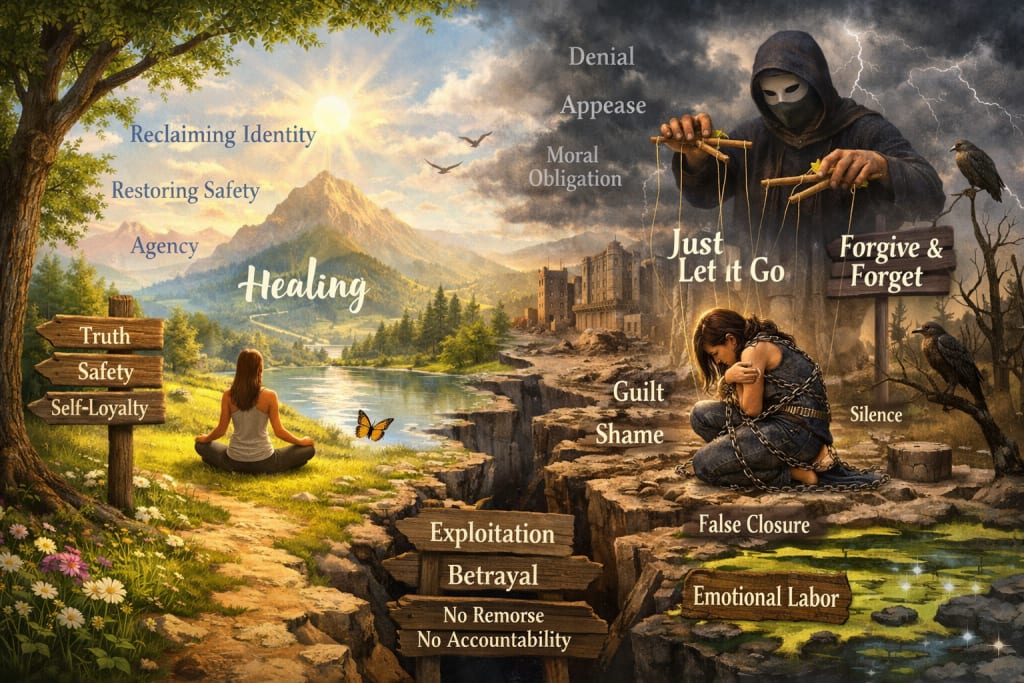
There is a persistent cultural belief often framed as callow wisdom that forgiveness is necessary for healing. Survivors are told that to move forward, they must “let go,” “make peace,” or forgive those who have harmed them. This belief is not only inaccurate; for many survivors but it is also actively harmful.
Healing and forgiveness are not the same thing. They operate in different domains, serve different purposes, and answer to different needs.
Healing is physiological and psychological because the body keeps score right. Healing is about restoring safety to the nervous system, rebuilding a sense of agency, and reclaiming one’s identity after it has been violated. Healing asks Am I safe now? Do I belong to myself again? Can my body rest? Very important questions for your nervous system, mental and emotional health to have answered; and if your nervous system cannot heal then the source of harm is still poisoning.
Forgiveness, on the other hand, is a moral or relational choice. It is about absolution, reconciliation, or the release of moral debt. That may be meaningful in some contexts but it is not a requirement for healing and treating it as such confuses ethics with biology.
Intent Matters
Not all harm exists on the same moral plane. When harm is accidental, forgiveness can sometimes function as a tool for repairing trust. Accidents imply a lack of intent, and remorse can open the door to accountability and change. This can apply on small and large scales but the intent is the most important and second to it is was a lesson learned from it; did the person improve on not doing that again. Whether it is an action or crossing boundaries or addressing people a certain way.
But when harm is intentional, exploitative, and carried out with awareness; the ethical equation changes entirely. For example, sexual violence is not a misunderstanding. It is not an error in judgment. It is a choice made with knowledge of its impact. Lying (white lies too) with intent to manipulate for your own selfish intent; that is a choice made with knowledge of it’s impact. Especially when set on repeat like life is a cd player.
Refusing to forgive in these cases is not “holding onto negativity.” You’ll hear things like “let it go” “but they said sorry (disingenuously/forced)” “don’t be so negative” It is accurately naming reality. Forgiveness is not something owed to the intentional offender.
Lack of Remorse Breaks the Moral Contract
Forgiveness, if it exists at all, presumes certain conditions like accountability, an understanding of harm, and genuine remorse. Without these, forgiveness becomes hollow an empty gesture demanded of the survivor rather than earned by the perpetrator; and even then the person has every right to reserve the answer as “no, i do not forgive them”. Intersectionality is a thing and if the answer is “no” then respect that. I find that if forgiveness is plausible that is the offender, the abuser’s responsibility to demonstrate accountability, understanding of the harm and holding that genuine remorse for their actions. It is not the victim’s responsibility at all; they did not choose to be in that situation…the offender did.
When there is no remorse, what is often called “forgiveness” becomes something else entirely forced emotional labor. Survivors are expected to soothe the discomfort of others while minimizing their own pain and provide moral closure that the perpetrator has not earned.
In these situations, forgiveness becomes a loophole. It allows harm to be reframed as resolved even when nothing has been repaired.
When Forgiveness Is Premature or Coerced
Premature or coerced forgiveness rarely benefits the survivor. More often, it benefits the abuser or the system surrounding them.
It can silence anger that exists to protect boundaries and short-circuit justice or accountability; or be weaponized as proof that “it wasn’t that bad”…None of this is healing. Anger, when properly integrated, is not pathology; it is information. It tells us where harm occurred and what must not be repeated. It is your mind and your body reminding you it must not be repeated.
Not Forgiving Is Not the Same as Being Consumed by Hatred
Refusing to forgive does not mean living in bitterness. It does not mean remaining stuck in the past. It means you’re holding a boundary. A person can move forward, build a meaningful life, reclaim joy, and still refuse to absolve someone who chose to harm them.
That refusal is not cruelty…it is discernment. It does not matter if it is friend, family or foe.
Healing does not require rewriting history to make it more palatable. It requires truth, safety, and self-loyalty. For many survivors, the most healing act is not forgiveness but the decision to stop abandoning themselves for the comfort of others.
About the Creator
Cadma
A sweetie pie with fire in her eyes
Instagram @CurlyCadma
TikTok @Cadmania
Www.YouTube.com/bittenappletv
The Angry Man in Your House
"If you grow up with an angry man in your house, there will always be an angry man in your house" This statement has caused plenty of controversy online, people say its a statement that blames victims while also undermining those who break traumatic cycles to form health relationships... but if I'm honest now that I'm in my 30s it makes more sense to me than ever, and I'd argue that its not just about fathers and uncles.
By S. A. Crawford3 days ago in Humans



Comments
There are no comments for this story
Be the first to respond and start the conversation.