
Five Heroes of Three Kingdoms
The Twilight Years of the Eastern Han Dynasty
Cao Cao, courtesy name Mengde, nicknamed Aman, was born in Qiaojun, Peiguo (now Haozhou, Anhui). Cao Cao was born in the first year of Yongshou (155) of Emperor Huan of the Eastern Han Dynasty and died in the 25th year of Jian'an (220) of Emperor Xian of the Eastern Han Dynasty. He was 66 years old.
Before talking about Cao Cao, we must first talk about the era in which he lived.
The end of the Eastern Han Dynasty was a very turbulent time. But as I said in the previous article, the so-called "heroes come out of troubled times" is also such a historical environment, which has created a large number of heroes, and also provided people like Cao Cao with an opportunity to show their ambitions. In other words, if there were no such troubled times, there would be no such powerful characters as Cao Cao, Liu Bei, and Sun Quan, and there would be no such soul-stirring stories. In a sense, that was a real loss.
But it is always said that the world is chaotic, just how chaotic is it? What kind of major events in this era have caused this dynasty to decline and fall? Leaving aside the stupidity of the emperor himself (such as ignoring government affairs, selling officials, etc.), let's briefly talk about some external forces.
This is a historical question. The emergence of the foreign relatives group can be said to have been formed since Wang Mang usurped the Han at the end of the Western Han Dynasty.
Here comes the question, what is a relative? Foreign relatives are relatives of the emperor, people on the side of the emperor's "mother", and some are called relatives of the state. This mother, why is there a quotation mark, because some "mothers" are not the emperor's own mother (for example, the emperor was adopted from another branch of the imperial family).
The old emperor passed away, and the new emperor ascended the throne. If the new emperor is a child, adults will be needed to "help" him manage the state apparatus, because children do not understand what a state apparatus is. At this time, the empress of the old emperor was also promoted to the empress dowager, and the empress dowager, a woman, could not control the government by herself. She needs her brothers and relatives of her family to "help" manage it together. Moreover, such people generally have high official positions, and they are all people who lead troops like generals. And there is a relatively high-level title-"Uncle Guo".
The second episode of The Romance of the Three Kingdoms is "Uncle He seeks to punish eunuchs". The He Guojiu here is He Jin, who is the uncle of Liu Bian, the young emperor of the Eastern Han Dynasty. Liu Bian was the son of Emperor Ling, and his mother was Queen He of the Zhenggong Palace. He Jin was originally a butcher, but because of the He family, he was promoted to heaven and became a general. There are people in charge of the soldiers in the outer court, and there are queen mothers and others in the inner court, so the government is firmly controlled in their hands. With the spread of power, they placed family members all over the court, and eventually such a group of foreign relatives became more and more powerful in the court.
And the emperor is like a puppet.
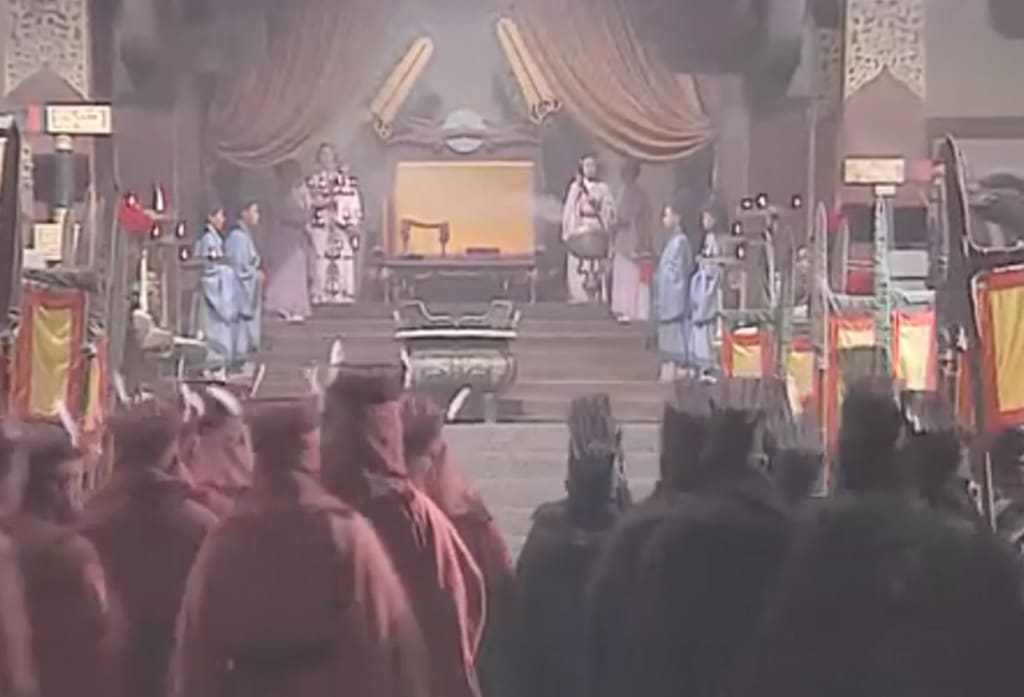
General He Jin (picture taken from CCTV's "Romance of the Three Kingdoms" in 1994, the same below)
But as the little emperor got older, he wanted to be in charge and manage the world himself. He found that it was impossible, because the relatives group covered him like a thick network of relationships, making him breathless. He needs a force to check and balance his relatives.
The eunuch appeared.
Eunuchs are people who are not respected and are looked down upon by everyone. If such a group wants to gain a firm foothold, it has to cling to the emperor's thigh. The emperor also needed a group to help him, and it was just right for both. The eunuchs were even more confident by virtue of serving the emperor. They will "elect" a "leader", that is, the boss of the eunuch group. He represented the emperor, domineering, and even issued an edict in the name of the emperor to whip the world.
Of course, the foreign relatives group could not tolerate the existence of the eunuch group, and the eunuch group also feared these soldiers, so fierce conflicts began. The two groups competed for power, which undoubtedly intensified the internal struggle of the ruling group and accelerated the decline of a dynasty.
Than how to enter the chaos. At that time, Liu Bian, the prince of Emperor Ling, came to the throne, Empress Dowager He came to court, and He Jin was in power. The eunuch group (headed by the "ten permanent servants") wanted to get rid of He Jin, but He Jin was spared from being killed. When he found out, he quickly killed the "eunuch chief" Jian Shuo. Everyone in the eunuch group was in danger, and when they jumped the wall in a hurry, they naturally planned a bigger conspiracy. He Jin's lieutenant Yuan Shao advised him to kill all eunuchs, while school lieutenant Cao Cao advised him not to do too much. When He Jin was hesitating, the eunuch took the lead and used Empress He's name to pretend to call He into the palace. He Jin didn't know what to do, and was killed by the eunuch after entering the palace. Then Yuan Shao led his army into the palace and killed more than 2,000 eunuchs. A small number of eunuchs hijacked Emperor Liu Bian and Chenliu Wang Liu Xie to flee, attracting Dong Zhuo to enter Luoyang as "King Qin". Dong Zhuo abolished Liu Bian, killed Empress Dowager He, and established Liu Xie in order to dedicate himself to the emperor of the Han Dynasty and control the government. For decades since then, an unprecedented warlord melee began.
Dong Zhuo abolished Liu Bian and established King Chenliu as emperor, dedicating himself to the Han Dynasty
Therefore, the power struggle between foreign relatives and eunuchs has greatly weakened the power of the central government. On the contrary, the strength of local armed separatists has greatly increased. The state and county Mushou took the opportunity to expand his territory and develop his power, becoming the overlord of the separatist side. The world is in such chaos.
There is another side effect of the dispute between relatives and eunuchs. Imagine that the government is controlled by these two groups, and their party members are planted everywhere, which greatly hinders the advancement of scholar-bureaucrats. This group of "intellectuals" who wanted to gain fame through their own efforts were completely angered. They were dissatisfied with the status quo and rose up to resist. The final result was the "disaster of the party", which happened twice.
The first time was in the ninth year of Yanxi Emperor Huan (166). Yin Li of Henan Province was convicted of strictly governing eunuchs, so he was convicted and sent to prison. Taiwei Chen Fan complained about Li Ying's grievances, and more than 30,000 Tai students joined forces to support Chen Fan, Li Ying and others. This formed a relatively influential group, which the eunuchs called the "Party" group. The eunuch was frightened, he couldn't move Chen Fan, but he could move Li Ying. So he slandered Emperor Huan again, and sent Li Ying, Fan Pang and more than 200 people to prison for the crime of "making friends with friends and slandering the court". Later, because of the amnesty, these people were spared from death, but after they were released, they all became civilians, and "all were pardoned and returned to the fields".
Two years later, in the first year of Emperor Ling Jianning (168), the second disaster of party imprisonment began. The eunuch launched an attack, killed the Taiwei Chen Fan and the general Dou Wu, and at the same time slandered the "party members" against the emperor. At that time, Emperor Ling was only a fourteen-year-old child. He didn't understand why Cao Jie (the head of the eunuch) punished them and what bad things they did.
"Why kill them?"
"Report to Your Majesty, they are colluding with each other with evil intentions."
"The intention is wrong? What do you want to do?"
Cao Jie leaned into the little emperor's ear, "I want to seize your world, the emperor, everything about you."
The little emperor was frightened and took a few steps back. Immediately approved Cao Jie's Shangshu, ordered to kill more than 100 people including Li Ying and Fan Pang, and exile their families to the frontier. The eunuch group strikes while the iron is hot, imprisoning more literati and doctor groups in the world, and classifying them as "partisans".
But everything has two sides. Just when the scholar-bureaucrat group was being suppressed by the eunuch group, the foreign relative group extended an olive branch, because they had the same political interests (enemies with the eunuch group), so they could also temporarily join together. The foreign relatives group promotes party members and supports them. The intention is obvious, to fight against the eunuch group. Therefore, the situation in the court has changed. Some people sympathize with the party members and stand in the team of "party members".
Cao Cao is the descendant of the members of this group.
Therefore, imprisoning the party members cannot imprison the hearts of the party members. Once things go too far (such as the second party imprisonment), new things will be triggered. Scholars cared about the country and sweated for the court. They discussed the state affairs and praised and criticized people together. At the same time, there was also a group of hermits. but keeps a keen eye on the political situation). But generally speaking, the disaster of party imprisonment was also a trigger for the political demise of the Eastern Han Dynasty.
After talking about the court, let's talk about the people.
The court is full of chokeholds, the state machinery is in chaos, and the biggest victims are the people of the world. The corruption of the ruling group has aggravated the burden on the people. The people not only bear heavy corvees and taxes, but also catch up with successive years of locust plagues, droughts, etc. It can be said that natural disasters and man-made disasters have come together. In order to survive, the people will take desperate risks—riots.
The small riot was suppressed by the court. But the effect is to increase the resistance of the people.
So in the seventh year of Lingdi Guanghe (184), a large-scale nationwide peasant uprising—the Yellow Turban Uprising led by Zhang Jiao—broke out.
In the seventh year of Guanghe in the Eastern Han Dynasty (184), the Yellow Turban Uprising broke out
Not much to say about the details. The Yellow Turban Army was invincible at the beginning, attacking and plundering prefectures and counties, winning successive victories. But after all, it is not a regular army, and there is no unified militarized management, so the later battles failed repeatedly. In less than a year, they were wiped out by the imperial army one by one, and the uprising failed.
Although the Yellow Turban Uprising failed, it dealt a serious blow to the state rule at the end of the Eastern Han Dynasty. It has had a very negative impact, making the political foundation of the country no longer stable. In the process of suppressing the uprising, the warlords of the prefectures and counties recruited troops one after another, expanded their territory, served the country in name, but actually developed their wings. This also provided the conditions for the later warlords to fight.
The melee between warlords can be said to be the historical evolution process of "the long-term division must be united, and the long-term unity must be divided", or it can be said that "nothing can be broken and no establishment can be established".
Cao Cao represents one of the groups of the above-mentioned warlords. His starting point was very low, and his power was weak, but he could finally stand out and become the hero of the separatist party. Although he failed to unify the country, he promoted the flow of this process, transformed such a historical environment, and acquired a large area of land for himself. On this land, his people recuperate and live. Although they can't talk about living and working in peace, at least they are far away from the suffering of war. At the same time, he also laid down a land for his descendants. Therefore, this article mainly talks about the historical background of the end of the Eastern Han Dynasty, so that everyone can more directly experience Cao Cao's growth in that era, and what he experienced, as a small foreshadowing for the following article.
This is the end of this article, and the next article will discuss Cao Cao's family background.
About the Creator
Cabin Fever Because of Snow, Sleet, and Freezing Rain That Turned to Icy Roads
What Is Cabin Fever? The short answer is that cabin fever is restlessness from being in a confined area. Cabin fever is the distressing irritability or restlessness experienced when a person or group is stuck at an isolated location or in confined quarters for an extended time. Research shows that prolonged cold, gray skies, and being stuck indoors can trigger mood shifts similar to “winter blues.”
By Margaret Minnicksa day ago in Humans
Why Certain Connections Feel Familiar Without History.
Some relationships feel familiar even without shared history. People often experience an immediate sense of comfort, trust, or recognition with strangers. This phenomenon occurs in friendships, romantic encounters, professional interactions, and social situations. While it may feel mysterious, science and psychology provide explanations. Familiarity without history arises from subconscious pattern recognition, emotional resonance, and neural processes that link perception, memory, and social cognition. Understanding why certain connections feel familiar offers insight into human intuition, relationship building, and social awareness.
By Wilson Igbasi5 days ago in Humans


Comments
There are no comments for this story
Be the first to respond and start the conversation.