
Expensive Misconceptions
A short story by Alexandra Svoboda

‘Morning Hugh’
‘Morning Felicity’
‘The usual?’
‘Cheers.’
Felicity pays at the counter and waits patiently for the coffees to be made. She leans against the bench beside the coffee machine, flipping through the pages of a newspaper, feigning an air of nonchalance. Every few moments, she sighs loudly at something she reads, then looks over to see if the barista is watching. He’s engrossed in his work, pouring the drinks with precision. When he’s finished, he reaches over the machine to hand the two takeaway cups to Felicity. One with a lid, soft tan foam bubbling out of the sipping hole, the other lidless, nestled in two cups so that Felicity doesn’t burn her hand. As she takes the drinks, Felicity smiles and nods to thank the barista for this thoughtful gesture, taking it as a sign that he recognises her, notices that she’s wearing makeup and styled her hair, notices that she’s buying a coffee—like she does every day—for the lonely old man who sits outside the café writing in his notebook.
Felicity doesn’t realise that she has a smudge of pink lipstick on her front tooth or that the blush she applied has given her a clownish appearance. The barista has noticed her efforts but avoids eye contact, nodding pointedly at the person waiting behind her, indicating that Felicity ought to move on, now.
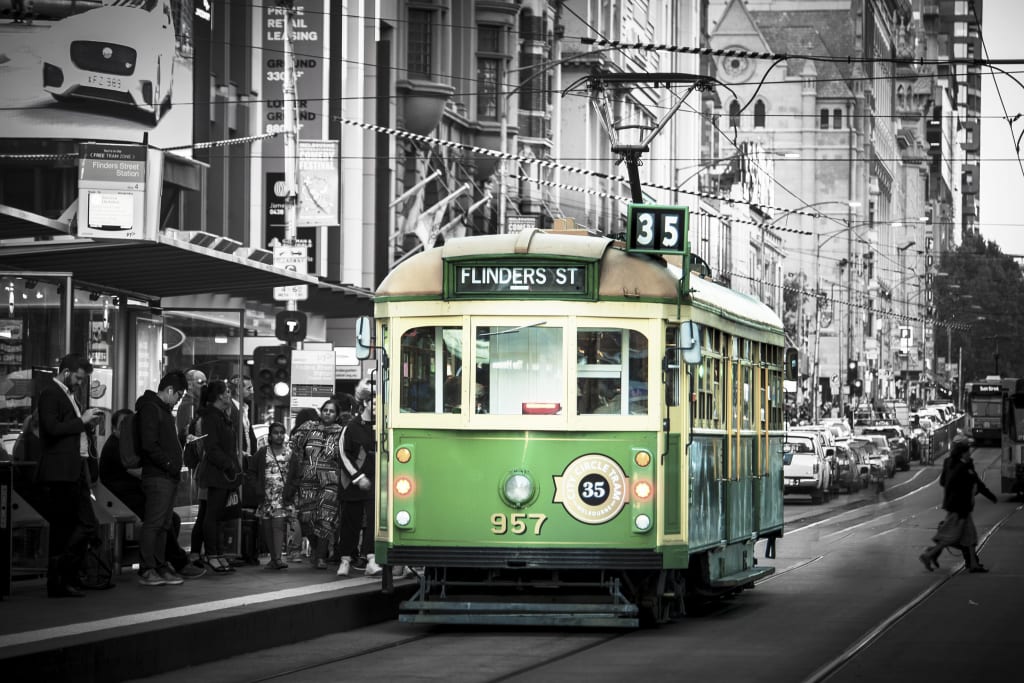
Hugh sits on a low brick retaining wall that forms a barrier between the outside seating area of the café and the side of the road. The wall is conveniently located close to the tram stop and far enough from the tables that patrons can legally smoke a cigarette with their coffee before catching the tram. That’s how Felicity and Hugh met about three months ago, making casual conversation while sucking hungrily on the hot smoke that warmed them against the frigid Melbourne winter, Felicity pretending it was the only cigarette she indulged in for the day.
As Felicity hands the coffee to Hugh, she worries he might mistake her effort to improve her appearance as flirtatious; directed at him. Surely not. Hugh is old. As in, old old. Stooped and wrinkled with white hair and hands gnarled and knobbly with age. On the coldest days, he walks with a frame because his joints hurt so badly. Felicity is only thirty-four. She may be somewhat homely, dressing in dowdy mid-length skirts and ill-fitting floral k-mart blouses, but she isn’t desperate—just a little lonely. To drive home her point, Felicity stares pointedly over her shoulder at the handsome barista as he bangs the grinder over the bin, triceps flexing under his tight shirt, a lock of shiny black hair falling over his face that he tosses out of the way unselfconsciously. She sighs longingly and turns back to Hugh.
Hugh gets the message; he knows their friendship isn’t going anywhere, nor does he want it to. If anything, she’s a little annoying, buying his coffee every day as if he’s some charity case. He isn’t. He never asked her to, she just did and Hugh didn’t say no. Although Hugh is a widower, he has four children and eight grandchildren who visit regularly on weekends. During the week, he rides the trams around Melbourne, making notes of his observations that will go into the novel that he writes in the evenings. After a lifetime of fast-paced corporate offices and non-stop interstate travel, Hugh enjoys spending his retirement wandering Melbourne—he’s earned it.
As an observer, Hugh has learned to read people. He spotted Felicity’s infatuation with the barista from a mile away. The whole thing has been painful and sad, made especially so because the young man is clearly sleeping with the woman at table six wearing leggings so tight that you can see her breakfast.
And the businesswoman at table eight with calves cut like diamonds, shown off in a tight pencil skirt and sky-high heels.
And the man in the designer suit who comes in on weekdays before work and flirts outrageously, but rushes past on weekends, pushing a stroller, walking alongside his wife.
Chuckling, Hugh makes a note in the little black notebook that he carries specifically for this purpose. His desk drawer is full of them. Pulling the lid off the black biro with a pop, Hugh notes down in small, neat print: ‘attracted but not attractive.’ Felicity has inspired a character for his novel.
Hugh closes the notebook but doesn’t put it away, pulls a scratchie out of his pocket and leans it against the notebook to score at the flimsy ticket. He doesn’t need the money but enjoys the thrill when he wins five or ten dollars here and there, catching the tram to the newsagent the suburb over where he can cash the ticket and then go to the pub next door to sink his winnings into the pokies.
‘What’s the grand prize today?’ Felicity reaches over to put her finished cigarette in the bin. She does so pointedly, looking down with disapproval at the smoking butts scattered at Hugh’s feet. He ignores her stare and continues scratching.
‘A hundred K.’
Felicity marvels at the neat silver circles Hugh has carved onto the ticket. He blows delicately at the filings, angling his head this way and that as if he were a street artist making an impression for a tourist, not an old man trying his daily dose of luck.
‘You’ve probably spent a hundred k on those things by now.’
‘Not quite.’
Felicity is strongly against gambling. It ruined her parents. As much as she hopes Hugh will win eventually, she considers it an extreme waste of money. Why pay ten dollars to maybe win a hundred k when you can just keep the ten dollars? In his thin coat and worn boots, he looks like he could use it.
The scratchie finished, Hugh holds the ticket to the light, squinting. His eyes are bad and he can barely make out the writing, despite how neatly he’s marked the ticket.
‘Any luck?’
‘Ah, not today.’
‘Maybe tomorrow.’
‘Yeah, maybe.’
Down the street, Hugh can see the tram approaching. It’s travelling to the suburbs and away from the city, where he knows Felicity isn’t heading, so decides to board it. He isn’t in the mood for her sighing, misplaced pity.
‘I’m on the 34 today.’
‘Where ya heading?’
‘Kew. Needa see a man about a dog. Thanks for the coffee.’
‘Any time. See ya tomorrow.’ Her eyes are wet with tenderness and he cringes inwardly, turning away quickly to walk toward the tram stop, to stand at a spot close to where the doors will open so that he has a better chance of grabbing a seat.
As Hugh walks away, he leaves the scratchie on the ledge where he was sitting. Felicity looks down to see it lying next to the empty coffee cup and scowls at his mess. She reaches down and picks up the cup and the scratchie, scrutinising the writing.
‘Two stars equals first prize.’ She reads quietly. The tram is waiting at a red light, 100 metres up the road.
‘One star and one lightning bolt equals second prize.’ She continues. She looks at the images that Hugh has scratched off. A bow, a candle, a paw, a lightning bolt, a flower, a star. She checks what second prize is and her heart stops. Twenty k.
The tram remains stationary. Hugh stands with his back to her, hands stuffed into the pockets of his coat. She double checks the legend against the images. She checks again. She flips the ticket to read the terms and conditions. Hugh’s won second prize. Hugh’s won twenty k!
The light changes and the tram dings its bell and begins to move up the road, lurching like an old drunk. The crowd surges and Hugh disappears among the jostling commuters in black suits and puffer jackets. The doors open and the disembarking passengers step out. As the swarm flows, for a moment, Hugh is visible again, waiting patiently by the door of the tram. He looks back and sees Felicity watching.
Felicity waves, mouthing to ‘come back! You left your scratchie! You’ve won! Come back!’
Hugh sighs and returns the wave unenthusiastically. ‘What an odd bird.’ As he sits down at his hard-won seat, he tries to figure out what she was saying. He notes another observation in his book: ‘empty life. latching on. could use some luck.’ It might be time for him to find another café, another route, a different selection of personalities to liven up his novel. The tram moves away, heavy with passengers, swaying as it gains momentum.
Stunned, Felicity sits back down on the ledge, staring at the ticket.
Twenty thousand dollars.
That amount could change her life.
She thinks of her car loan—two hundred a month—that gouges a hole in her meagre salary. Gone.
Those credit cards. Repayments of one-hundred and fifty a month, only paying off seventy at a time because of the banks’ crippling interest rates. Gone.
She thinks of what she could do with the extra three-fifty a month. Move out of the share house that she lives in with the holier-than-thou couple, who use the royal we and glare at her when she tries to sit with them on the couch, as if she’s interrupting their date night. She could rent an apartment of her own.
What would she do with the rest of the cash? Finally go to the dentist and sort out that tooth that hurts every time she chews on the left side of her mouth.
Pay back the $300 that Jeremy loaned her for the long weekend in Apollo Bay six months ago. He never asks for it, but the shame is heavy and she avoids social occasions so that he doesn’t judge her for splashing out on dinner and drinks when she should be paying him back.
With twenty k she’ll finally be—not ahead, no, these days twenty k isn’t that much—caught up.
No longer thirty-four years old with no savings.
No longer an adult woman who has to eat tuna bake and mi goreng in the lead-up to pay day like a uni student.
She imagines shouting dinner for her parents at one of those fancy restaurants on Chapel Street where they charge sixteen bucks for a glass of wine and twenty for six dumplings.
She pictures intercepting the bill and handing her card to the waiter without looking at the amount, telling him magnanimously to add 30% for himself and then smiling graciously at her parents: ‘It’s no trouble.’
The barista sweeps past her as he collects empty mugs from the table where a group of mums in Lululemon tights have been having coffee after their yoga class. She imagines buying a pair of tights, signing up to a studio and becoming lean and lithe. She pictures herself walking down the street with her hair tied back in an effortless bun, face flushed with pleasant exertion.
The fantasy is thrilling.
‘Don’t you have to go to work?’ The barista is back, leaning against the lamp post while he lights a cigarette that he’s pulled from his apron.
She considers her options. If she never comes back to this café, Hugh will never find her. She could cash the winning ticket at the newsagent now. He'd never know.
Then she thinks of his worn shoes, thin coat and joints that play up in winter. He can’t even afford a cup of coffee. She should find him—today.
She sits back down and lights another cigarette—her third for the morning—and inhales deeply, blows the smoke out slowly, thoughtfully. The barista is watching, waiting for an answer.
Without responding, Felicity finishes the cigarette, puts it out carefully on the sole of her shoe and places it in the bin beside her.
‘Not today. I have a tram to catch.’
About the Creator
Alexandra Svoboda
Alexandra Svoboda is a writer, academic editor and business analyst. She has completed two manuscripts, one in the genre of creative nonfiction and the other in young adult fantasy, and is currently seeking publication.
Keep reading
More stories from writers in Humans and other communities.
The CEO of Everything
They say "jack of all trades, master of none," but they forgot to mention the part where the jack of all trades is also the camera woman, the makeup artist, and the person currently yelling at a tangled Wii microphone cable in a her own bathroom while recording herself singing and trying to make it look realistic and professional. (As professional as you can make it with nothing but a cell phone camera and a mic that doesn't work)
By Sara Wilson5 days ago in Humans
Immigration Officer Misconduct at KLIA
The Kuala Lumpur International Airport (KLIA) has become the focal point of several significant immigration officer misconduct investigations in recent months, revealing systemic integrity issues within Malaysia's immigration operations.
By Anie Liban3 days ago in Humans


Comments
There are no comments for this story
Be the first to respond and start the conversation.