
Emptiness and Cultural Decay
Emptiness and Cultural Decay in Hollow Men by TS Eliot

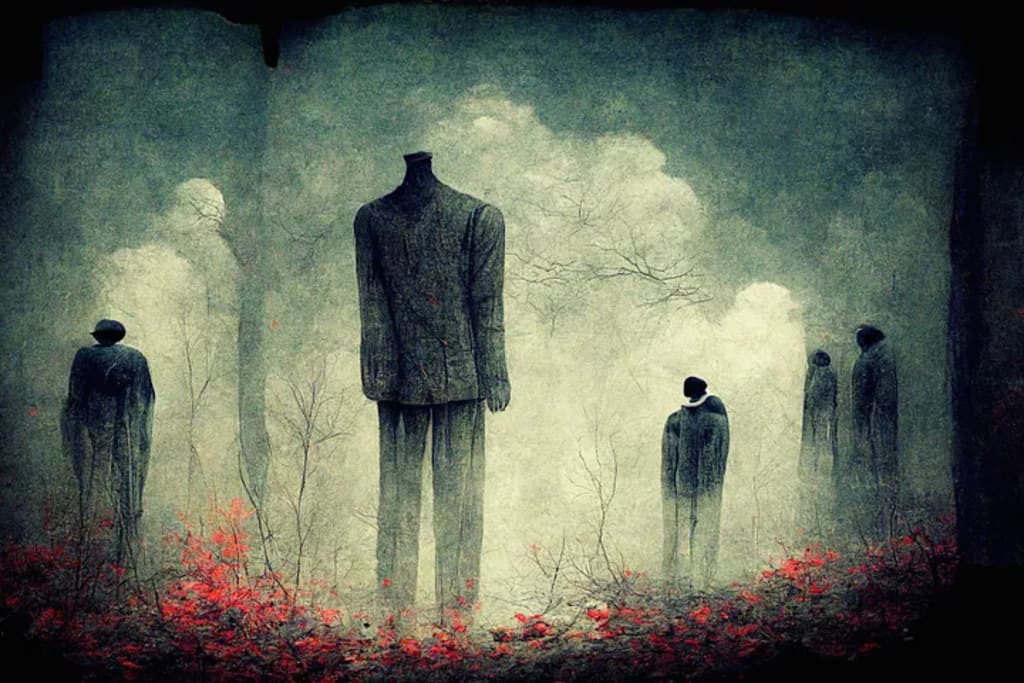
In the opening line of “The Hollow Men,” the speaker makes a strange and unsettling announcement: he’s part of a group of “hollow” people. Moreover, he lives in a landscape which is itself “hollow.” As the poem proceeds, however, it becomes clear that the speaker’s hollowness is not strictly literal. Instead, it serves as an extended metaphor for the decay of European society and culture.
The speaker describes himself — and his fellow “hollow men” — as inhuman, dangerous, and incapable of taking real action. For instance, in the first part of the poem, the speaker characterizes the hollow men’s “voices” as “dried.” Instead of sounding like normal human voices, full of emotion and information, they are “quiet and meaningless / As wind in dry grass.” In other words, their voices no longer sound like human voices — and their voices no longer carry information or emotion, like human voices are supposed to do. Instead, their voices have become as random and senseless as the wind itself. The “hollow men” are more than simply empty in the sense of being sad or despairing — rather, they’ve lost their humanity.
And in the process, they’ve become a danger to human societies. In section two, the speaker describes himself wearing a “rat’s coat” and “crowskin.” These are symbols of disease and death, respectively, and they suggest that the “hollow men” are dangerous to be around. This is not because they’re necessarily bad or malicious; if they do damage to other people, it’s because they happen to be contagious. Their despair is like a plague that passes from person to person.
Indeed, the “hollow men” seem incapable of actually doing much of anything — much less being intentionally destructive. In section three, the speaker notes that they “would kiss” each other, but they can’t. Instead, they “form prayers to broken stone” — which implies that they are worshipping false idols. (For more about that, see the “Faith and Faithlessness” theme). And the “hollow men” can’t bring themselves to come into contact with each other or with other people; they aren’t able to act on their desires or impulses.
However ineffective the “hollow men” are, however unable to act on their impulses, they nonetheless have a strong effect on the world around them. Indeed, the environment in which they live seems to have taken on their characteristics. For instance, the speaker describes the landscape as a “hollow valley” and as a desert, with only prickly cactuses for vegetation; the wind whistles mournfully through it. The landscape is just as hollow as they are.
Yet while the “hollow men” are a danger to human communities, the landscape itself is an image of a damaged culture. In lines 22–23, the speaker says that in the desolate landscape where he lives “the eyes” — a symbol for God’s judgement — are like “sunlight on a broken column.” The column serves here as a symbol of Western Civilization and Western Culture: columns are one of the defining architectural features of ancient Greek and Roman temples. For such a symbol to be broken suggests that the landscape the speaker describes is more broadly symbolic of Western Civilization in decline.
This serves as a helpful hint for how to understand the poem as a whole. Instead of being a piece of science fiction about a group of hollow people, it is a reflection on the state of European culture at the time of Eliot’s writing, right after World War I — a devastating war that shook many people’s faith in European culture and left behind a shattered generation of soldiers who survived. The poem’s judgment of European culture after World War I is very negative: the culture itself is in decline and the people who could preserve it are empty, ineffectual, and even dangerous to their own societies.
About the Creator
Shams Says
I am a writer passionate about crafting engaging stories that connect with readers. Through vivid storytelling and thought-provoking themes, they aim to inspire and entertain.
Keep reading
More stories from Shams Says and writers in Humans and other communities.
Pandemic in the Making? The Growing Threat of Bird Flu
How stressed ought to we be approximately winged creature flu? It’s a address that I’ve been inquired by companions and colleagues a few times over the final couple of weeks. Their concerns have been impelled by a few possibly troubling advancements in the US, counting the proceeded spread of the infection among dairy cattle, the location of the infection in a pig as well as cow’s drain, and—most concerning of all—the developing number of human infections.
By Shams Saysabout a year ago in Humans
Staying sane in the insane world.
”It is no measure of health to be well adjusted to a profoundly sick society.” Jiddu Krishnamurti This quote has been one of my favourites since the moment I first laid my eyes on it. To me, it cuts right through the fog of the illusion of normality that permeates our lives. And since I am someone who has never felt (well) adjusted to this society, Krishnamurti’s words gifted me with the realisation that there isn’t anything inherently wrong with me.
By Eva Smitte6 days ago in Humans
Why Do Professional Singles Struggle to Meet Compatible Partners Offline
Single professionals usually find it difficult to find suitors in real life due to the hectic work schedules. Working long hours, travelling and taking huge workloads do not allow them much time to interact with other people outside their work. Career advancement rather than personal connection Networking events, conferences, and business dinners can offer the opportunities of interaction, but they are usually oriented at the career development instead of the personal bonding. This prompts the difficulty of having time to meet a potential partner either in a casual or meaningful environment.
By Mark Hipster6 days ago in Humans




Comments
There are no comments for this story
Be the first to respond and start the conversation.