
Do You Know All Of Nucleic Acids?
DIFFREMCES BETWEEN DNA AND RNA
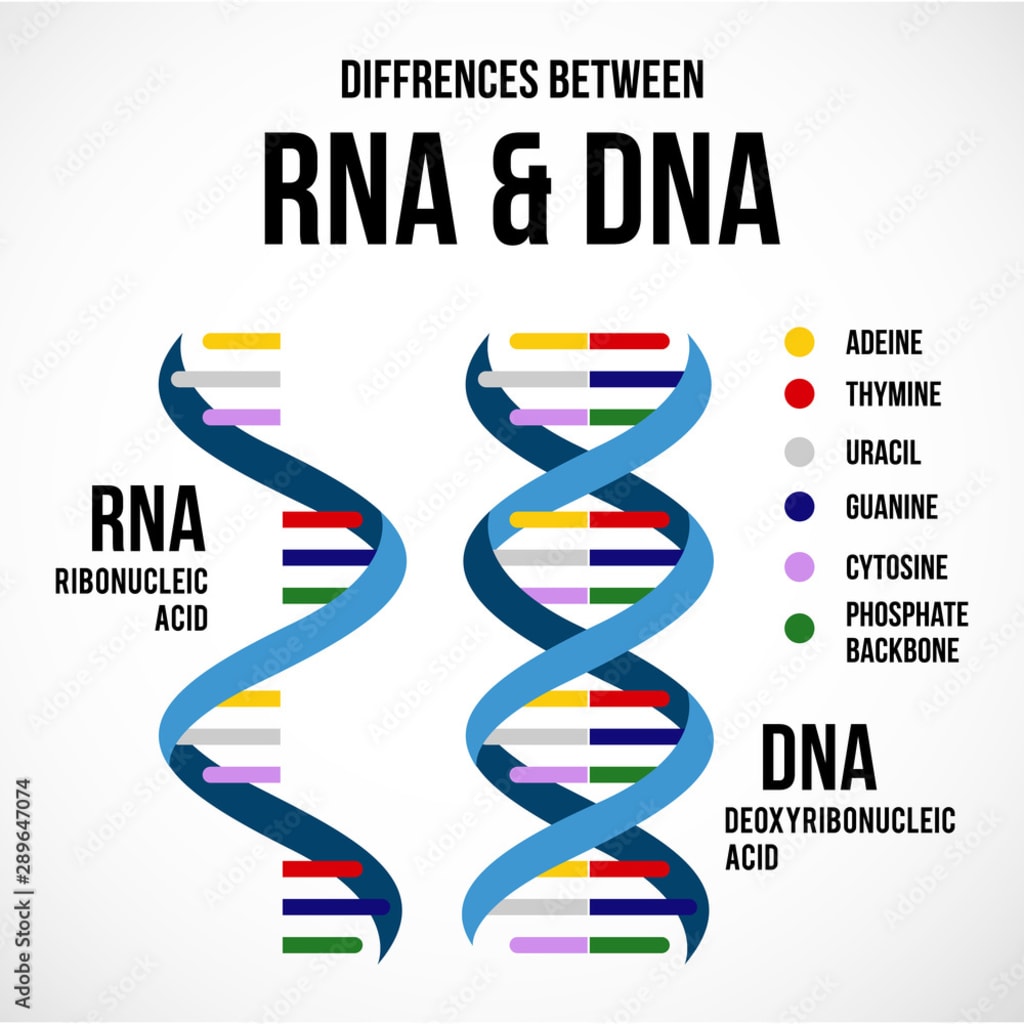
During this period, you will explore nucleic acids and the historical context of biopolymers. These structures consist of monomeric units, known as nucleotides, which serve two critical roles: storing genetic information and facilitating essential biological functions. Key concepts, including the definition of nucleic acids and their relationship to biopolymers, will be discussed. "Bio" refers to life, indicating that these polymers exist within biological systems rather than being artificially created. Polymers are composed of repeated units, specifically nucleotides in this context.
Examples of different types of biopolymers include proteins, which are well-known for their various functions in the body. The focus will be on the basic structure of nucleotides, which is fundamental to understanding their role. A simple diagram will illustrate the structure of a nucleotide, which consists of a nitrogenous base, a sugar component, and phosphate groups.
The discussion will also address the significance of deoxyribose, highlighting its role in making nucleotides more stable due to the absence of an oxygen atom. This stability is crucial for their function in genetic processes. The presence of nitrogen-containing molecules is essential, as they are integral to the structure and function of nucleic acids. The human body is composed of organic compounds, including carbon, hydrogen, and oxygen, which combine to form complex ring structures and molecules.
Two main types of ring structures will be identified: single-ring structures, known as pyrimidines, and double-ring structures, classified as purines. Understanding these fundamental components is vital for comprehending the larger framework of nucleic acids and their biological significance.
Today, the focus is on the two types of nucleic acids: DNA and RNA. DNA stands for deoxyribonucleic acid, while RNA stands for ribonucleic acid. Both DNA and RNA are large organic macromolecules that consist of carbon. They are made up of nucleotides, which are the monomers of nucleic acids. Each nucleotide contains three components: a phosphate group, a five-carbon sugar (known as a pentose), and a nitrogenous base. The sugar in DNA is deoxyribose, which has one less oxygen atom than the ribose found in RNA.
In DNA, each nucleotide includes one of four nitrogenous bases: adenine, guanine, thymine, or cytosine, abbreviated as A, G, T, and C. The pairing of these bases occurs through hydrogen bonds, adhering to specific pairings: adenine pairs only with thymine, and guanine pairs only with cytosine. This is referred to as the base pair rule. Nitrogenous bases have distinct molecular shapes; adenine and guanine possess a double-ring structure, classifying them as purines, while thymine and cytosine have a single-ring structure, classifying them as pyrimidines. A helpful mnemonic is that "pyrimidine" includes a "y," correlating with thymine and cytosine.
In contrast to DNA, RNA nucleotides can include adenine, guanine, or cytosine, but instead of thymine, RNA contains uracil. Therefore, any nucleic acid with thymine is DNA, whereas those with uracil are RNA. Like thymine, uracil also has a single-ring structure and is categorized as a pyrimidine.
The nitrogenous bases play a crucial role in constructing DNA. A DNA strand forms when the phosphate group of one nucleotide bonds with the five-carbon sugar of another. The two strands of DNA are linked through hydrogen bonds between their nitrogenous bases. When DNA unwinds, these base pairs resemble the rungs of a ladder. The shape of the DNA molecule is described as a double helix, a structure first detailed by James Watson and Francis Crick in 1953, based on x-ray images taken by Rosalind Franklin.
Examining RNA, it is always single-stranded, unlike the double-stranded DNA. In eukaryotic cells, DNA is confined to the nucleus, whereas RNA can be located in both the cytoplasm and the nucleus. DNA governs heredity by holding the instructions for synthesizing proteins that compose the body, while RNA utilizes these instructions to produce all necessary proteins in a living organism. There are three types of RNA: messenger RNA (mRNA), ribosomal RNA (rRNA), and transfer RNA (tRNA).
mRNA originates in the nucleus, where it transcribes the instructions for protein assembly from the DNA. After transcription, mRNA transports these instructions to a ribosome in the cytoplasm, which consists of rRNA and proteins and acts as the site for translating the protein recipe. Finally, tRNA in the cytoplasm delivers specific amino acids to the ribosome, enabling the formation of the protein specified by the mRNA instructions.
The last type of organic macromolecule to discuss is nucleic acids. A nucleic acid is a large organic molecule composed of many smaller units. There are two primary types of nucleic acids: deoxyribonucleic acid (DNA) and ribonucleic acid (RNA). Both names include the term "nucleic acid." In living organisms, DNA serves as the main component of chromatin, which condenses to form chromosomes before cell division. The DNA within chromosomes is arranged in a specific sequence, which constitutes an organism's genes. Genes provide instructions for every function, characteristic, and activity within a living organism, including growth, reproduction, and heredity, the transmission of genes to offspring. RNA plays a crucial role in synthesizing specific proteins by correctly assembling amino acids. Proteins are essential for all cellular processes in living beings.
Nucleic acids, as organic macromolecules, contain carbon, and like proteins, they also include hydrogen, oxygen, and nitrogen. Additionally, nucleic acids contain phosphorus. The structure of nucleic acids consists of monomers called nucleotides. Each nucleotide is comprised of three components: a phosphate group containing phosphorus, a five-carbon sugar known as a pentose, and a nitrogenous base that includes nitrogen. The pentose sugar in RNA is ribose, while the sugar in DNA, known as deoxyribose, has one less oxygen atom than ribose. The nitrogenous bases found in DNA are adenine, thymine, cytosine, and guanine, commonly abbreviated as A, T, C, and G. In RNA, the bases are adenine, uracil, cytosine, and guanine, abbreviated as A, U, C, and G. DNA includes thymine, while RNA has uracil.
Nucleotide monomers link to form nucleic acids through the bonding of the phosphate group from one nucleotide to the sugar of another. This process creates a nucleic acid polymer. Although RNA and DNA both feature alternating sugar and phosphate groups, they differ in structure; RNA is single-stranded, while DNA is double-stranded. The two strands in DNA are connected by hydrogen bonds between their nitrogenous bases.
In summary, nucleic acids are organic macromolecules that include DNA and RNA, responsible for transmitting hereditary information and guiding protein synthesis in cells. They contain carbon, hydrogen, oxygen, nitrogen, and phosphorus. Nucleotides are the basic building blocks of DNA and RNA, consisting of a phosphate group, a five-carbon sugar (pentose), and a nitrogenous base. The nitrogenous bases in DNA are adenine, thymine, cytosine, and guanine, while those in RNA are adenine, uracil, cytosine, and guanine. Deoxyribose is the sugar in DNA, and ribose is the sugar in RNA.
About the Creator
Nguyễn Trần Bảo Khang
I'm a VietNamese and I want to give everyone know more about VietNam - a beautiful country you must try to go for a summer trip, ya!
Keep reading
More stories from Nguyễn Trần Bảo Khang and writers in Humans and other communities.
A Quick Summary Of Vietnamese History Over 4000 Years
Vietnam's history spans 4,000 years, with records originating from ancient Vietnamese texts dating back to 2879 BC. This period includes the Spring and Autumn, as well as the Warring States periods, during which the ancient Vietnamese faced pressures from Northern China and the So Tan Kingdoms. These external forces led to the gradual loss of territory by Vietnamese tribes, with some being assimilated into Chinese culture. The alliance of the Bach Viet tribes eventually disintegrated, leading to the establishment of the Van Lang Kingdom by the Hung kings in 257 BC. An Duong Vuong, the leader of the Au Viet tribe, founded this kingdom, with Co Loa as its capital.
By Nguyễn Trần Bảo Khangabout a year ago in History
Time to change your life.
Is it even possible for you to change your life? A lot of people, more than there should be, are unhappy with their lives. But what are they doing about it? Usually nothing. People talk about how shitty their lives are and want change, but are they not taking the actions to change?
By Jen Phillips5 days ago in Humans
Mental Health Warning Signs Within Emotionally Draining Relationships You Notice
Constant emotional burnout is one of the first indications of an emotionally exhausting relationship. However, you might be exhausted despite rest, emotionally exhausted after communication, or so stressed working on sustaining the relationship. This exhaustion can come as a result of being in a constant conflict management or on eggshells, or holding back your real feelings in order not to create tension. In the long run, this emotional exhaustion may decrease motivation, concentration and general pleasure in life.
By Robert Smith4 days ago in Humans
Why Black History Matters in America?
The United States of America is celebrating their 250th anniversary in 2026. I'm proud to be an American and as someone who was born here, I wouldn't imagine myself living anywhere else. This is a country where opportunities are possible. Where anyone can be successful in anything they desire to do. Equality, community, and togetherness are the backbones of what America is and should be about. However, we have an administration who wants to erase and disregard those who have made positive, meaningful impacts in our country, specifically Black figures, such as Martin Luther King, Jr., Rosa Parks, and Maya Angelou. President Trump and his administration have been constantly complaining and fighting against what they call the "Woke agenda". They use this excuse as a distraction from other issues they refuse to address, such as the high cost of living, climate change, and inflation. That equality is dividing America, when in reality, it's bringing us together. Being woke is not tied to a specific political party. No matter where you stand on the political spectrum, you can still care about other people and their plights. Compassion and empathy for others isn't tied to a political party, either. We were taught as children to treat others the way we want to be treated and not judge others because they're different from us. Caring about others isn't a personal attack on your beliefs. It doesn't make you any less of a person. People who are easily offended over African American figures, past or present, or anything related to it, are grasping at straws. Current and future generations need to know who people like Harriet Tubman and Shirley Chisholm were, especially in the classroom. Black History is part of American History. It should be recognized, not hidden or forgotten. Besides, you can't shield children from everything, just because your feelings are easily hurt.
By Mark Wesley Pritchard 3 days ago in The Swamp



Comments (2)
Thanks for sharing
I really love your content and how it's crafted , I love it and happily subscribed , you can check out my content and subscribe to me also , thanks for this beautiful one