
Dirty Underwear and Scarves from Elvis
Based on a True Story


My grandfather never told me how he came into possession of Elvis’ scarf. The pale blue scarf was in decent shape lying on the kitchen table next to a faded yellow advertisement of the 1975 New Year’s Eve show in Detroit, Michigan. Beside the scarf were two Hummel figures, a hiking boy and a girl sitting with an umbrella. Dan, my older brother, ate cereal against the counter with a smile on his face.
“Lacy, I need you to put this stuff on eBay for me,” my grandfather said.
“Is this stuff real?” I asked back.
“Be careful,” Dan said.
“It’s certainly not imaginary,” my grandfather said, not answering the question. His charisma was like a Texas humidity clinging to you in July. You couldn’t replicate it in Colorado, but anytime you were around him, you felt it. He made you feel like you were part of it – a little piece of him belonged to you when you were with him. He taken care of me and my brother since our elementary school days. He was always pseudophilosophizing and lecturing us about something. Just last week he exclaimed that fellatio sounded like a Shakespeare character. What do you say to back to these things? One day I’d teach him something he didn’t know.
After I finished my chores, I listed the three items. After some research, it seemed like the Hummel’s were only worth $75 each. My grandfather heard they might be worth thousands, and some were, just not these two. The scarf was harder to price. Listings ranged from $30 to $5000. Surely, the cheaper ones were replicas from scammers. Maybe the more expensive ones were using a high price to hide their inauthenticity. They were all signed by Elvis too, which seemed strange to me. He threw them out into the audience and all these people just happened to catch him later at the pub? I listed it for $1000. Grandfather checked the listings hourly.

“Why sell this stuff now? The scarf is really cool,” I said.
“If something has been in a box in a basement for over 30 years, it’s not cool. If you like it so much, take a picture,” he replied.
***
Two weeks later, I was on a Greyhound bus from Detroit to Chicago. My grandfather was a retired bus driver. He loved the open road, but since I graduated from high school three years ago, I wasn’t interested in seeing cornfields and power lines. I liked my job at the golf course. I worked with new people. It made me feel grown up, but the season had ended.
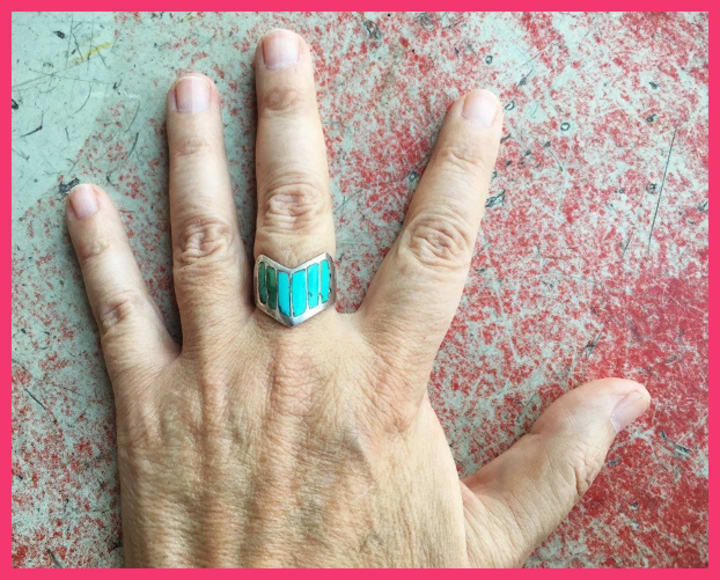
The three items had sold, the buyers residing in Chicago, Columbus (Indiana, not Ohio – who knew such a place existed) and Nashville. I swiped through the photos I’d taken on my phone of my grandfather wearing the scarf outside his townhouse. He posed in front of his perfectly manicured lawn and wall of geraniums, feigning Americana with his buckshot-lodged tobacco smile and turquoise ring he never took off. Dan and I called him Turk because of it.
My grandfather didn’t trust the mail. He didn’t want the figurines to be broken in transit or the scarf to be “nabbed” by a porch pirate. He’d written my itinerary in a small black book: Detroit to Chicago (5 hours), Chicago to Columbus, Indiana via Indianapolis (4.5 hours), Columbus to Nashville (5 hours). He pre-booked hotels for me and listed them in the book. He’d drawn maps to each of them from the bus terminal. He didn’t trust Google Maps. He had glued 10 envelopes onto the black book’s pages. They were separated equally with blank pages between.
#1 – Open when you’ve left Detroit
#2 – Open when you’ve left Chicago
#3 – Open when you’ve left Columbus
#4 – Open when you’re ready to leave Nashville
I opened the first envelope and there was $500. There was a list of places to visit: eat a hotdog at Wrigley Field, take a picture at The Bean, a river cruise down the Chicago River.
***
“I don’t like how people say It’s a Wonderful Life is a Christmas movie. It’s summer for most of the movie. And the theme of the film is very anti-fat man gives gifts. There’s a sign in the movie that literally says, “All you can take with you is that which you’ve given away.” The film is talking about kindness, friendship, community. Not giving away PlayStations. How was Chicago? You deliver the goods?” Grandfather was always ranting about semantics. Dan and I had heard him wax poetic about how Tarzan should have a beard for as long as we could both remember.
“I delivered the first Hummel. The old man was very happy with it. Chicago is great. I went and saw the Cubs play today. I had a great single seat on the third baseline,” I said.
“Third base line? You’re an expert now?”
“You can’t go to a Cubs game without learning something,” I replied.
“You check off all the things on my list?” he asked.
“All of them,” I said. I’d been checking off his list in the black book, making notes of what I saw and who I met.
***
“I don’t like the term daylight savings time, with an ‘s’. The word daylight is like moose or sheep. I’d never say to your grandmother, “It’s sheep savings time.” There’s no ‘s’. Come on, people. It’s daylight saving time. Got it? You deliver the goods?”
“Delivered. The man who bought the Hummel suggest I check out the Miller House. The guide said the house is right up there with Frank Lloyd Wright’s work. It wasn’t on your list though,” I said.
“I’m not an architecture buff, but it seems like there’s lots to see there,” he said.
“I saw the things on your list, too. Don’t worry. The Zaharokos ice cream shop was like angels crying on my tongue,” I said.
“You know I don’t like cloud-borne deities."
***
“You ever notice how period films always have every car from the exact year the film is set? It makes no sense. Look around next time you drive. There’s cars from the last 30 years everywhere, not just from 2021,” Turk scoffed over the phone.
“Now I won’t be able to unthink that. Thanks, grandpa,” I said, watching a 90’s Camaro growl down Broadway in Nashville out of the bar window.
“You see the Grand Ole Opry?” he asked.
“No. Not yet. I visited the RCA Studio B and the Frist Art Museum. I’m at AJ’s Good Time Bar now. Apparently, it’s the oldest building on Broadway and used to be a Civil War hospital. I met some people who saw the Red Wings patch on my backpack. They’re from Detroit, too. We’re headed down to the river soon,” I said.
***
I told Sandy, one of the girls I met at the bar, that I needed a ride to deliver the scarf. She looked like a Sandy, with auburn hair and freckles that looked like permanent glitter affixed to her face with cotton candy floss hair. She asked to see the scarf. I handed her the plastic freezer bag it lay safe in. She looked at it with awe, like it was the treasure of the Sierra Madre. She didn’t understand how anyone could part with such a piece of history. I told her about my strange grandfather and the wild goose chase he’d sent me on. Afraid of the United States Postal Service, I said. She flipped through my black book. She carried one too, but hers was swollen and red, littered with flyers and concert tickets. She handed me a photo.
“Who is this?” she asked.
“Where did you find this?” I replied.
“It was in the back pouch of your notebook,” she said.
“I didn’t know there was a secret pocket,” I said back.
In my hand was a photo of my grandfather. Much younger of course. He had his arm around Elvis. Elvis held a scarf in his hand, with the biggest smile on his sweaty face. My grandfather had a notebook in his hand with a pencil.
“Is there anything else in the notebook pocket?” I asked Sandy.
“Let me see…” she said, turning the book upside down and shaking it. A small piece of thin rule-lined paper fluttered out. She picked it up and read it to me:
Thanks for the laughs. You’re right. People don’t say Mountain Everest.
Elvis
***
The man buying the scarf was a collector of rock n’ roll memorabilia. He called himself Wolf and was only a couple years older than us. He was tattooed with a prominent nose and smelled like sweet firewood. He ran a small recording studio and was decorating it. He thought Memphis took too much credit for Elvis and wanted the scarf in the lobby to show he was serious about music. I showed him the photo and the autographed piece of paper. He had more questions, but my grandfather had never told me these stories.

He took photos of the picture and autograph with his Leica camera. Wolf was perplexed why this proof wasn’t included in the item description on the auction website. It should have sold for a lot more, he said. Again, we didn’t have answers. Wolf gave Sandy and me gold pins promoting his studio. He pinned them on our jackets and let us pick out a vinyl of our choice from his collection of hundreds.
“Whatever you choose, I can replace. I can’t replace the scarf,” he said.
***
I called Turk after we left the store. He hadn’t provided me with any return bus tickets. My brother answered instead.
“Any idea on how I’m supposed to get home?” I asked.
“The money in the envelopes,” Dan replied.
“I only ever opened the first one. Who needs more than $500 for a couple days travel? Wait – how do you know about the money in the envelopes?” I asked.
“He sent me on the same trip two years ago. But I opened all the envelopes before the bus left Detroit city lines,” he said, laughing.
“What did he make you deliver?” I asked.
“A blue Elvis scarf and two Hummel figures,” he said.
“He has more than one scarf?”
“Turk had his car full of scarves at the concert. He found out what hotel Elvis was staying at and waited for him in the lobby bathroom until he heard a commotion. He had three scarves in his hand, all a similar blue to the one he saw on stage that night. He made Elvis hold them all. He says that made them Elvis’ scarves,” Dan explained.
“Where’s the third scarf?” I asked.
“Probably the Rock & Roll Hall of Fame – who knows. He won’t tell me. Here’s the deal – use the $20,000 from the envelopes to come home. Or maybe don’t come home,” he said.
***
Back at grandfather’s house I added two photos to the fridge. Wolf had framed the scarf along with the photo and autograph facsimiles. With the photo, he sent a book of Arthur Rimbaud’s poems as a thank you. In the front cover he wrote, “Rimbaud only wrote poetry between the ages of 16 and 20. Maybe that’s a fun fact you can stump your grandfather with.” Underneath he wrote two hashtags and signed his name:
#returntosender #suspiciousminds
I put Wolf’s photo of his studio beside a photo of Dan pretending to pick the Mona Lisa’s nose at the Louvre in Paris. I added one more picture of Sandy and myself beneath the Santa Monica Pier with our feet in the Pacific. I still had more to print.

END
About the Creator
Jason Wallace
Jason is an artist living in Calgary, AB, Canada. He's written pop culture criticism for the publications Vue Weekly and See Magazine. He worked on Elite: High Performance Lessons and Habits from a Former Navy SEAL by Nick Hays (Wiley).
Keep reading
More stories from Jason Wallace and writers in Humans and other communities.
How to Win Film Friends and Influence People
You’re on your way to a dinner party thinking of the one thing you’ll say when you feel the inevitable silence thicken in the midst of strangers. Maybe you’ll have an un-fact-checked trivia question from Buzzfeed written down in your phone. Maybe you’ll memorize an editorial on the economics of bitcoin. The best thing you can do is adhere to the following prescription for starting a conversation about film. People will be in your DM’s forever asking you for movie recommendations. Buyer beware.
By Jason Wallace5 years ago in Geeks
Trying to seem cool
Yes the Taylor Swift called Eldest Daughter inspired me to write this piece. I may not be an Eldest Daughter but damn that song hits hard especially the line i have been afflicted by a terminal uniqueness i've been dying just from trying to seem cool. In case you haven't read my previous pieces I am a bit of a unique soul! I am not complaining at all!
By Amanda Nicole2 days ago in Humans


Comments
There are no comments for this story
Be the first to respond and start the conversation.