
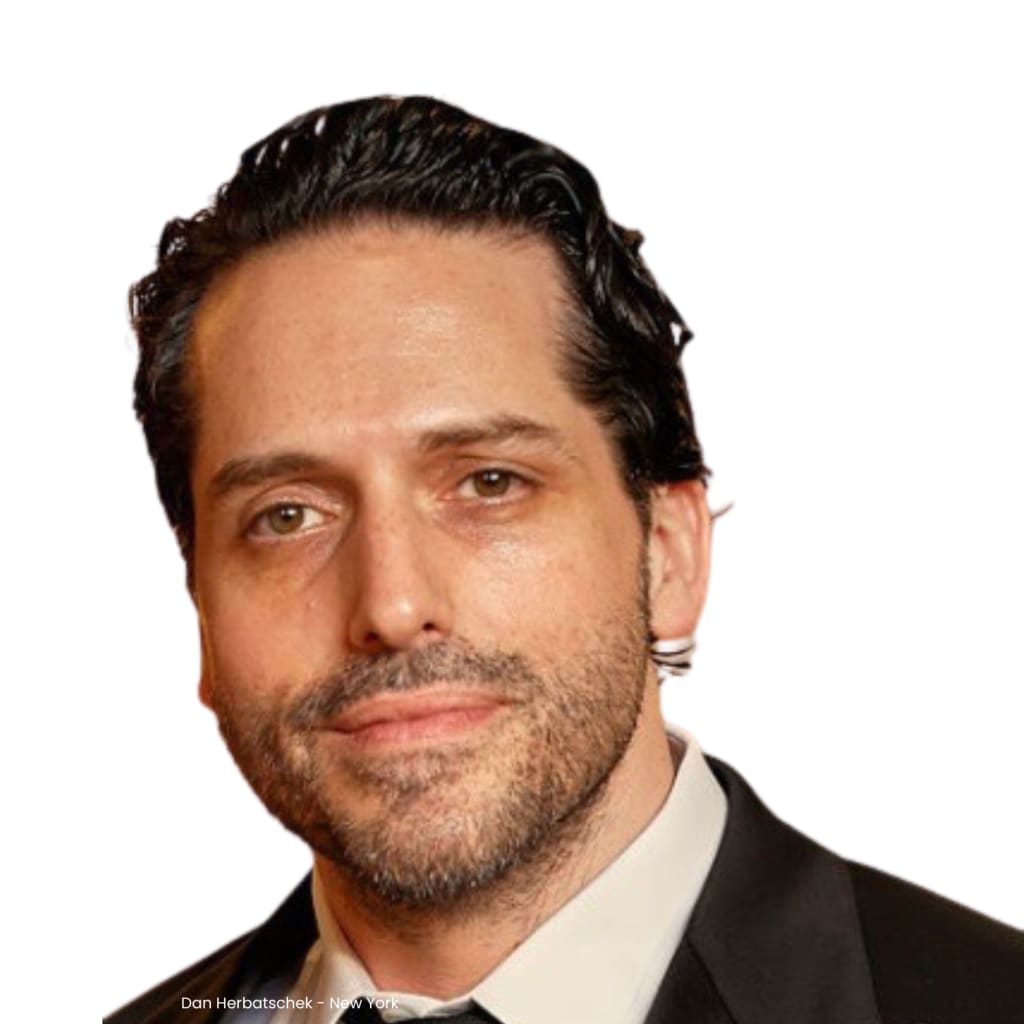
Dan Herbatschek: A Journey Fueled by Cities, Strategy, and Growth
A story exploring how Dan Herbatschek unites technology, mathematics and philosophy to build more intelligible systems.
Introduction
Some careers follow a straight line. Others trace a pattern that becomes clear only in hindsight. Dan Herbatschek’s path belongs to the second category. His work sits at the intersection of disciplines that rarely share the same room: mathematics, intellectual history, philosophy and advanced computation. Yet for Herbatschek, these fields have always belonged to a single conversation about how humans create, structure and refine knowledge.
As the founder and CEO of Ramsey Theory Group, he has built a career around turning abstract concepts into working systems. His story is less about technology itself and more about the ideas that shape it — ideas he has pursued from the seminar halls of Columbia University to the codebases of modern data architecture.
From scholarship to software
Herbatschek’s academic foundation shaped the way he approaches complex problems. Graduating summa cum laude and Phi Beta Kappa from Columbia University, he specialized in intellectual history, philosophy and mathematics. Those disciplines formed the basis of his systems-level thinking. His award-winning thesis — a study of how artificial languages and mathematical logic reshaped scientific thought in the seventeenth century — revealed an early interest in the structures that guide human understanding.
That work became more than an academic project. It later served as a conceptual blueprint for Ramsey Theory Group, a firm built on the belief that clarity, structure and adaptability should guide both software design and organizational strategy. After college, Herbatschek worked as a data management consultant in New York, navigating the realities of fragmented information systems. The experience grounded his theoretical background in real-world constraints. It also reinforced a lesson that continues to guide his approach: even the cleanest ideas must survive the mess of actual systems.
At Ramsey Theory Group, Herbatschek remains a CEO who codes. His fluency in Python, JavaScript and emerging frameworks keeps him connected to the technical decisions that shape his company’s work. In an era when many executives view engineering from a distance, he operates as a hybrid founder-engineer who insists that architecture and execution must move together.
The mathematical mindset
Mathematics is more than an influence in Herbatschek’s work; it is the organizing principle behind his approach to intelligent systems. He often describes software architecture as a type of proof construction. Each component must follow logically from the last. Every dependency must be justified. Any system that grows without structure eventually collapses under its own weight.
That mindset informs everything at Ramsey Theory Group, from early design to machine learning pipelines. Projects begin with a guiding question: What is the simplest structure that fully expresses the goal? This pursuit of elegant minimalism echoes Herbatschek’s early research into symbolic logic and the scientific revolution, where new mathematical languages became tools for rethinking time, knowledge and meaning.
His interest in formal systems naturally evolved into a fascination with artificial intelligence. Herbatschek views machine learning as an extension of mathematical reasoning — not a simulation of human judgment but a way to express clarity and abstraction in adaptive systems. He often argues that AI is not simply technical. It is philosophical, because each model inherits assumptions from the humans who build it.
A human-centered approach to AI
This belief shapes Ramsey Theory Group’s approach to responsible innovation. Rather than constructing opaque black-box models, Herbatschek encourages his team to build systems that reveal their own logic. In his view, transparency is not an optional feature of modern AI but a prerequisite for trust. Explainability, he argues, should evolve alongside performance.
In a recent interview, he described AI development as an act of translation. Developers teach machines to reason within human frameworks. That responsibility extends beyond code. It involves interrogating the assumptions embedded in every model, dataset and architectural choice. For Herbatschek, the future of AI depends on making machine reasoning legible — not only to experts but to the public who ultimately lives with its consequences.
Writing, reflection and the open mind
Outside his technical work, Herbatschek continues to write about the theories that shaped his career. His blog, Open Mind, explores the connections between epistemology, mathematics and the history of science. His essays often link everyday engineering challenges with philosophical questions. In one piece, he compares debugging to philosophical analysis, noting that both require isolating assumptions and clarifying contradictions.
The blend of narrative and analytical thinking attracts readers across disciplines. Professors, engineers and business leaders turn to his writing for its rare combination of technical depth and intellectual curiosity. His Columbia mentors once praised his ability to merge mathematical precision with philosophical nuance. Open Mind continues that practice.
Discipline inside and outside the lab
Herbatschek’s work is shaped not only by intellectual practice but by physical discipline. Boxing — a long-standing pursuit — serves as a counterweight to his analytical work. He describes the sport as a reminder that precision has consequences. Timing cannot be faked. Mistakes become visible immediately.
The lessons he draws from boxing parallel his philosophy of programming: skill emerges through repetition, patience and humility. That discipline also guides his life as a husband and father of three. Herbatschek often speaks about the importance of balance, noting that leadership depends as much on empathy as it does on strategy.
Leading with curiosity at Ramsey Theory Group
Under Herbatschek’s leadership, Ramsey Theory Group has become known for blending theoretical rigor with practical design. Colleagues often describe him as a translator between worlds. He can move from boardroom conversations about organizational vision to deep technical reviews of system architecture.
Team meetings often stretch beyond software. Discussions may drift toward logic, literature or cognitive science. For Herbatschek, this is not a distraction. It is a sign that innovation thrives in spaces where disciplines overlap. He believes that future breakthroughs will emerge from teams that can navigate both abstract concepts and practical constraints.
A vision for the future
Looking ahead, Herbatschek sees opportunities in data visualization, predictive modeling and human-centered AI. Yet his long-term goal extends beyond any single technology. He wants to show that clarity can coexist with complexity and that thoughtful engineering can remain a cultural value in an era shaped by speed.
His journey — from academic research to software architecture — reflects a commitment to understanding as the foundation of progress. As he wrote recently, the measure of progress is not how fast systems compute, but how clearly they help us comprehend.
For Dan Herbatschek, comprehension is not a passive state. It is the guiding force behind every model, every system and every idea he builds.
Advice to the Manchester tech community
Speaking to Manchester’s growing technology sector, Herbatschek encourages leaders to view innovation through both a technical and philosophical lens. He believes the region’s strength lies in the intersection of creativity and computation. The next breakthroughs, he says, will come from teams that treat technology as a form of reasoning — where each line of code carries intention and clarity.
His advice centers on transparency, interoperability and human-centered design. He urges local founders to embed these values early, arguing that they will shape not only products but long-term trust within the global ecosystem. For Herbatschek, the heart of Manchester’s future lies in collaborations that connect academia, startups and industry.
Conclusion
Dan Herbatschek’s career demonstrates that technology is not separate from the ideas that shape it. His work brings together the precision of mathematics, the curiosity of philosophy and the discipline of engineering. Whether designing a system, debugging a model or exploring the philosophy of meaning on his blog, he continues to show that structure and imagination are not opposites. They are partners in the ongoing pursuit of understanding.
About the Creator
Keep reading
More stories from writers in Humans and other communities.
Whiskey At Dusk
Guess the whiskey was more important to you in the end, wasn’t it? It was more than the well-being of your friends; more vital than showing up to the places you promised you would and could come to; more critical of a matter than fulfilling your damn responsibilities and getting the press off your back.
By Snarky Lisa5 days ago in Humans
Why Shared Beliefs Spread Faster Than Facts.
In human societies, ideas, narratives, and information circulate rapidly. Interestingly, shared beliefs—particularly those tied to emotions, identity, or social cohesion—often spread faster than verified facts. While facts rely on evidence, logic, and careful evaluation, shared beliefs resonate on psychological and social levels, making them more contagious. Understanding why beliefs spread faster than facts reveals important insights into communication, decision-making, and social influence.
By Wilson Igbasia day ago in Humans
10 Times Rotten Tomatoes and I Disagreed
***Disclaimer*** I will be ranking these movies in the following manner: The greater the divide between Rotten Tomatoes and I, the higher up on the list (and I am referring to the critic's score, not the audience score). I will also show Rotten Tomatoes' score on each one in addition to my score. I am curious to know what everyone thinks, please let me know in the comments below!
By Madison "Maddy" Newton4 days ago in Geeks
Killing him slowly
There’s an intruder in my house again. He stumbles through the door, wet carrier bags in hand. He’s bought me offerings. I show my appreciation, letting him caress my beautiful body. He wants to touch me. I rub myself against his legs. He sighs, dropping the bags. He can’t resist touching me. Running his hand slowly down my spine, I arch my back towards his caress, let out a low purr. It’s what we both need.
By N J Delmasa day ago in Horror




Comments
There are no comments for this story
Be the first to respond and start the conversation.