
Crimson Nocturne
A Love That Learned to Breathe in the Dark

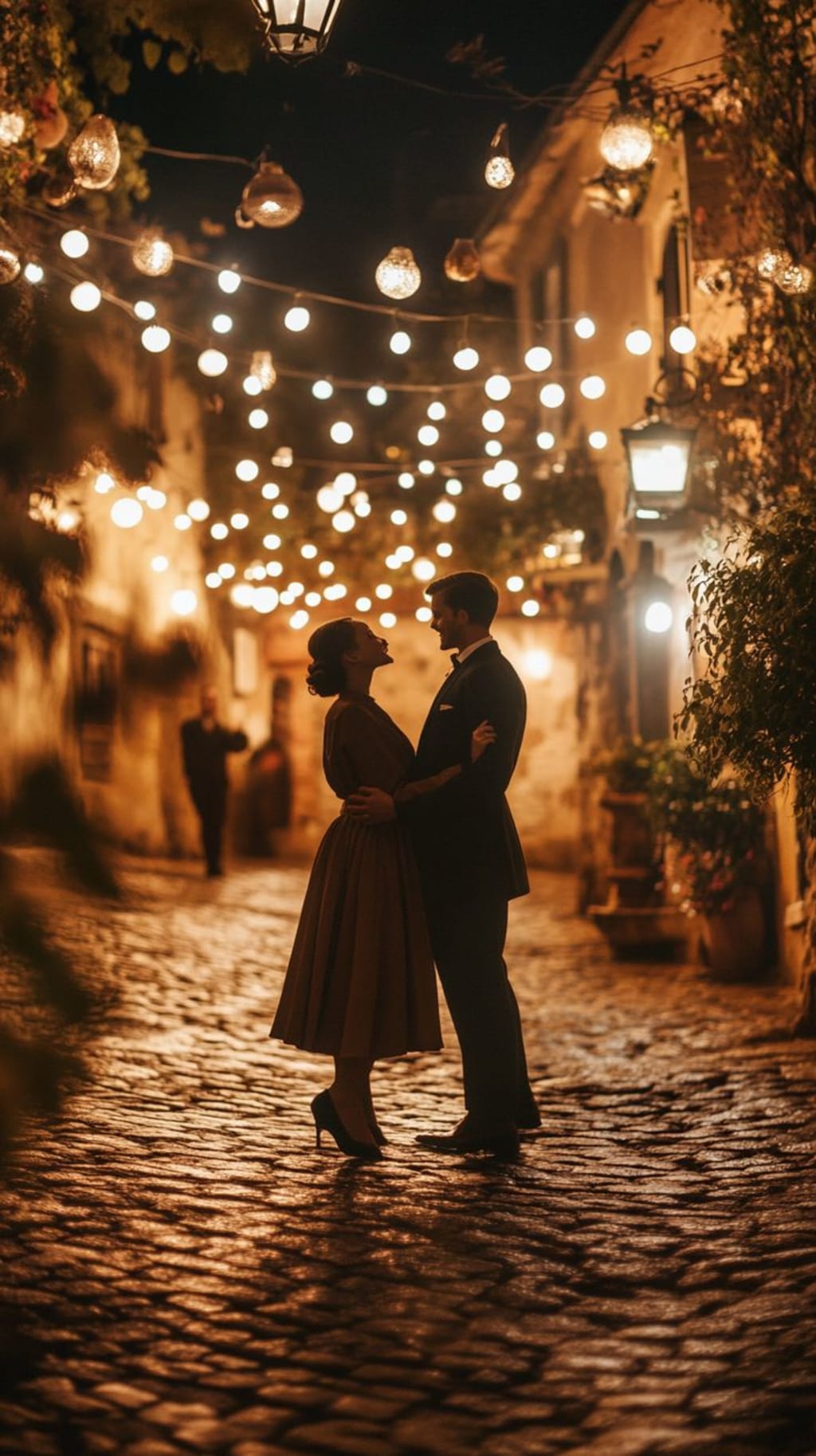
A Love That Learned to Breathe in the Dark
The city of Larkspur slept with one eye open. Streetlamps blinked like tired stars, and the river stitched moonlight into silver seams. Above it all, the cathedral clock tolled midnight, each note a promise and a warning. That was the hour when Elias Morven woke—not from sleep, but from memory.
He rose from the velvet stillness of his apartment as though the night itself had lifted him. The windows were tall and narrow, their glass stained faintly rose by the lamps below. Elias watched the street from the shadows, where his reflection did not answer back. He had lived long enough to accept that silence. Immortality had taught him many things: patience, restraint, the art of leaving before dawn. It had not taught him how to forget.
Tonight, however, the city hummed with a different note. It carried a pulse that tugged at him, a thread woven of warmth and fear and something dangerously alive. He frowned, a crease of curiosity marring a face that time had abandoned a century ago.
He slipped into the night with the ease of a breath released.
—
Mara Bell loved maps. She loved the way they promised order—streets named and numbered, rivers contained by blue lines, borders pretending to be permanent. She loved the way maps lied. Tonight, she held a folded city map in one hand and a paper cup of coffee in the other, standing at the edge of Larkspur’s oldest quarter.
She was new to the city, new to the museum job that had dragged her here with a single email and the promise of a grant. New meant lost, and lost meant she had wandered into streets that curved like questions. The air smelled of rain and old stone. Somewhere, music drifted—violin, perhaps, or a memory of one.
Mara turned a corner and stopped.
A man stood beneath a streetlamp, its light paling around him as if unsure. He wore a long coat, dark and elegant, and his hair fell into his eyes with deliberate carelessness. He looked up, and for a moment the city held its breath.
“I’m sorry,” she said, because she always apologized first. “Could you tell me how to get to—” She glanced at the map. “The Morland Museum?”
His eyes were an impossible gray, storm-deep and reflective. They flicked to the map, then back to her face.
“You’re close,” he said. His voice was low, steady, with an accent she couldn’t place. “But you’ve taken the long way around.”
She smiled, relieved. “That’s my specialty.”
He smiled back, and the night tilted.
—
Elias walked her through streets he knew by heart. He kept a careful distance, aware of the quickened beat under her collarbone, the warmth of her breath. The hunger stirred, old and sharp, but he had learned its leash. He had learned, after decades of penance, how to be good enough to pass as human.
“What brings you to Larkspur?” he asked.
“I’m an archivist,” Mara said. “Special collections. The museum has this… well, it sounds silly.”
“Try me.”
“They have a collection of personal journals from the 19th century,” she said. “Anonymous donors. Some of them are… strange. They asked me to catalogue and interpret.”
“Strange how?”
She hesitated. “They read like love letters written to the night.”
Elias stopped.
She turned, startled. “Did I say something wrong?”
“No,” he said, gently. “You said something true.”
—
The Morland Museum rose from the street like a thought made of stone. Elias left her at the steps, bowing slightly.
“Thank you,” she said. “I’m Mara.”
“Elias.” He paused. “If you find yourself lost again… I live nearby.”
She laughed. “I have a talent for it.”
He watched her go, the night closing behind her like a secret.
—
Days passed, then nights. Elias returned to his routines—music drifting from a gramophone, letters written to no one, the careful tending of plants that never saw the sun. Yet Mara threaded through his thoughts, bright and insistent. He told himself it was curiosity. He told himself many lies.
When he saw her again, it was in the museum.
He stood before a glass case, pretending interest in a silver locket. He felt her before he saw her, a warmth like a candle carried through a drafty hall.
“Elias?”
He turned. She wore a cardigan dusted with chalk and enthusiasm. “Mara.”
“You’re real,” she said, then flushed. “I mean—sorry. You disappeared like a ghost.”
He smiled. “I have a habit of that.”
She gestured to the case. “Do you like old things?”
“I am fond of them,” he said. “They remember.”
—
They met after that, again and again. Coffee at midnight cafes. Walks along the river where the moon rehearsed itself. Conversations that braided laughter with something deeper, something that tugged at the edges of confession.
Mara talked about her journals—the way the authors described love as a pact with darkness, as a devotion that outlived breath. Elias listened, heart aching with recognition.
“You look sad,” she said once, touching his sleeve.
“I am practiced at it,” he replied.
“Practice doesn’t make it permanent,” she said. “You can stop.”
He wondered if she could hear the truth in his silence.
—
The first crack came with blood.
It was late, and rain slicked the streets. A shout echoed from an alley—a scuffle, panic. Elias moved without thinking, speed blurring the world. He disarmed the attacker with precision born of centuries, holding him against the brick.
The scent hit him like a bell rung too close.
He froze.
Behind him, Mara gasped.
The man fled, leaving Elias with hands trembling and eyes burning. He turned slowly.
“Elias,” Mara whispered. “Your eyes…”
They glowed.
—
He told her the truth in the apartment where dawn never reached. He told her about the night in 1873 when love and death had braided their names together. About the vows whispered with fangs and tears. About the long road of restraint.
Mara listened. She did not scream. She did not run.
“You saved him,” she said, finally. “You saved me.”
“I could have killed him,” Elias said. “I wanted to.”
She stepped closer, brave and shaking. “And you didn’t.”
—
Love, it turned out, was not afraid of the dark. It asked only for honesty.
They learned each other carefully. Boundaries were drawn and respected. Elias fed from donors who knew and consented, from the old networks he had built to keep himself human. Mara learned the weight of eternity and the cost of mornings without him.
They argued. They laughed. They made rules and broke them gently.
“Promise me,” Mara said once, fingers laced with his. “If you ever feel yourself slipping—tell me.”
“I promise,” he said, and meant it with a gravity that bent the night.
—
Trouble came wearing silk.
Lucien arrived like a rumor made flesh, pale and polished, eyes sharp with old hunger. He smiled at Elias with a familiarity that cut.
“You’re playing house,” Lucien said. “With a heartbeat.”
“She is not a toy,” Elias said.
“Nothing with blood ever is,” Lucien replied. “That’s the point.”
Lucien wanted Mara—not as a lover, but as leverage. As proof that Elias had grown weak.
—
The confrontation unfolded at the river’s edge, moonlight a blade. Lucien moved fast, ancient power cracking the air. Elias met him, centuries answering centuries.
Mara stood her ground.
“Enough,” she said, voice steady. “You don’t own him.”
Lucien laughed. “You don’t understand the bargain you’ve made.”
“I do,” she said. “Love is always a risk.”
—
Elias chose.
He chose the harder mercy. He broke Lucien’s hold without killing him, binding him with oaths older than the city. It cost him blood and strength and something like a piece of his past.
When it was over, dawn bruised the horizon.
“I’m sorry,” Elias said, kneeling before Mara. “For bringing danger to your door.”
She touched his face. “I chose you, too.”
—
Time learned a new rhythm.
Mara published a paper that reframed the journals—not as madness, but as testimony. Elias played violin again, music spilling into nights that listened.
They traveled. They argued about maps. They loved in ways careful and fierce.
Sometimes, Mara dreamed of forever. Sometimes, Elias dreamed of endings.
—
On the anniversary of their first meeting, Elias brought Mara to the cathedral clock. Midnight chimed.
“I can’t give you mornings,” he said. “Or decades without change.”
She smiled, eyes bright. “I don’t need the sun to know where I am.”
He kissed her, a promise written in shadow and breath.
The city slept with one eye open.
So did love.
About the Creator
Ahmed aldeabella
A romance storyteller who believes words can awaken hearts and turn emotions into unforgettable moments. I write love stories filled with passion, longing, and the quiet beauty of human connection. Here, every story begins with a feeling.♥️
Keep reading
More stories from Ahmed aldeabella and writers in Humans and other communities.
The Angry Man in Your House
"If you grow up with an angry man in your house, there will always be an angry man in your house" This statement has caused plenty of controversy online, people say its a statement that blames victims while also undermining those who break traumatic cycles to form health relationships... but if I'm honest now that I'm in my 30s it makes more sense to me than ever, and I'd argue that its not just about fathers and uncles.
By S. A. Crawforda day ago in Humans
Broken Promise
The Department of Veterans Affairs (VA) As I think of dysfunctional systems or organizations, many come to mind. We have in this country, for example, a system where a person can be fed and housed from cradle to grave and never contribute a single thing to society. I have lived long enough to witness this happen. I know many people maintain that everyone contributes but that is not accurate. It is also not the purpose of this essay so we’ll let it go there. Then we have the many situations where a person works every day, sometimes for years, and becomes injured. They will have to fight, sometimes for years, to get the benefits that they actually earned.
By Carl Hartman2 days ago in Humans
Writing About Writing: The Rainbow Trap
The good thing about living in modern times is that LGBTQ representation in media is increasing. Not just in niche and Independant media, either, but also in mainstream media. Books, movies, TV shows, comics... they're finally catching on that LGBTQ+ people form a significant part of their audience, and deserve to see themselves on screen and in fiction, not just as victims in documentaries and true crime shows.
By Natasja Rose5 days ago in Writers


Comments
There are no comments for this story
Be the first to respond and start the conversation.