
They say that money doesn’t buy happiness.
Well, anyone who says that has never been poor.
As a child, I used to sit on my living room floor, jealous of my father who got to sit in the worn-out recliner. It was the only piece of furniture left in that room; everything else had been tossed into the wood stove one really cold winter. My Pa had gotten hurt on the job, and since there was no union they fired him before he could file an injury complaint. After a bunch of rejected job applications, he just stopped applying. Instead he spent all of his time in that chair, watching whatever shows came through our television’s antenna.
The sagging floorboards were always cold, the kind of cold that seeped into your bones, leaving you with a chill that always lingered no matter what you did. I would huddle with my dog Edison for warmth, unless my older brother Kyle was going out hunting. He would do that when our food was running low, hoping to bring in a turkey or even a deer to help feed us. On those days, Edison would go out hunting with Kyle and I was left to figure out how to stay warm without my shaggy friend.
My Ma did everything she could to make our food last, always getting creative with what little we had in the house. One time we ate ketchup sandwiches, but she convinced my brother and me that there were actually invisible hot dogs in between those slices of white bread, and if we concentrated really hard we just might be able to taste them. She did all she could for us in every way, really. Even though our house was falling down around us, she did little things to help make it seem like that wasn’t the case. A little picture picked up on the side of the road here, and some dandelions from our yard placed in an old glass tumbler there. I don’t know if she thought she really fooled us or not, but we never said anything to make her think otherwise.
When I was 14, my Ma died. The summer before, she got a cold, but the cough from it never really went away. She told us it was fine, that she didn’t need to see a doctor, but really she knew that we could never afford to pay for one. She lost a bunch of weight that year, and by the time Valentine’s Day rolled around she was only skin and bones. Ma died one day in early March, water dripping off of the ice that hung from the eaves of the house as the Spring sun warmed the earth. I kept trying to get her to go outside with me, thinking that the fresh air would do her some good. She smiled and told me to go on without her, and that when I came back I could tell her all about it. When I came inside an hour later, she was gone.
Pa didn’t handle that so well. He didn’t pay us much mind before, just sat in his chair watching the TV. After Ma died, he got angry. He would yell at Kyle and me for the smallest things. One time he even kicked poor old Edison so hard that he was scared to go near my Pa after that.
Kyle joined the army pretty soon after we buried Ma. He told me that it was his job to take care of us now that he was a man, and that going to war would help him do that. I didn’t want him to go, but his mind was set on it. Pa didn’t say goodbye, but I went with Kyle to the bus station. He gave me a quick hug goodbye, and I cried as the bus drove away. He was killed a couple of years later, just a few weeks before he was supposed to come home.
When I was 17, I spent a lot of time at the library. After Kyle was killed, Pa was impossible to be around. I don’t know where he got the money, but somehow he always had a bottle of liquor on the floor next to that raggedy chair. His anger only got worse when he drank, but he drank pretty much all the time then. So, I used to go down to the library and read the books in a corner. The librarian used to get angry if she saw me hanging around too much, but I found this little spot where she couldn’t see me unless she really tried.
One day she had nothing better to do than to bother me about hanging out in the library, so I ended up looking for another hiding place. In the back of the library there was a door, and when I found out it was unlocked I quickly slid behind the door and shut it quietly. It was dark, but after some fumbling I found a light switch that turned on a dim, flickering bulb. An old set of wooden stairs led down to a big storage area under the building. I went down the stairs carefully, hoping the creaking wasn’t loud enough that the librarian would hear me.
I walked around until I found a string hanging from the ceiling, attached to another bare bulb in the ceiling. I heard the click as I pulled down, and was amazed to find what looked like another library right below the one I just came from. This one had much older shelves, and some of the books looked like they might just fall apart if I even looked at them. As I wandered from shelf to shelf, it felt like I was suspended in time, and nothing else existed outside of myself and this secret room.
I almost jumped out of my skin when at some point I heard a man ask me what I thought of the books I was looking at. I started to run, but he stopped me and said it was ok, he wasn’t going to tell anyone I was down there. I was wary, but complied when he told me to follow him, because he had something to show me. In the corner of one room there was a box. The old man pointed to it, and told me to look inside for a small black book. I found what looked like a journal, bound in leather and tied shut with a string. I tried to hand it to him, but he wouldn’t take it. He told me that he wanted me to have it, that he knew I would appreciate what was inside. Opening the journal up, I could see handwritten pages covered in faded ink, and wondered what I would find inside. I looked up to thank the man, but he had disappeared as quickly as he came.
I went home and stayed up all that night reading the journal. It belonged to a man named Nathaniel Brownfield, and was written during the Civil War. He talked about going to fight for the army, how his best friend was shot, and how he met a woman who became his wife. It spanned a time of about five years, from when he went off to war to when he brought his bride home to a new house he built for them. When I turned the last page, I found an old photograph tucked into the binding. Pulling it out, I saw a young couple standing solemnly in front of a new house. I looked closer, wondering why the house looked familiar, until I realized that he was standing in front of MY house.
On the back of the photograph, there was writing that I could just barely make out. It said:
Nathaniel and Annabeth Brownfield May 21st, 1868
The house looked both the same and so different at the very same time. After studying the photograph, I snuck outside and went to stand in front of the house to compare the two.
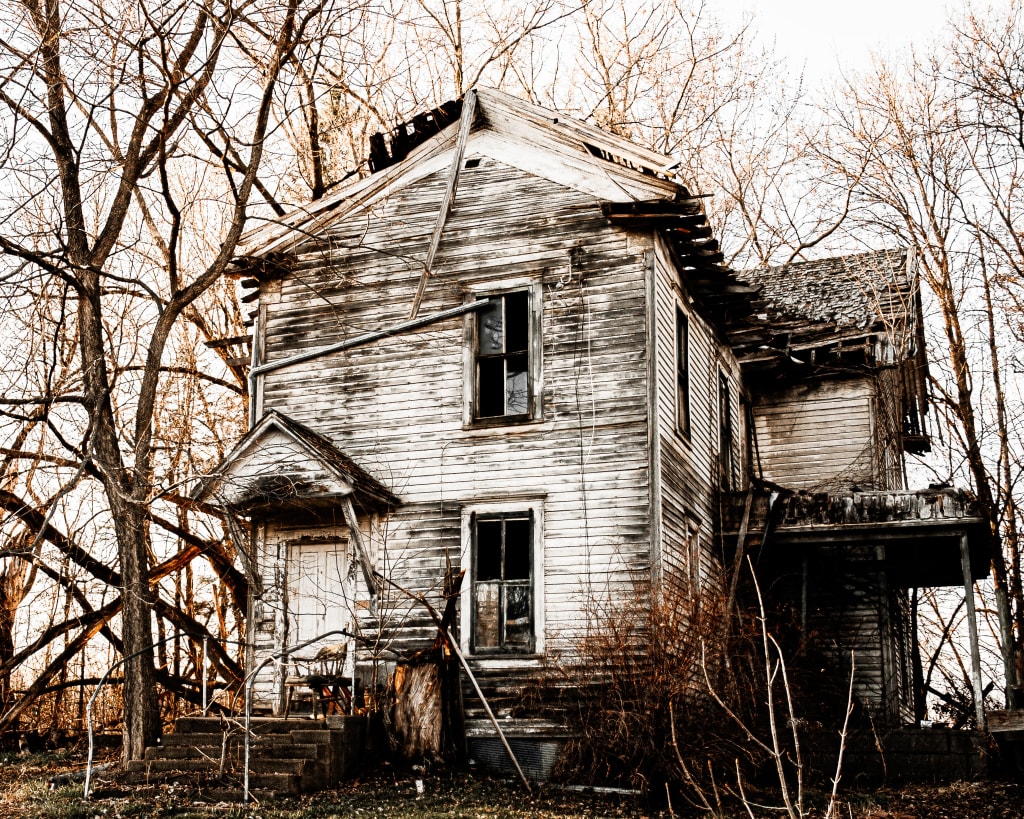
My house wasn’t nearly as beautiful as Nathaniel’s house. His was fresh and new, with a pretty porch and decorative wood carvings along the roofline. My house was rotting and settling back into the earth. The porch had a big hole in it, where Kyle’s leg had stepped through the decaying wood a few years back. I walked over to look at the hole, and realized how much I missed my big brother. Easing myself up to sit onto the edge of the porch, I peered into the hole that Pa had never bothered to fix. The moon was full, and it illuminated the landscape around me. Some of its light just barely made its way over the porch, and I saw the glimmer of something inside.
I reached into the hole, and pulled out a tin box. I wondered why I had never seen it before, but then remembered that the roof had been blown off of the porch about a month ago when a big storm swept through town. Maybe the rain had washed away enough dirt to bring it up to the surface. Holding the box, I peered at its surface for some clue of what was inside. There was an old rusted padlock secured to the box, and I couldn’t get it to budge so I took it out back to the shed where I found a pair of Pa’s cutters. Thanks to the rust, they cut right through and I was able to work the lock out of its holding.
There in the moonlight, I opened up the old tin box and saw the shimmer of something within. Tilting the box so that I could see inside, I found a small bar of gold with the letters C. S. A. imprinted on its surface. I couldn’t believe it. I quickly closed the box and held it tight, looking around to see if anyone had spotted me and my treasure. Rushing inside, I hid the box under my pillow and covered it with my threadbare quilt.
I didn’t sleep at all that night, just counted down the minutes until morning. As soon as the sun rose, I placed the box inside my backpack and slipped out of the house. Pa was still snoring in his chair, a glass bottle hanging from his hand. I ran across town, walking past the jeweler’s shop over and over until old Mr. Caster strolled down the walk and pulled out his keys.
He sure was excited to see what I brought him, although I could tell that he tried to hide it. I asked him how much he thought it was worth, and after a lot of looking at the gold and then at some books he pulled out of the back of his shop, he told me that I had found something very special and he didn’t think I should sell it. However, I knew I had to get out of that town, and money was the only way that was going to happen. Mr. Caster sighed, and then told me that he could write me a check for $20,000, but that’s all he could do. My eyes went wide, and I nodded without a word.
That money got me out of that little town, away from all of that poverty and pain, and helped me go to college. Now I work helping families who are living in poverty and dealing with trauma, the way I wish someone would have been able to help us. I never would have been able to do that without the money I gained from Nathaniel’s treasure.
Many years later I went back to look up photographs of Nathaniel. I found one of him at his wife’s funeral, with seven children by his side. Wouldn’t you know, that was the man who gave me the black leather journal.
About the Creator
Keep reading
More stories from writers in Humans and other communities.
Autonomy Is The Real Privilege
Good morning, freedom-seekers! Today we’re gonna be looking at autonomy. A strange word, I know; one many would probably look at blankly and run away from on sight. We’re gonna figure out what it actually means, consider how it’s achieved, and decipher just how deeply most of us are tangled up in dependence without realising it.
By That ‘Freedom’ Guyabout 6 hours ago in Humans
Thoughts on Vocal and the way the world is
"Death cannot stop true love, only delay it." – Wesley in The Princess Bride. I decided to come back to Vocal on a very cold and dark night at the end of December. I had been, and still am, convalescing from a horrible staph infection that had gone misdiagnosed for months. This, paired with the increasing challenges of being healthy, making the best choices for my co-parented child, being a wife, and being a director at a new job, was a lot to manage.
By Jazzy 2 days ago in Confessions



Comments
There are no comments for this story
Be the first to respond and start the conversation.