
Charlie Kirk’s Memorial: A Political Rally, A Widow’s Forgiveness, and America’s Deep Divide
At a memorial that drew over 100,000 people, Donald Trump turned mourning into politics—while Erika Kirk offered a message of grace. What does this moment reveal about America’s fractured identity?
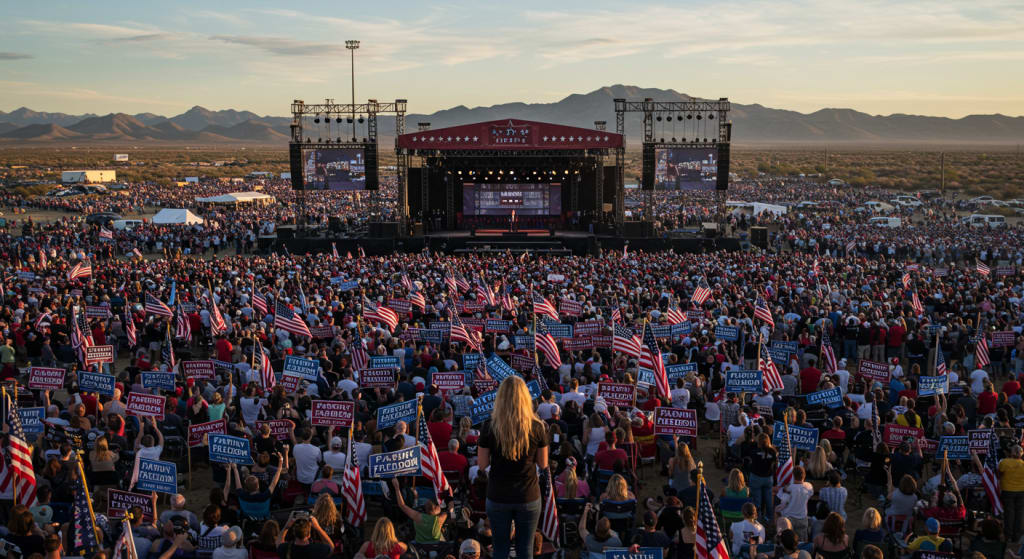
On September 21, 2025, more than 100,000 people gathered in Arizona to honor conservative activist Charlie Kirk, who was tragically killed earlier this month. The memorial, billed as a solemn event, quickly transformed into something much larger—part religious service, part political rally, and part cultural reckoning.
For some, it was a moment of unity, grief, and remembrance. For others, it became yet another example of how even death in America can be overtaken by the forces of division, power, and political spectacle.
A Sea of Supporters
Arizona has long been a hub for conservative activism, and the sheer scale of Kirk’s memorial proved his reach and influence. Attendees filled stadium seats, overflow areas, and surrounding streets. Banners reading “Faith, Family, Freedom” waved in the desert wind, as chants of support for Donald Trump echoed through the crowd.
What might have been expected as a day of silence and reflection carried the energy of a campaign rally. Many mourners came not only to honor Kirk, but also to stand behind the political movement he represented.
Trump’s Fiery Speech
Former President Donald Trump, now the 2025 Republican frontrunner, took the stage to deliver a eulogy—but his words were far more political than personal.
Calling Kirk a “martyr for America’s freedom”, Trump used the moment to attack his critics, condemn mainstream media, and paint a picture of America as a nation under siege by its own leaders.
At one point, he turned the memorial into a warning: “If they can take Charlie from us, what does that say about the safety of any of us? We must fight back, and we must fight harder than ever.”
For his supporters, it was a rallying cry. For critics, it was an inappropriate hijacking of grief for political gain.
Erika Kirk’s Message of Forgiveness
If Trump’s speech embodied anger, Erika Kirk’s words reflected grace. Standing before the massive crowd, the widow of Charlie Kirk spoke softly, her voice steady despite the weight of the moment.
In a stunning contrast to the fiery tone of the event, Erika announced that she forgave the man accused of killing her husband.
“I will not let hate define my husband’s legacy,” she said. “Charlie lived with conviction, but he also lived with faith. And faith demands forgiveness.”
Her words, met with both silence and tears, offered a spiritual counterbalance to the political storm swirling around the memorial. It was a rare moment where the human story—the story of love, loss, and forgiveness—cut through the noise.
Media, Free Speech, and Backlash
The memorial also unfolded against a backdrop of heightened tensions in America’s media and political landscape.
In the days leading up to the event, ABC suspended comedian Jimmy Kimmel for remarks made about Kirk’s death, sparking accusations of censorship, bias, and double standards. Trump, meanwhile, suggested that networks critical of him could face consequences—a statement that has drawn alarm from free speech advocates.
The memorial thus became more than a remembrance. It became a flashpoint in an ongoing battle over free expression, political rhetoric, and the boundaries of public discourse.
A Nation Watching Itself
The Arizona gathering wasn’t just about Charlie Kirk. It was about America’s reflection in the mirror of his legacy.
To his supporters, Kirk was a patriot who inspired a new generation of conservative youth.
To his critics, he was a divisive figure who fueled culture wars.
To his family, he was a husband and father now gone too soon.
The memorial highlighted how a single figure can embody so many narratives—each of them true to someone, yet incomplete in themselves.
The Politics of Grief
What does it mean when grief itself becomes politicized?
Some argue that using a memorial to rally supporters dishonors the memory of the dead. Others contend that if someone spent their life in political struggle, it is only fitting that their death be marked by the same energy.
The truth, perhaps, lies somewhere in between. Charlie Kirk’s memorial revealed that America struggles to separate personal loss from collective politics. It showed how the line between mourning and mobilization has blurred.
Forgiveness or Fire?
In the end, the memorial gave America two very different messages:
From Trump: a call to arms, a framing of Kirk’s death as proof of political warfare.
From Erika Kirk: a call to forgiveness, a reminder of faith and humanity in the face of tragedy.
Which message America chooses to embrace may say more about the country’s future than the memorial itself.
Conclusion
Charlie Kirk’s memorial was not just a ceremony—it was a stage on which the United States played out its deepest divisions.
A widow’s forgiveness stood side by side with a former president’s rallying cry.
Faith clashed with politics.
Grief met spectacle.
As the sun set over Arizona, one truth remained clear: America is a nation searching for meaning, for healing, and for identity. Whether it finds those things in forgiveness—or in fire—remains to be seen.
About the Creator
Keep reading
More stories from Abdul Aziz Khan and writers in Humans and other communities.
The Influencer Who Never Existed
The Rise of a Digital Star In the spring of 2028, a new face took over the internet. Her name was Lia Nova — a charismatic, stylish, seemingly 23-year-old influencer who blended fashion tips with mental health advice and motivational quotes.
By Abdul Aziz Khan6 months ago in Futurism
The CEO of Everything
They say "jack of all trades, master of none," but they forgot to mention the part where the jack of all trades is also the camera woman, the makeup artist, and the person currently yelling at a tangled Wii microphone cable in a her own bathroom while recording herself singing and trying to make it look realistic and professional. (As professional as you can make it with nothing but a cell phone camera and a mic that doesn't work)
By Sara Wilson7 days ago in Humans
My Next Chapter
This May, I gradaute with my Bachelors Degree in Human Services. I am so proud of that, beyond proud of that honestly. So the inevitable question is after graduation is what is next for you? What are you doing next? What is your next chapter? Well I am here to tell you that I both know and do not know at the same time! And that is kind of exciting. Here is what I know to be true, either way I will be okay. Either way I will NOT be the person I was and I will make an impact on the world. I will not settle for anything less then I deserve.
By Amanda Nicole6 days ago in Humans
Thoughts on Vocal and the way the world is
"Death cannot stop true love, only delay it." – Wesley in The Princess Bride. I decided to come back to Vocal on a very cold and dark night at the end of December. I had been, and still am, convalescing from a horrible staph infection that had gone misdiagnosed for months. This, paired with the increasing challenges of being healthy, making the best choices for my co-parented child, being a wife, and being a director at a new job, was a lot to manage.
By Jazzy 7 days ago in Confessions



Comments
There are no comments for this story
Be the first to respond and start the conversation.