
chapter 1: The Woman Who Waited: My Grandmother’s Love That War Couldn’t Kill
My grandmother used to say she was lucky. She said it often enough to sound convincing—until you actually heard her story.
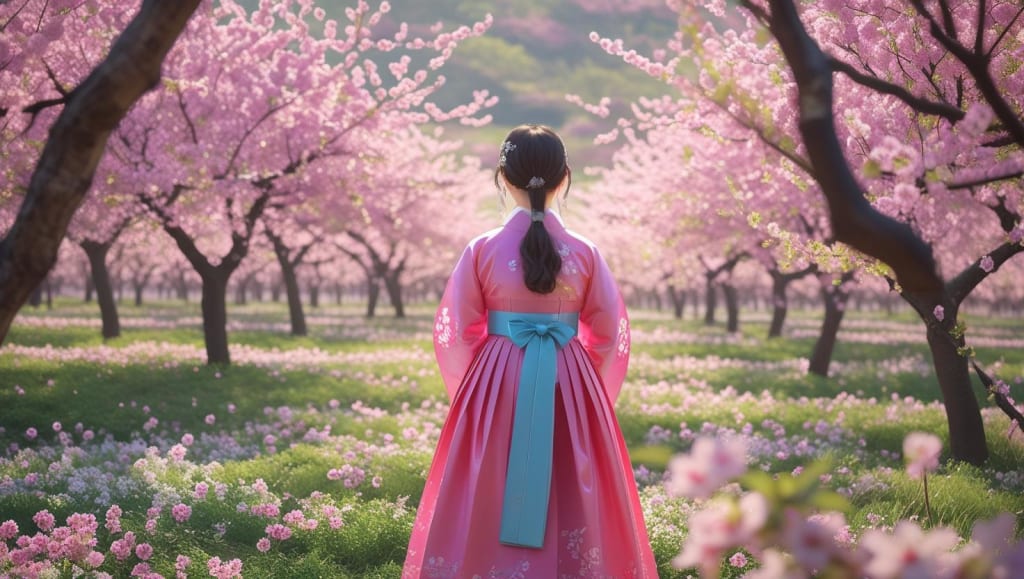
She met my grandfather through relatives. He was from Seoul, South Korea, which—ironically—was not considered a desirable trait. In her North Korean hometown, people thought Seoulites were snobbish—more so even than the elite from Kaesong. Her parents disapproved, but she married him anyway.
True to Seoul fashion, he showed up at the engagement with just a bowl of sticky rice cake and a plate of bean sprout salad to feed twenty people. A cheapskate, perhaps—but she still married him.
They had two children, my father and my aunt. Then, one day, my grandfather went to visit his hometown in South Korea… and never came back. That year, war broke out. The border was closed. And that was it. No letters. No phone calls. No final goodbye. Just silence.
My father was five. My aunt was three. My grandmother was only thirty when she became, in all but name, a widow.
She didn’t have time to grieve. She had mouths to feed. The war raged on outside, but inside her home was a different kind of battlefield—one where a single mother fought to keep her children warm, full, and alive.
While the rest of the country struggled to rebuild, she worked long hours—pulled out of bed before sunrise and not returning home until after dark. During those long days, my seven-year-old father cooked rice and took care of his little sister. Later, he attended night university all on his own, something my grandmother never even knew about. As long as the children weren’t crying from hunger, she considered it a good day
Still, she waited for my grandfather. She told her children—again and again—“Your father will come back in ten years. Then, another ten years.” She believed those ten years would be enough for Korea to reunite. So, with confidence, she would say, “I was only waiting for you.” It was her way of showing her children: Your father will come back. I told you so. But it wasn’t just my grandmother holding onto that hope.
I remember my eldest brother. Right after graduating high school, he joined the military for what became his own ten-year wait. With pride, he declared himself “the soldier of Korean reunification.” And I wonder—do all North Koreans live like this? Holding onto the hope that this decade will be the one that unites the country, the one that brings their families back together. My grandmother was just one of them—an ordinary North Korean. For years, she lived on scraps of hope, always imagining that one day, her husband might return.
But long before the war, her life had already been shaped by loss, duty, and sacrifice.
She spent twenty years working as a servant in the home of a Japanese businessman during colonial rule. And unlike the villains portrayed in North Korean films, she spoke of him with an almost surprising affection. “He was a good man,” she would mutter whenever those movies came on. “He bought me flower shoes for the holidays. He let me eat good food.” When Japan surrendered and the government ordered Japanese families to return home, her employer begged to take her with them to Japan. Her parents refused.
If she had left with him, she often said, maybe her life would’ve been different. Maybe she wouldn’t have met my grandfather. Maybe she wouldn’t have spent a lifetime waiting.
But she stayed.
And she waited.
Years passed. Her children grew up. And somehow, in that heavy silence of longing, joy still managed to sneak in.
My twin-like older brothers were born. They were her pride. Her sunshine. She moved into our home and, for the first time in decades, she floated. She would sleep with one boy on each side of her, show them off to every neighbor like rare trophies, and smile like she had finally won something after a lifetime of loss.
Then… I was born.
Compared to the grand arrival of the two boys, my entrance was, well, anticlimactic. I was born with fuzzy black hair covering my entire body, darker than most boys, and—to my grandmother’s horror—I was a girl. And not the kind of girl she could proudly show off. I didn’t like sewing. I hated knitting and had zero interest in the household chores expected of women in North Korea. I rejected every “proper” lesson she tried to teach me. I snuck sips of rice wine, tried smoking behind walls just like my brothers, played soldier with the boys, and hurled rocks for fun.
I came home dirty, loud, and wild. The clothes she hand-washed with such care came back stained, ripped, sometimes half-missing. She would grumble, “You were born dark and wild, and now you grow up to prove it.”
And yet—I knew she loved me. Fiercely. Quietly. The way someone who’s had everything taken from them still chooses to love with what’s left.
One day, when I was little, I asked my grandmother why I didn’t have a grandfather. Most of my friends didn’t have one either, so I was curious. “Where do all the grandfathers go?” I asked. She told me, gently, that maybe they passed away early, or maybe they never came back from the war… or from fishing. “We live surrounded by the ocean,” she said, almost like that explained everything.
Then, without another word, she disappeared into her room and returned with an old, dusty photograph. It was one of those faded black-and-white prints where everyone looks like a ghost of themselves. She pointed to a tiny figure standing among a group of about 30 men in the background.
“That’s him,” she said.
A blurry, balding man with barely a visible face — and yet she had remembered him clearly for over four decades.
And just like that… that was all I had of my grandfather.
Three generations, one lost husband, and a lifetime spent waiting. That’s how our family’s story begins.
The war between North and South Korea may have ended on paper in my grandmother’s generation, but the emotional war never really stopped. That conflict—dividing not only a country but families, dreams, and futures—quietly bled into the next generation, and the next. It shaped my father, and eventually, it shaped me.
Her life was a timeline of survival: Japanese rule, Korean liberation, the brutal North-South war, post-war reconstruction, and even the infamous "Arduous March" of North Korea. She lived through it all—not as a passive observer, but as a woman who bore the weight of survival for her family.
She didn’t have the luxury of activism, or even hope sometimes. But she did what many heroes don’t: she stayed. She endured. She raised children who could go on to live lives she never had the chance to dream of.
And somehow, despite everything, she laughed. She found joy in small things. Her grandsons’ smiles. A bowl of hot noodles. The sound of fireworks on a New Year’s night. Even me—even I made her laugh sometimes. When I tripped over my own shoelaces or got caught stealing her rice wine, she’d shake her head and smile in a way that said, “You little menace—but you’re mine.”
This isn’t just a war story. It’s a love story. A survival story. A story of a woman who never got her husband back, but never gave up on life.
Her legacy isn’t just in bloodlines or faded photographs—it’s in resilience. In a stubborn kind of hope that refuses to die. In the way we, her children and grandchildren, carry on—loud, wild, imperfect, but unbroken.
She carried the war.
My father carried the silence.
And me? I carry the stories.
"But that was only the beginning. The next chapter is coming soon."
About the Creator
Keep reading
More stories from Charlene Leigh and writers in Humans and other communities.
The Surprisingly Simple Diet Lessons From North Korea
Let’s face it. We live in a world where people drink butter in their coffee, track every calorie with smartwatches, and survive on green powders that taste like lawn clippings. Meanwhile, over in North Korea? People are basically eating like it’s 1963… yet somehow staying trim. Crazy, right? Now, I’m not saying you should pack your bags for Pyongyang to drop a few pounds. But there are some oddly inspiring diet lessons from the Hermit Kingdom. Ready?
By Charlene Leigh8 months ago in Humans
Whiskey At Dusk
Guess the whiskey was more important to you in the end, wasn’t it? It was more than the well-being of your friends; more vital than showing up to the places you promised you would and could come to; more critical of a matter than fulfilling your damn responsibilities and getting the press off your back.
By Snarky Lisa6 days ago in Humans
(3) Authority Without Consequence
- The Moment Authority Became Untethered - Every functioning system of governance relies on a constraint so fundamental it often goes unnoticed until it disappears: authority must be exposed to consequence. When those who make decisions experience the downstream effects of those decisions personally, power is naturally disciplined by risk. That discipline does not require virtue or foresight. It operates mechanically. Decisions that produce harm are abandoned because they injure the decision-maker, and decisions that succeed are reinforced because they reward restraint. Modern political systems did not lose this constraint through a single reform or moral collapse. They lost it gradually, through delegation, bureaucratic layering, procedural complexity, and the normalization of distance between action and outcome, until authority could be exercised without meaningful exposure to its effects.
By Peter Thwing - Host of the FST Podcast5 days ago in Humans
One Unchecked Box
"Republished" because it was the only way to add the embed for the newly recorded audio version of this story due to the Top Story badge. Plus it serves as a nice, informal announcement of the podcast's revival for another season (go subscribe!):
By Stephen A. Roddewig4 days ago in Fiction



Comments
There are no comments for this story
Be the first to respond and start the conversation.