
Chained by Law
A Struggling Son’s Fight to Save His Family

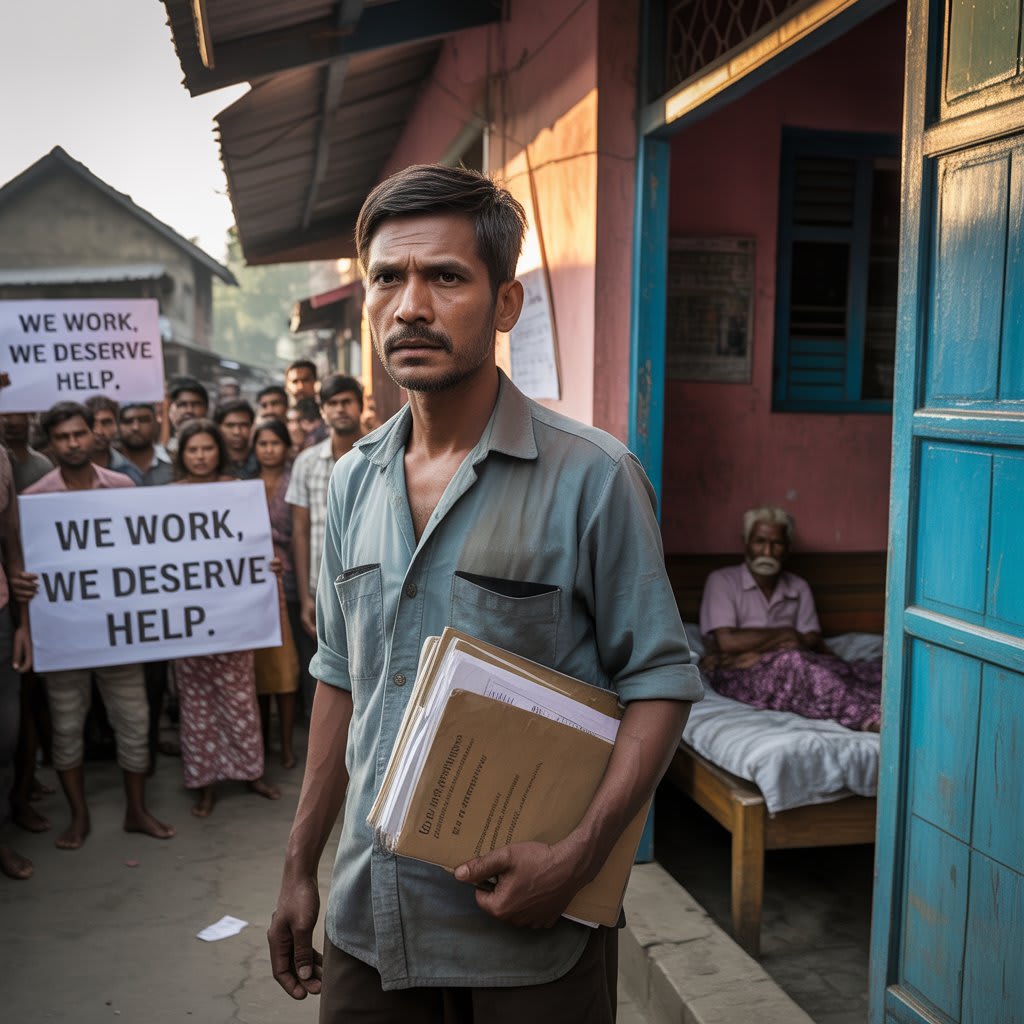
Rafiq stood under the blazing afternoon sun, sweat soaking his shirt as he waited outside the government office. The line had barely moved. He looked down at the crumpled papers in his hand — his application for financial aid, his father’s medical reports, his meager income statement. Again and again, he’d been told the same thing: “Your request doesn’t meet the legal criteria.”
It wasn’t just disappointing — it was devastating.
Rafiq was a 34-year-old factory worker in a small South Asian town. He had always believed that hard work would be enough to take care of his loved ones. But life had other plans. His father, once a proud tailor, had suffered a stroke a year ago. Since then, he had been bedridden, unable to move or speak clearly.
Medical bills piled up. Rafiq’s wife took up stitching work at home, and his two children — aged 6 and 9 — often went to bed hungry so their grandfather could afford medicine. Rafiq worked overtime, took night shifts, and even sold his wife’s gold bangles. But it was never enough.
What crushed him most wasn’t poverty. It was the system.
In his country, laws surrounding social welfare were outdated and full of loopholes. To qualify for government assistance, Rafiq would have to be jobless — but being jobless meant no income at all. If he worked, even for a few rupees a day, he was “disqualified.” There was no middle ground, no support for people who were struggling but not yet broken.
Rafiq’s uncle, Kareem, an elderly man with a small tea stall, tried to help. Every week, he brought rice or lentils and sometimes money scraped from his daily earnings. But Kareem’s own income barely supported his household. Eventually, even his help slowed to a stop.
Rafiq never blamed him.
---
One evening, Rafiq sat beside his father’s bed. The old man stared at the ceiling, his chest rising and falling slowly. Rafiq held his hand.
“I’m trying, Baba,” he whispered. “But the law… the law is like a wall I can’t climb.”
His father’s fingers twitched slightly in response. Rafiq wiped his eyes and went to prepare rice with salt — all they had left for dinner.
The next morning, Rafiq stood outside the clinic. He had come to beg the doctor to give his father a few more days of medicine on credit. While he waited, he overheard another man arguing inside — yelling that he was also refused assistance because he worked “just enough” to be ineligible. Rafiq stepped away, stunned. He wasn’t alone.
________________________________________________________________________
That night, an idea took root.
Rafiq used his old smartphone, slow and cracked, to search for stories like his. He found hundreds. Fathers, mothers, widows, orphans — all caught in the same trap. They worked hard but were punished for not being completely destitute.
He started a blog called “Trapped by the Law.” He shared his story, using simple words and real photos — of his father, his pay slips, his empty kitchen shelf.
He didn’t expect much.
But within a week, his post began spreading. People commented, shared, and added their own stories. One woman from a nearby city wrote, “I lost my husband, and I have two children. I earn a little by cleaning houses. The officer said I made ‘too much’ to qualify. I cried that day.”
Rafiq wrote more — he interviewed people from his town, his factory, his uncle’s customers at the tea stall. He added facts and figures, and highlighted how the legal system punished the poor for simply trying to survive.
Soon, a journalist reached out. Then a small online news channel. Then a lawyer.
---
One month later, Rafiq stood in the same government office — but not in line.
..
He was being interviewed by reporters outside its gates. Behind him were posters with the words: “WE WORK, WE STRUGGLE, WE DESERVE HELP.”
People had gathered. Not to protest violently, but to be seen.
His blog had grown into a movement. More than 50 families had shared stories, and a few kind-hearted lawyers helped Rafiq submit a petition to the court, challenging the outdated welfare laws.
Still, life at home didn’t change overnight.
His father still needed care. His wife still cooked what little they had. His uncle still brought tea and hope. But now, Rafiq had something else — a voice that mattered.
The case took months. During that time, donations poured in from strangers who read his blog. Not enough to make them rich, but enough to buy medicine, milk, and fresh fruit for the kids.
One rainy morning, as thunder rumbled in the sky, a ruling was announced. The court agreed: the welfare law was unjust. It ordered immediate reform and demanded a new system to support the “working poor.”
It was a small victory. But for Rafiq, it was a lifeline.
---
A year later, his father smiled faintly from his bed — recovering slowly thanks to consistent medication. His children were back in school. His wife now volunteered at a local women’s help group. Rafiq still worked at the factory, but he walked with a little more strength in his step.
The law hadn’t changed overnight. Corruption still existed. But now there was pressure, scrutiny, and above all — hope.
He continued his blog, now renamed “Voices of the Forgotten.” People still shared their pain, their dreams, and their resilience.
Rafiq no longer felt trapped.
He had found a way to turn his helplessness into action — not just for himself, but for thousands.
---
Moral of the Story:
When the law fails the people, the people must rise — not with violence, but with truth, unity, and relentless hope.
D eading y tory
About the Creator
A Historic Declaration
We the People of the Husbands of the United States of America, in Order to form a more perfect Union, and I mean you...with me...establish Justice, insure domestic Tranquility, provide for the common defence, promote the general Welfare, and secure the Blessings of Liberty to ourselves, after Puberty, do ordain and establish this Declaration of Co-Dependence.
By Gerard DiLeo5 days ago in Humans
Socialism
Socialism is one of the most used forms of government since it was coined. Despite the ancients running similar systems, it has taken a different form in each place, depending on regions. The different forms all have similar core principles. Yet they do differ in the smaller factors. It conquered many nations with its promises of equality and high social benefits. The equality of the systems draws so many to their ideas. They are generally simple and offer a sense of equality, but they deliver few results that consolidate power in the ruling elite. As this system has been tried, it has not always been successful. It is a system of government control that lacks personal ownership and offers little room for dissent. Socialism will ultimately depend on everyone working together to make the system function, but it will still suffer from financial difficulties. Over a hundred years, the results have spoken: socialism has proven it struggles without elements of capitalism to address financial issues.
By Sarah Danaher6 days ago in Humans



Comments (1)
Powerful and so deeply moving! 🙌 This really resonates—when the system falters, it’s up to us to stand tall, but always with integrity. Truth, unity, and hope are our most formidable weapons. It's a reminder that change doesn’t always come through force, but through collective strength and unwavering belief in what’s right. A truly inspiring message. 🌟