
Cain and Abel: A Bible Story of Jealousy and Redemption
A Bible Story

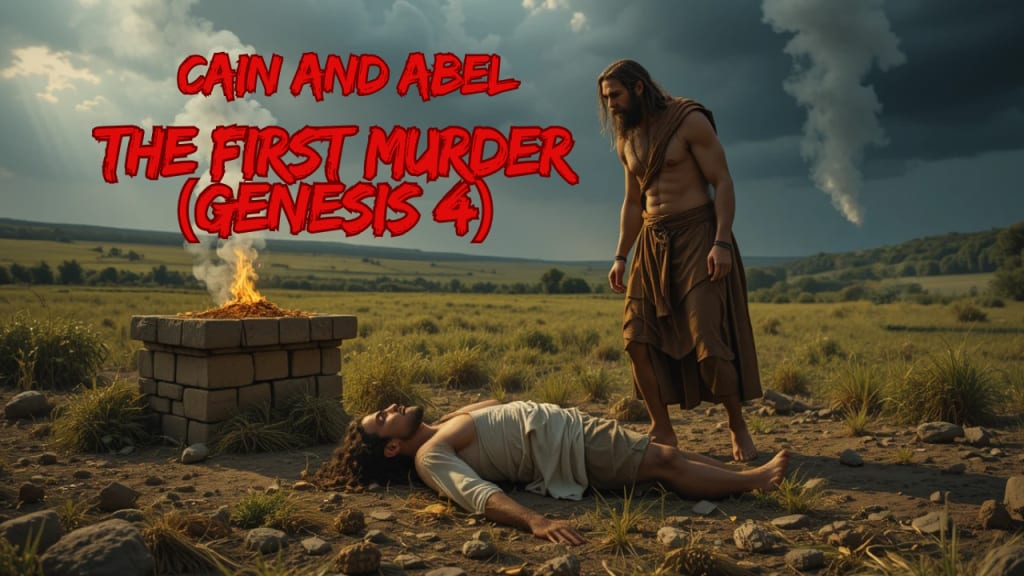
In the early days of the world, shortly after Adam and Eve were expelled from the Garden of Eden, they began a new life on the earth God had created. They had two sons, Cain, the firstborn, and Abel, the younger. The story of Cain and Abel, found in the Book of Genesis (4:1-16), is one of the Bible’s earliest accounts of human struggle, revealing the destructive power of jealousy and the enduring mercy of God. Set in a time long before recorded history, this story speaks to the complexities of the human heart and God’s call for righteousness, a lesson that resonates even today.
Adam and Eve settled in a land east of Eden, where they worked the soil to grow food, a task made difficult by the curse of sin. Cain, their eldest son, grew up strong and became a farmer, tending to crops of grain and vegetables under the hot sun. Abel, the younger, was a shepherd, caring for flocks of sheep and goats, guiding them to green pastures. Both brothers knew of God through their parents’ stories of Eden, and they sought to honor Him by bringing offerings from their labor. Cain offered some of the fruits of the soil—grains and produce he had grown—while Abel brought the firstborn lambs from his flock, the best of what he had.
One day, the brothers presented their offerings to God. Abel’s gift was given with a heart full of gratitude and devotion, offering the finest of his flock. God looked with favor on Abel’s offering, accepting it with delight. But Cain’s offering, though from his harvest, was given without the same sincerity—his heart was not fully in it. God did not look with favor on Cain’s offering, and this rejection stung deeply. Cain’s face darkened with anger, his brows furrowing as jealousy burned within him. He glared at Abel, who stood innocently by his sheep, unaware of his brother’s growing resentment.
God, seeing Cain’s heart, spoke to him with kindness and warning. “Why are you angry, Cain?” He asked. “If you do what is right, will you not be accepted? But if you do not do what is right, sin is crouching at your door; it desires to have you, but you must rule over it.” God’s words were a plea for Cain to master his emotions and choose righteousness, but Cain’s jealousy had already taken root. He ignored God’s counsel, letting bitterness fester until it consumed him.
One fateful day, Cain invited Abel to go out to the fields with him. Abel, trusting his older brother, agreed, and the two walked together under the wide sky. As they reached a secluded spot, Cain’s anger boiled over. In a fit of rage, he attacked Abel, striking him down with a stone. Abel fell to the ground, his life slipping away, the earth soaking up his blood. Cain stood over his brother’s lifeless body, his hands trembling, the weight of what he had done crashing over him like a wave.
God’s voice broke the silence. “Where is your brother Abel?” He asked, though He already knew the answer. Cain, his voice shaking, replied, “I don’t know. Am I my brother’s keeper?” But God responded with sorrow, “What have you done? The voice of your brother’s blood cries out to me from the ground.” God pronounced a curse on Cain: “The ground you work will no longer yield its crops for you. You will be a restless wanderer on the earth.” Cain cried out in despair, “My punishment is more than I can bear! Anyone who finds me will kill me!” But God, in His mercy, placed a mark on Cain to protect him, ensuring that no one would take his life as vengeance for Abel’s death. Cain left his family, wandering to the land of Nod, east of Eden, where he lived out his days as a marked man.
This ancient story, passed down through generations, holds profound lessons for us today on May 26, 2025, at 06:20 PM IST, as we share it on platforms like Vocal Media. The story of Cain and Abel reveals the dangers of unchecked jealousy and anger. Cain’s refusal to heed God’s warning led to the first murder in human history, showing how sin can grow when we let negative emotions rule us. It also highlights the importance of giving our best to God, not just in offerings but in our hearts and actions, as Abel did.
For us now, this story is a call to examine our own hearts. Are we harboring jealousy or resentment toward others, perhaps a sibling, friend, or coworker? Cain’s story urges us to seek God’s help in overcoming these feelings before they lead to harm. It also reminds us of our responsibility to care for one another, answering God’s question, “Am I my brother’s keeper?” with a resounding yes. In a world where conflict and division often arise from envy, we can learn from Cain’s mistake by choosing love, forgiveness, and humility.
Moreover, the story shows God’s mercy even in judgment. Though Cain committed a terrible act, God protected him, giving him a chance to live despite his sin. This reflects God’s desire for redemption, a theme that runs through the Bible and into our lives today. As we reflect on this story on this Monday evening, let us strive to guard our hearts against jealousy, to care for those around us, and to trust in God’s mercy, knowing that He offers grace even when we fall.
About the Creator
David Andrews
Hi, I'm David A., I'm excited to explore topics that inspire, inform, and engage readers across different genres. I bring a blend of curiosity and creativity to my writing journey here on Vocal Media.
Keep reading
More stories from David Andrews and writers in Humans and other communities.
Adam and Eve in the Garden of Eden: A Story of Creation, Choice, and Consequence
In the beginning, before the world as we know it took its final form, there was only the vast expanse of the heavens and the formless void of the earth. Then, with a word, the Almighty Creator brought forth light from darkness, separated the waters from the land, and adorned the world with a tapestry of vibrant life. On the sixth day of this grand creation, the Creator declared, "Let us make mankind in our image, in our likeness, so that they may rule over the fish in the sea and the birds in the sky, over the livestock and all the wild animals, and over all the creatures that move along the ground."
By David Andrews8 months ago in Humans


Comments
There are no comments for this story
Be the first to respond and start the conversation.