

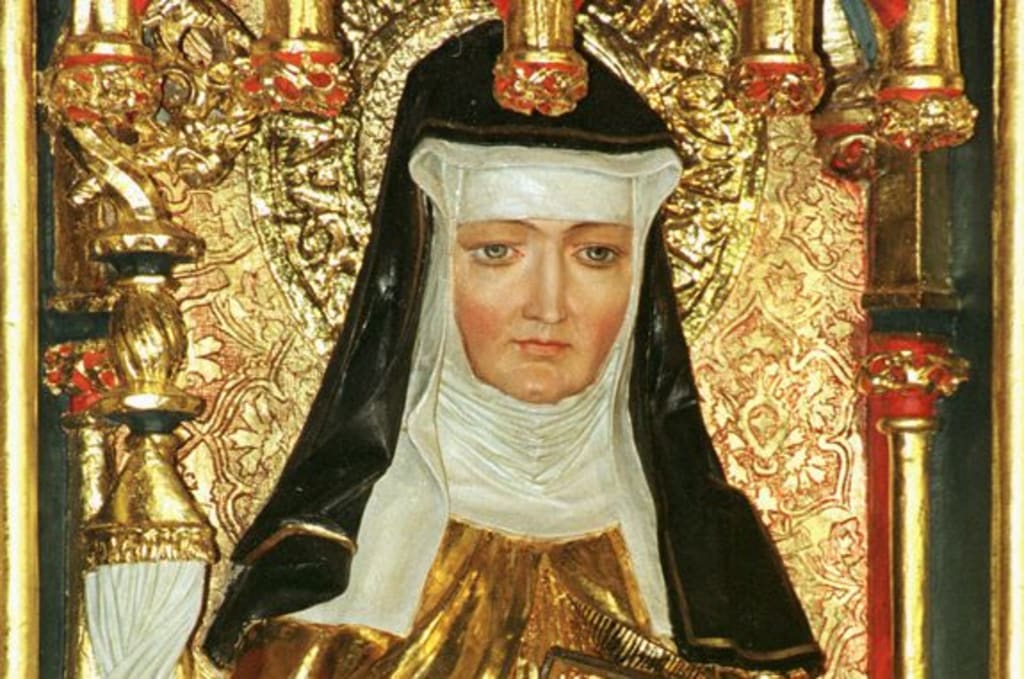
St Hildegard of Bingen
“You understand so little of what’s around you because you do not use what is within you.” (Scivias 1.2.29)
St. Bingen was bringing a lot to the dark ages besides expanding her own habits. Not only did she write the only two books on medicine in the 12th century in the West, but she was also an accomplished musician, a theologian, artist, mystic and Benedictine abbess. If the renaissance was a rebirth, then she was the first coming. Hildegard is an inspiration to many, including Carl Jung.
Humanity, take a good look at yourself.
Inside, you’ve got heaven and earth, and all of creation.
You’re a world—everything is hidden in you.
—Hildegard, Causes and Cures

The Black Forest has always been a place to hide or be hidden, the witch from Hansel and Gretal set up shop between the murky pines, a sausage lived there with a mouse and a bird, and an ungrateful son wandered around with a malicious toad stuck to his face. Schwarzwald is known to be one of the most oppressive forests in Germany, the conifers are so densely packed that all light is blocked out, save, perhaps, a stray moonbeam which will occasionally lance through the cool mists.
But if you are familiar with the winding paths, the forests are a place of protection. If you know your way around you can avoid being harassed by invaders and left alone to hone your craft. So that’s where women went to brew their beer at times when there was no other space left for them. Similarly, convents served as a protected space and encouraged single women in the arts and sciences.
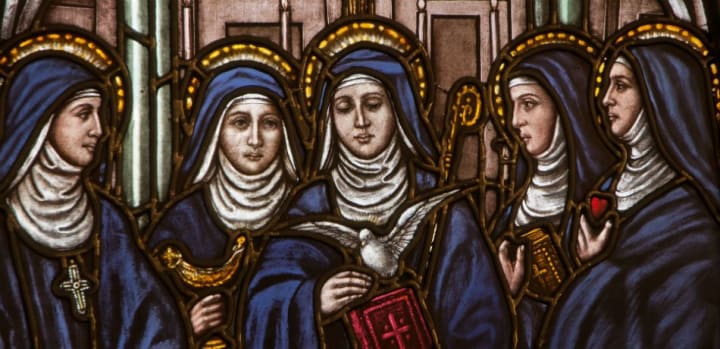
St. Hildegard of Bingen benefited from the space granted by both nature and convents. In her convent not only was she given access to books and taught to read and write, she was encouraged to follow her curiosities. While St Bingen never literally dawned a brewsters pointed hat, she was the first to describe the preservative qualities of hops in beer. And while her contemporaries were recommending hops as a treatment for depression, Hildegard believed that too much hop would increase the “black bile” of a person’s physiology. For medieval European Christianity, humorism was commonly used as a way to diagnose individuals and understand ailments. According to Hippocrates, the human body housed four types of liquids which could cause specific mental or physical issues in the individual if imbalanced. Each type of liquid, or humor, is connected to an element of nature and each humor can be broken down into the following personality traits:
Blood: Sanguine
Phlegm: Phlegmatic
Yellow Bile: Choleric
Black Bile: Melancholic
Too much or too little of any humor would trigger a dangerous reaction within the individual. With an overproduction of black bile, a person would become trapped in their own doubts and lose sight of the world around them. They often looked like a new moon, faded and cool and surrounded by darkness. Today it is proven that hops have the ability to calm the nervous system and promote sleep, which is only helpful if you don’t struggle to get up in the mornings. St. Bingen had many progressive insights, and this one was not even at the top of her list.
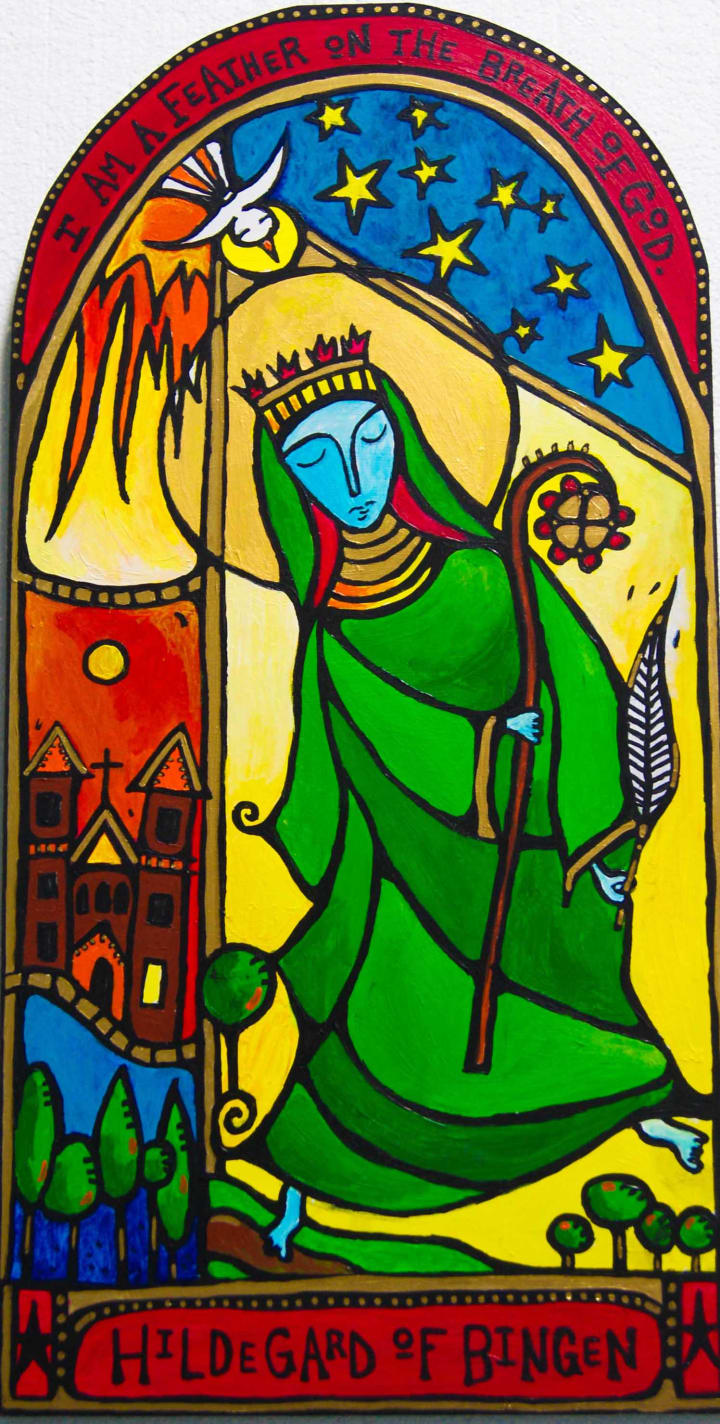
One important concept that grew to become her most recognizable is the viritas thread. The premise is that nature is not only reflecting the Divine, but the creative expression of heaven lives within it and can be directly observed in the forests and farmlands which surround us. It was in contemplating the greening power of nature that Hildegard saw viriditas as an outward reflection of what was within our bodies and our souls. Such a sentiment closely parallels a sentence in one of Jung’s letters, “we cannot understand a thing until we have experienced it inwardly.”
To commemorate the nine-hundredth anniversary of Hildegard’s birth, Newman eloquently listed some of her more significant accomplishments:
Hildegard is the only woman of her age to be accepted as an authoritative voice on Christian doctrine; the first woman who received express permission from a pope to write theological books; the only medieval woman who preached openly before mixed audiences of clergy and laity with full approval of church authority; the author of the first known morality play, and the only twelfth-century playwright who is not anonymous; the only composer of her era known both by name and by a large corpus of surviving music; the first scientific writer to discuss sexuality and gynecology from a female perspective; and the first saint whose official biography includes a first person memoir. (1998,1)
References
Clendenen, Avis. “Encounter with the Unconscious, Hildegard in Jung.” Jung Journal: Culture & Psyche , vol. 3, no. 1, 2009, pp. 39–55.
“Hildegard of Bingen: Viriditas – The Greening Power of the Divine –.” Path to the Maypole of Wisdom, 7 May 2020, https://maypoleofwisdom.com/hildegard-of-bingen/.
Dornbusch, Horst. “The Oxford Companion to Beer Definition of Hildegard Von Bingen.” Craft Beer & Brewing, https://beerandbrewing.com/dictionary/HylpeImJ4Z/.
About the Creator
Prema Smith
Born and raised in the PNW by my Indian mother and Scottish father. I split my time between the city and the countryside, growing up somewhere in-between.
Keep reading
More stories from Prema Smith and writers in Humans and other communities.
It's not my story anymore
There's a Taylor Swift song called the Manuscript it's about closing a Dark chapter of one's life. Or any chapter for that matter. I wanted to write about this because I think it's important to realize that yes while the things I write about on here are personal and about things I have dealt with. But that does not mean I am that person forever. I'm not the girl I was 5 years ago or even last year. I am NOT the niave women I was back then. I know better now. MUCH better. In fact I cringe at the person I was. I will NEVER tolerate the shit I did back then.
By Amanda Nicole5 days ago in Humans


Comments
There are no comments for this story
Be the first to respond and start the conversation.