
Bianca Bulgaru, Reporting From Kyiv Under Fire: Civilian Life, Drones, and Propaganda
Bianca Bulgaru: How does Kyiv correspondent Bianca Bulgaru document civilian survival under drone attacks while confronting propaganda and language politics?

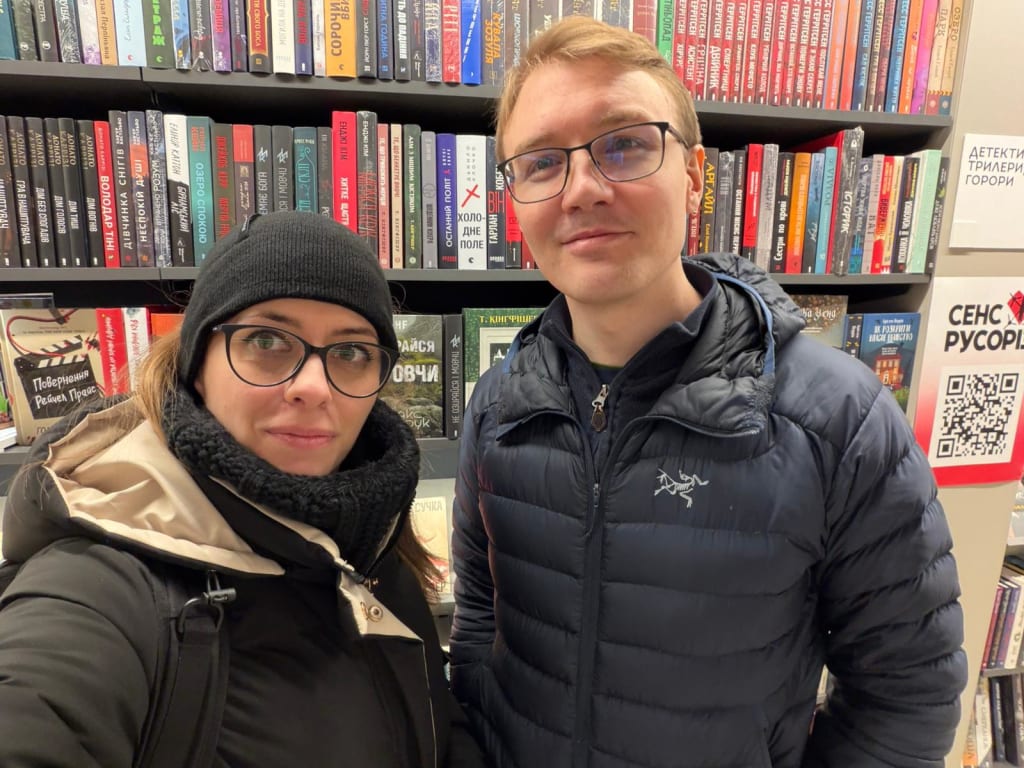
Bianca Bulgaru is a Romanian journalist and Kyiv-based correspondent for Beta News Romania. Reporting from cities including Kyiv, Kharkiv, and Sumy, she focuses on how civilians adapt to air raids, infrastructure strikes, and the long psychological aftershocks of living under threat. She also tracks the parallel war over narrative: propaganda that inflates fringe extremists into state-defining myths, and the language politics that can turn a reporting choice into an accusation. Scott Douglas Jacobsen spoke with Bulgaru about habituation to danger, the ethics of witnessing, and why transparency matters for sustaining Romanian support for Ukraine.
Scott Douglas Jacobsen speaks with Bianca Bulgaru, a journalist reporting from Ukraine, about adapting to danger and documenting civilian life. Bulgaru recalls her first air alert minutes after arrival, initially curious, later more fearful as she learned how indiscriminate strikes are. She describes drone attacks in Kharkiv, the aftermath of a double-tap strike in Sumy, and how distance shapes injuries and identification. The conversation explores language politics, accusations of not being inpartial, and propaganda that inflates fringe extremists into state-defining myths. Bulgaru argues that transparency and communication matter for sustaining Romanian support. She returns because people's stories never stop.
Scott Douglas Jacobsen: This is Bianca Bulgaru, a journalist. What was the name of the publication you wrote for again—Beta News? Beta News, thank you. How long have you lived in Ukraine? Has this period been consecutive? What was your first feeling of being in a country at war?
Bianca Bulgaru: I first arrived in Ukraine last year, at the end of February. At first, it was supposed to be a short weekend in Chernivtsi for a material, but it turned into a weekend in Kyiv, and then another weekend in Chernivtsi—so it became about a nine-day trip—and then I went back to Romania. It was interesting to see how people navigate through war, and I got the sense that I am not very sensitive to danger.
My first air alert happened within about 5 minutes of arriving at the accommodation, and I reacted by going to the window. That may be foolish, or I did not understand the danger at that time. I saw the first drone being shot down the night after that.
Jacobsen: When you first saw or heard an explosion, what did you feel? Has that feeling changed over time when you hear explosions or air raid alarms at night? Has it remained the same low- to mid-level fear—"Am I next?"
Bulgaru: The fear increases as you become more aware of the danger. The longer you stay, the more you understand the risks. At first, I was surprised. It made me more alert and aware of my surroundings during air raid alerts.
Now I feel the danger and the implications of an attack more clearly, because bombs can fall anywhere. Last summer in Kharkiv, I was under a drone attack. I could hear the drones above me and did not know whether they would strike nearby. They sounded very close.
So yes, the fear has increased over time. However, I have also become used to it. I feel the danger more acutely, yet sometimes, when I hear drones at night, I go back to sleep because I need rest. If something happens, it happens.
Jacobsen: I have felt something similar. This is my longest trip so far, and I intentionally arrived on the anniversary date as the transition into it (the longest day). I have joked that if I am going to die, I will at least die well-rested. In your early reporting, what were you focusing on? What assumptions did you have about the kinds of stories you wanted to tell?
Bulgaru: I was interested in war stories even before this war. I often read books about the Second World War. I did not focus primarily on military strategies or political stakes. Those elements were present, but I was more interested in people's experiences—how they lived through war and endured it.
I read many accounts from people who were children during the Second World War and later told their stories. When I came here, I wanted to tell human stories—stories of ordinary people—rather than analyze military strategy.
Although I am aware of political and analytical issues, I focus on the human side of this conflict. People are suffering here, and they must continue their lives during wartime. Their lives are not normal, even if they go to work. Some go directly to their jobs after spending the night sleeping in the subway during air raids.
They try to maintain normal routines, but their lives are not normal. That is what I try to document: people's lives and how this war has transformed them.
I have interviewed many people who changed their careers because of the war. I spoke with a man who used to repair small household electronics and now builds drones. I interviewed a woman who was a salesperson and is now a deminer. "Sapper" is the more technical term.
I have also met people who joined the military out of conviction and ideology, not because they were drafted. I have seen people who were alive six months ago and are no longer alive. That changes your perspective. It forces you to confront how fragile life is. We tend to believe that such things will not happen to us, but that assumption is not reliable.
I try to document these transformations—how the war reshapes careers, identities, and lives.
Jacobsen (to Romanian journalist Alex Craiu): Have people ever accused you of being pro-Russian because of language issues?
Alex Craiu: Yes. I spoke with some ultra-nationalists who criticized me for continuing to speak or sing in Russian. I argued that the Russian language should not be banned outright; instead, Ukrainian should be encouraged and promoted.
We also have to consider people such as Moldovans who live in Ukraine, support Ukraine, and speak Russian as a common language. I was not defending Russia politically. In Romania, for example, we do not grow up speaking Russian; we learn English in school. However, the issue is more complex for others in the region.
Some people implied that I was pro-Russian because of that position. I do not accept that label. I know where I stand.
It is difficult for me to conduct interviews. Many people say, "I do not speak English." Often, they do not want to give an interview. When I switch to Ukrainian, they have fewer reasons to refuse. That is my strategy. My mother learned some Russian in school, as part of her generation, but she does not remember much and never liked it. Language education in our region has shifted over time.
Jacobsen: Have you ever been in a situation where death felt very close?
Bulgaru: I am not sure whether it truly was that close, but it felt that way. It was during the drone attack in Kharkiv that I mentioned earlier. The drones struck a location about 750 meters away from me. There were six drones, arriving one after another.
The second perspective came later. The drones hit a building where I had slept two nights earlier. When I returned to the site and saw the damage, it was unsettling. The part of the building that was hit was on the opposite side from where I had stayed, but if you are inside, you would still feel the impact. It was close enough to understand how narrowly circumstances can change outcomes.
Jacobsen: How many journalists do you know personally who have been killed?
Bulgaru: I have not personally known a journalist who was killed. However, I have followed cases in the news. For example, a French photojournalist was killed last year. I did not know him personally, but I was familiar with his work.
I was struck by the fact that someone doing similar work—though far more experienced than I am—became a target. It reinforces the reality that journalists are targeted, whether Ukrainian or foreign. They are hunted alongside civilians near frontline areas, sometimes described as a "human safari."
That changes your perspective when you report near the front. I was in Sumy last April during a ballistic "double-tap" attack that destroyed two buildings in the city center and killed 30 civilians on a bus passing by. It was one of the most shocking events I have personally witnessed.
I arrived a few hours after the strike. It was dark. The electricity in the area had been cut. Only rescue lights illuminated the scene. The smell of ash and burned material was still in the air.
We interviewed a shop owner whose business was nearby. He had taken shelter during the strike and returned immediately afterward. He described seeing bodies lying on the ground "like dolls," burned and dismembered. He was visibly shaken as he recounted what he had seen.
Jacobsen: In such attacks, are burned and dismembered bodies the typical pattern, or are victims more often found intact? How does proximity to the strike affect the condition of the bodies?
Bulgaru: It depends on how close the victims are to the point of impact. The closer someone is to the blast, the more severe the physical trauma is likely to be. Those farther away may sustain different types of injuries. The condition of victims varies based on distance, force, and the specific circumstances of the explosion.
It depends on proximity to the strike. Some victims are burned, especially if the building catches fire or the heat is intense. Others die because they are trapped under rubble. Some are killed by shrapnel in critical areas, such as the neck or chest. In those cases, the bodies may not appear burned or severely disfigured. The physical condition varies depending on distance from the blast and the nature of the impact.
I went to a building two days after a strike because the addresses are not public. You have to follow the rescuers, check for smoke, or ask people nearby. I spoke with a woman who lived in the building that was hit. She had gone to the morgue to identify someone. She said she recognized the victim only by the colour of her hair, which had been dyed a few days before the attack. The damage was so severe that the person was otherwise unrecognizable. I believe the victim was her niece or goddaughter. She was devastated.
Jacobsen: Civilian casualties across Ukraine number in the thousands. Risk varies by location. Those in frontline cities face far greater danger than those in western regions. Military casualties are also significant on both sides. This is the largest conflict on European territory since the Second World War.
Do you think many civilian deaths over the winter have resulted primarily from missile strikes on infrastructure, or from secondary effects? For example, if energy grids are attacked and heating becomes inaccessible, vulnerable populations—the elderly, the ill, or children—may die as a consequence.
Bulgaru: Both direct and indirect effects matter. Missile strikes on infrastructure can cause immediate casualties, but they also create conditions that threaten lives over time. When electricity, heating, and water systems are damaged, especially during winter, the risks increase for those who are already vulnerable. The humanitarian consequences extend beyond the initial explosion.
I think it is both. Attacks continue on civilian areas, and so many people die from direct strikes on residential buildings. At the same time, attacks on energy infrastructure have caused major harm to civilian life. Winter in Kyiv and much of Ukraine can reach minus 20 degrees Celsius at night. In unheated apartments, indoor temperatures can fall to around five degrees. Some older buildings are poorly insulated. Pipes have burst, and water has frozen inside apartments. Those are extremely difficult living conditions, and for vulnerable people—the elderly, children, and the ill—they can be life-threatening.
Attacks on energy facilities also affect the medical system. Hospitals cannot function properly without electricity. Medical equipment depends on power. Some people rely on medical devices at home, and without electricity, those machines stop working. I am not a legal expert, but targeting power grids that sustain civilian life raises serious legal and humanitarian concerns.
Jacobsen: In the information space, the digital and cyber dimension of this war, what parts of Russian messaging are fully true, partially true, or based on facts that are then reshaped to support a broader narrative? In any war, it is rare for all sides to present information without distortion.
For example, there are nationalist or far-right groups in many countries, including Ukraine, the United States, and Russia. The question is whether their existence justifies aggression, and whether they represent state policy or a marginal presence. Russian messaging often frames Ukraine as dominated by neo-Nazism, while Ukraine's leadership includes a Jewish president. That rhetorical contradiction is frequently noted. How do you assess these narratives?
Bulgaru: Every society has extremist groups. Ukraine is not an exception. However, the presence of small nationalist or far-right groups does not mean that they control the state or that their ideology defines national policy. In Ukraine's case, extremist groups exist, but they are not representative of the government or the majority of society.
Russian messaging takes isolated facts—such as the existence of nationalist groups—and amplifies them to suggest that they define the country as a whole. That is a narrative strategy. It simplifies complex realities into a justification for aggression. The existence of fringe groups in a country does not equate to state ideology, nor does it justify invasion.
Jacobsen: At a deeper level, beyond rhetoric, I do not think the basic tests for justification are met. In some preliminary research—so I will be cautious—it appears that between the early years of the war and 2025, neo-Nazi and white supremacist groups in Ukraine have either remained stagnant or declined, while in the Russian Federation, they have remained stable or increased.
If such groups are increasing anywhere, that is concerning. If they are increasing in Russia while Russia claims to be fighting "Nazism," that is both concerning and ironic.
Bulgaru: It is a complex question. Russian authorities have used several narratives to justify aggression. Some begin with a limited or partial truth and then distort it. The example of neo-Nazi groups is one of them.
There are small ultra-nationalist or extremist groups in many countries around the world. Their existence does not mean that they define state policy or represent the majority of society. In Ukraine, such groups exist, but they are marginal and do not define the country or its government.
Another justification often cited by Russia is the claim that it is "protecting" Russian-speaking populations in Ukraine. However, those communities were not asking to be rescued. Many were living ordinary lives.
The separatist movements in eastern Ukraine intensified after Russian involvement and support. The narrative of protection was tied to the creation and amplification of tensions.
I can see similar patterns in attempts to influence other minority communities, including ethnic Romanians in Ukraine. There are efforts to persuade them that they are being discriminated against and that Russia is a protector. That narrative does not reflect the lived reality of most people. It is a strategy aimed at creating division and instability.
Missiles have rarely hit that region. There was one instance when a drone struck a building, but otherwise, it has been relatively quiet. Despite that, the narrative is repeatedly promoted that Russia is "protecting" those communities.
The strategy appears to follow a pattern: first, create or amplify tensions between ethnic groups, then present yourself as the saviour from the instability you helped generate. Minor local conflicts exist in many places where minorities live. These are usually small, localized issues that can be resolved within the community. They do not require outside intervention.
The pattern can be summarized as: create a problem, then offer yourself as the solution.
Jacobsen: How many people you know personally have been killed here?
Bulgaru: There was a Romanian volunteer who died on the front lines. I did not know him personally, but Alex (Craiu) interviewed him, and I was familiar with his work. I later met his family when they came to Kyiv to complete procedures related to his death and to commemorate him at Maidan. We placed his flag there in his memory.
His sister still struggles to accept his death. Although there has been confirmation from people close to his battalion that their entire position was destroyed, she holds onto hope that he might still be alive, possibly as a prisoner. Officially, she says she understands that he died, but emotionally, she cannot accept it.
Communication with the battalion has been difficult, and she feels she lacks sufficient information to achieve closure. She needs clearer answers about what happened to her brother.
Jacobsen: Since you have been living here, what have been some of the more substantive geopolitical changes between Romania and Ukraine as the full-scale invasion—what Russia calls a "special military operation"—has progressed?
Bulgaru: Romania's official position is supportive of Ukraine. However, I wish there were more visible and transparent communication about the support being provided. Romania does offer assistance, even if not as much as some might hope.
The challenge is that a growing number of people in Romania appear to be influenced by Russian propaganda and are increasingly skeptical about supporting Ukraine or Ukrainians. This may explain why communication about Romania's assistance is sometimes limited.
However, limited communication can have the opposite effect. Greater transparency and openness about the nature and scale of support would make it more widely understood and accepted. When official information is scarce, people are more likely to rely on unverified sources or misinformation.
Clear and consistent communication from official channels could counteract that tendency and strengthen public understanding.
Jacobsen: Thank you very much for the opportunity and your time, Bianca.
Scott Douglas Jacobsen is a blogger on Vocal with over 120 posts on the platform. He is the Founder and Publisher of In-Sight Publishing (ISBN: 978–1–0692343; 978–1–0673505) and Editor-in-Chief of In-Sight: Interviews (ISSN: 2369–6885). He writes for International Policy Digest (ISSN: 2332–9416), The Humanist (Print: ISSN, 0018–7399; Online: ISSN, 2163–3576), Basic Income Earth Network (UK Registered Charity 1177066), Humanist Perspectives (ISSN: 1719–6337), A Further Inquiry (SubStack), Vocal, Medium, The Good Men Project, The New Enlightenment Project, The Washington Outsider, rabble.ca, and other media. His bibliography index can be found via the Jacobsen Bankat In-Sight Publishing. He has served in national and international leadership roles within humanist and media organizations, held several academic fellowships, and currently serves on several boards. He is a member in good standing in numerous media organizations, including the Canadian Association of Journalists, PEN Canada (CRA: 88916 2541 RR0001), Reporters Without Borders (SIREN: 343 684 221/SIRET: 343 684 221 00041/EIN: 20–0708028), and others.
I mage Credit: Bianca Bulgaru.
About the Creator
Scott Douglas Jacobsen
Scott Douglas Jacobsen is the publisher of In-Sight Publishing (ISBN: 978-1-0692343) and Editor-in-Chief of In-Sight: Interviews (ISSN: 2369-6885). He is a member in good standing of numerous media organizations.
Keep reading
More stories from Scott Douglas Jacobsen and writers in Humans and other communities.
Rev. Dr. Louise Goben on Interfaith Hunger Relief: Dignity, Golden Rule Partnerships, and Food Pantry Impact
Rev. Dr. Louise Goben is President of the North Hollywood Interfaith Food Pantry and has volunteered with the pantry almost since its inception. With her family, she spent decades transporting food from Temple Beth Hillel to distribution at First Christian Church, strengthening a practical Jewish–Christian partnership against hunger in the San Fernando Valley. Ordained in the Christian Church (Disciples of Christ), she is retired from active congregational ministry but still preaches and teaches Bible when invited. She also teaches World Religion and History of Religion through the Encore Program at Los Angeles Pierce College. Her work centers on dignity.
By Scott Douglas Jacobsen18 days ago in Humans
When the Shelter Closes
Across the street from my house, a man slept under a tree, his dog by his side. My first, naive thought: he must be traveling through. But he kept coming back, often sleeping there during the day. Then it hit me—that person might not have a home.
By Bride of Sound2 days ago in Humans
How Lifestyle Practices Reduce Dating Anxiety And Improve Connection With Partners
Lack of self esteem, stress and exhaustion are key factors in the cause of dating anxiety. Self-care is an important issue to be prioritized, which gives a chance of healthier relationships with partners. Regular physical activity, proper dieting, and proper sleep improve mental and physical health. Self-care practices lower the levels of stress hormones, enhance confidence, and emotional stability and can more easily participate in dating situations more honestly. With a personal wellness, one develops a feeling of stability that will enable them to approach the partners with calmness and openness instead of fear or insecurity and connect them to a deeper level in the beginning.
By Willian James2 days ago in Humans



Comments
There are no comments for this story
Be the first to respond and start the conversation.