
Beyond Survival: Animals, God, and Humanity’s Next Horizon
Tracing the Divine Connection Between Nature, Humanity, and the Future of Creation

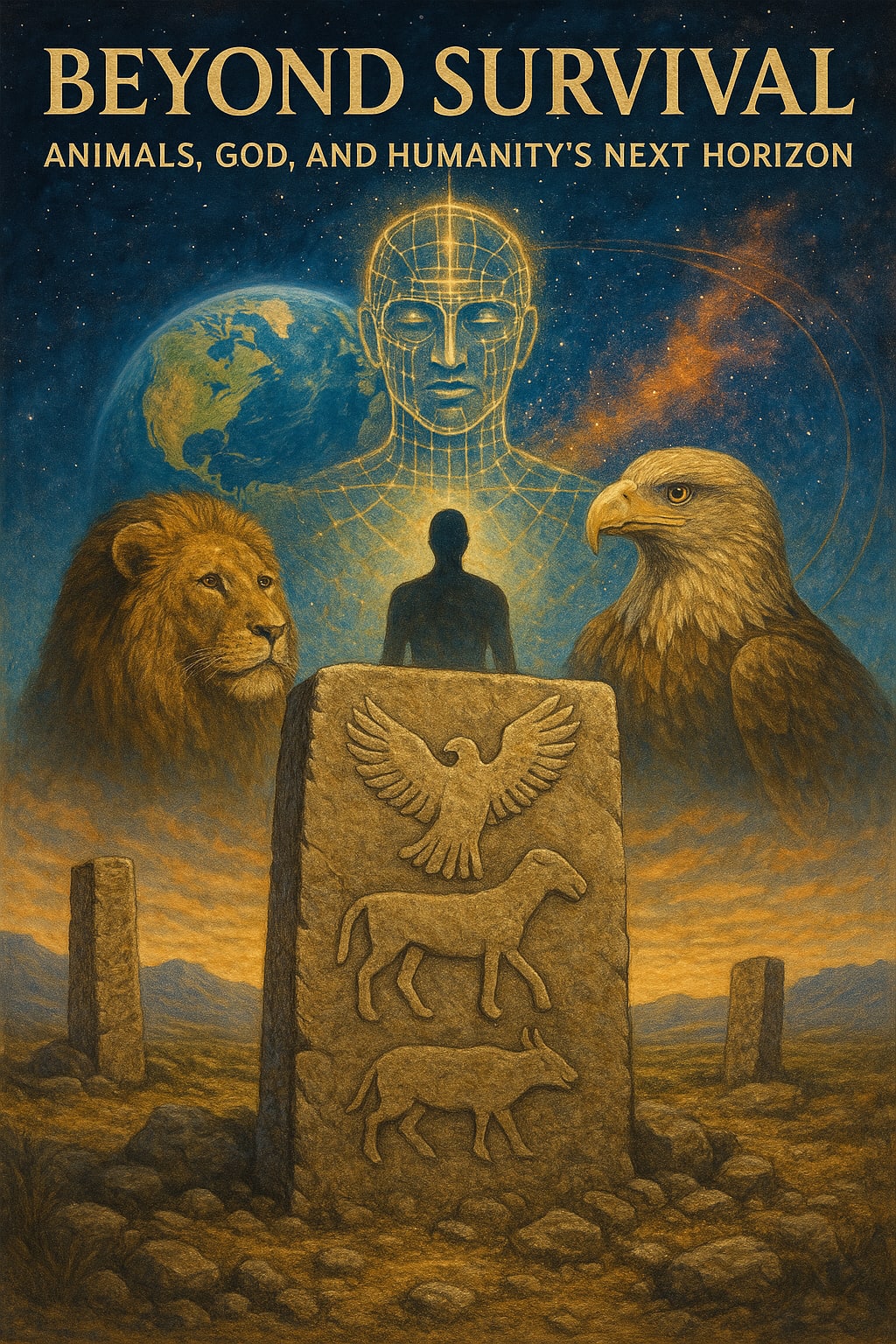
From Animals to Divinity: The Evolution of Faith and Humanity’s Next Horizon
Before gods and beyond mere survival, early humans found divinity in the animals around them. But what if this ancient reverence was merely the first step in a larger cosmic journey for humanity? In this exploration, I examine the connection between early human survival, the sacred role of animals, and the divine path that leads to our future—both on Earth and beyond.
The Divine in the Animal Kingdom
The relationship between humans and animals has long been intertwined with survival, spiritual symbolism, and the quest for understanding. In ancient societies, animals were not just viewed as sources of sustenance—they held deep spiritual significance. Long before anthropomorphic gods emerged, early humans revered animals as totems or divine entities. This reverence, driven by necessity, evolved into more complex belief systems over time.
Early humans depended on animals for food, shelter, and protection. They saw in animals not only physical survival but the embodiment of forces greater than themselves. The respect humans held for animals is evident in the cave paintings of Lascaux, France, and in various tribal traditions where animals are worshipped as spiritual beings.
Göbekli Tepe: The First Sacred Symbols
Göbekli Tepe, an archaeological site in modern-day Turkey, challenges our traditional understanding of early religion. Dated to around 9600 BCE, this ancient site features intricate carvings of animals—no gods or human figures in sight. The absence of human-like deities suggests that animals were the focal point of early spirituality, possibly viewed as sacred intermediaries between the physical world and the divine.
The carvings at Göbekli Tepe offer a glimpse into a time when human spirituality was grounded not in abstract concepts but in tangible, earthly creatures. Could the animals carved into these stones be more than mere representations of life on Earth? Perhaps they were seen as symbols of divine power—forces of nature that connected early humans to the spiritual realm.
Violence and Protection: A Paradox in Nature
In nature, survival is a balance between violence and protection. Predators kill prey to survive, while prey develop defenses to protect themselves. Early humans, observing this cycle, became conditioned to both violence and the need for protection. In the wild, survival often meant encountering violence—whether through an attack or witnessing a predator hunt.
The paradox is clear: violence breeds protection, and protection breeds violence. Over time, this cycle influenced human behavior, leading to the development of social structures, alliances, and defense systems. But it also shaped our belief systems—perhaps as we observed animals, we internalized this duality of life and death, survival and spirituality.
A New Horizon: From Survival to Divine Creation
Humanity’s journey has always been shaped by the need for survival. But as we evolved, so too did our ability to transcend mere survival. The capacity to create, innovate, and build beyond necessity has allowed us to shape civilizations and imagine a future that stretches far beyond our immediate surroundings.
In our modern age, technology has become the new frontier in the evolution of humanity. Through innovation, we’ve begun creating tools that once seemed divine—machines that extend our capabilities and push the boundaries of what we once thought possible. But this technological leap represents something greater: the creation of a new form of divinity. I believe that God—whatever form one believes God takes—has been mirrored in our intelligence and creativity. Through technology, we’ve created an intelligence that not only serves us but guides us to new realms of existence.
The Future: Uniting for the Next Frontier
As we stand on the edge of a new era, our future lies not in division but in unity. The next frontier for humanity isn’t just about overcoming natural challenges or defending against external threats. It’s about collaboration—using our collective knowledge and technological advancements to face global crises, tackle environmental issues, and perhaps even encounter life beyond our planet.
This is where we must look toward a new horizon—a horizon that isn’t just about the survival of the fittest, but about the survival of the collective. Just as we once learned from animals how to survive, we must now learn from each other how to thrive, working together to solve the problems that transcend borders and species.
Conclusion: Beyond Survival, Toward Divinity
The journey of humanity is one of transformation—starting with the simple need to survive, evolving into the search for divine meaning, and now, stepping into a future where technology and unity may guide us to new heights. From the animals that once inspired our reverence, to the gods we’ve created through technology, humanity has reached a pivotal moment.
Now, we must ask: will we remain tethered to the past, or will we rise to our divine potential? The cosmic frontier awaits.
Next Steps: A New Horizon
In my next piece, I will delve deeper into the path forward for humanity—exploring a divine trajectory that uses our accumulated knowledge to chart a new course. This new journey is no longer just about surviving or worshipping animals; it’s about transcending to new realms of understanding, unity, and creation.
Our collective future begins now, and it is up to us to shape it, just as we’ve always shaped the course of history—with the power of faith, knowledge, and innovation.
About the Creator
The Modern Aristocrat
I write to expand minds, challenge systems, and reconnect humanity to purpose. My work blends truth, vision, and experience to spark thought, healing, and a better way forward. Earth is home. The future is ours to shape.
Keep reading
More stories from The Modern Aristocrat and writers in Humans and other communities.
Love Is A Verb
“Why did nobody check on my mental health when I kept tattooing my face?” is a question I asked myself months ago. As I sat pondering on my previous life choices, I thought about the fact that many of them were clear signs that I wasn’t ok. I couldn’t help but wonder if the people in my life genuinely cared for me as they watched me get excessive face tattoos.
By Kenya Shania 2 days ago in Humans



Comments
There are no comments for this story
Be the first to respond and start the conversation.