

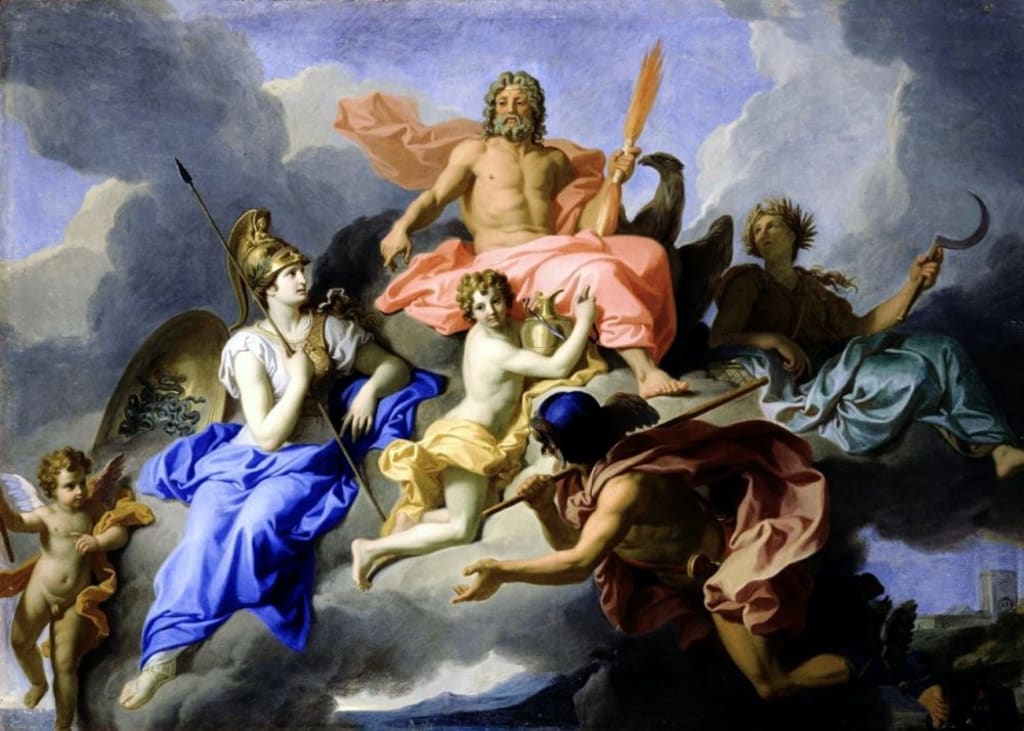
When we think of “gods,” we often picture moral, noble supernatural beings living high above us—who love their creation, give us laws, and sometimes punish us when we cross the line. But the ancient view of divinity was very different from this modern image.
First of all, gods were not distant or removed. They were always near—in the river, the tree, the coming desert storm, everywhere. Despite their closeness, these gods did not embody human morality. It was impossible to measure their actions by human standards.
In fact, gods were the world itself: the Sky, Time, Storm, and so on. This can be seen even in the etymology of their names. Take Zeus, for example. His name comes from the Proto-Indo-European word Dyēus, which literally means “sky” or “daytime sky.” So Zeus isn’t just a god of the sky—he is the sky.
You might wonder, “How could people pray to the sky and expect a response?” This is where polytheism meets animism. Spirituality worked like this: a thing in the world that was useful to humans—like water, or food, or even storms—was seen as having a power that could be appealed to. If you asked it nicely, it might listen and provide. Over time, this thing became personified—a god representing that force—to whom people could directly address their prayers.
Even today, we still behave like this. When a game is stuck loading, we might act like it “hears” us, hoping it’ll work faster. It doesn’t, of course, but we feel like we’re influencing it. This shows a natural human tendency to relate to the world as if it responds to our will.
The ancient gods were similar in this way—not moral judges, but forces behind nature’s laws. You couldn’t argue fairness with them; you could only try to align with their domain. So when people pray to Hermes or even a demon like Bune for help with money, and then an internship or work opportunity appears, it’s not that the laws were bent—only that intention found a pathway.
Gods didn’t always manifest as grand miracles like a parted sea or a burning bush. Instead, they might appear as strategic insight (Athena), a fortunate material opportunity (Mammon), or a sudden wave of inspiration that compels you to create (Odin). Their presence could be felt through the shift in your path, your mind, or your momentum.
One might assume, “Then gods are just mental projections onto the world.” Psychologically, that’s not wrong. But as a spiritual person, I’d like to share an additional perspective. In Hermetic texts—especially the Asclepius—there’s a passage that describes how people actually make gods. They take a statue or an idol and, through focused consciousness, ritual, and belief, imbue it with divine energy. That energy then takes form and becomes a living deity. It’s not just projection—it’s participation in creation. The divine becomes accessible through intentional contact with form.
So the best way for humans to survive was to appease these deities with devotion and offerings, hoping they would grant favorable conditions.
That’s why, in mythology, gods often do morally questionable things—because the universe doesn’t follow morality, it follows the natural order of things, which must not be broken. Zeus’ countless infidelities are a metaphor for the sky’s ability to fertilize the earth. Hermes’ pranks on Apollo are the purest showcase of cunning and intellect. Set, as a god of chaos, reminds us that order needs disorder, and vice versa.
To sum up: ancient gods were not loving caretakers—they were the forces that make up the world itself. Contact with them meant appeasing these forces through prayer and offerings so their domains would be favorable to you.
So, next time when you are struck with confusion about old polytheistic gods, remember that ancient people thought differently, thus their religion worked in completely different way. There's a Latin quote—do ut des—I give you so you may give. It's the logic on which reflected most of human-god relationship in the ancient world.
Thanks for reading! Share your thoughts in the comments, and feel free to share this article.
About the Creator
Keep reading
More stories from Alex Smith and writers in Humans and other communities.
How Different Cultures Understood the World?
Our world is truly big. Even thousand years of search I think, wouldn’t be enough to fully grasp the knowledge about it. But despite physical and sometimes, psychological limits of ours, we never stopped trying to understand it.
By Alex Smith3 months ago in History



Comments
There are no comments for this story
Be the first to respond and start the conversation.