
Automation Testing for Retail Business
Crucial Factors for Retail Businesses to Keep in Mind for Automation Testing


In today’s dynamic corporate environment, the retail business sector has experienced significant digital transformation, with projected online sales of $8.1 trillion by 2026, as suggested by recent studies. The growing number of online sales necessitates retail businesses to adapt to technological advancements, encourage innovation, and provide an outstanding user experience through top-notch and effective software applications. In this context, automation testing has emerged as a front-runner for businesses, helping them seamlessly validate crucial software functionalities and reach this objective.
Given the staggering growth and shifting user demands, it is critical for businesses to deliver end-users with accurately performing software applications that not only meet user expectations but also exceed them. This helps retail businesses secure a competitive edge in the market, sustaining growth and success. Here, properly implementing automation testing services becomes exceedingly beneficial, facilitating quick validation of these vital factors to deliver users an error-free, high-performing user experience.
Automated testing services involve the utilization of automated testing tools or frameworks to automate diverse software testing types and intricate processes.
In this blog post, we will explore the advantages of implementing automation testing for retail businesses, share best practices for efficient implementation, and discuss key considerations and challenges.
Primary Advantages of Automation Testing for Retail Businesses

- Amplified Productivity & Time Savings
Automation testing facilitates rapid and effective test case execution, lessening the need for manual testing and thereby saving substantial time and effort. It can also be performed concurrently across multiple browsers, platforms, and systems, resulting in faster product release cycles and a shorter time to market.
- Improved Testing Coverage
Automated testing significantly enhances the testing coverage across various platforms, such as websites, mobile apps, and point-of-sale systems. This testing technique handles many test cases and scenarios, ensuring the thorough validation of each crucial software component. As a result, it reduces the risk of any defects or flaws slipping past development into deployment, which helps elevate the software’s overall quality.
- Augmented Dependability & Quality
Ensuring retail software is reliable and free of any bugs is paramount to guaranteeing its successful reception and adoption by audiences. While performing manual testing can be helpful and add human logic to the testing process, it is still prone to human error and inconsistencies. Automated testing helps eliminate these possibilities, ensuring the seamless functioning of the software. It also aids in the early detection and resolution of errors, resulting in a dependable and high-quality software product capable of delivering an enhanced user experience.
- Cost-Efficiency & ROI
While the initial cost of setting up automated testing may be pricey, its exponential cost-effectiveness becomes apparent in the long run. The process involves selecting an automated testing tool, eliminating the need for a large testing team, and reducing manual testing efforts and associated expenses. With enhanced detection capabilities, automation testing makes identifying and addressing even difficult-to-detect software problems easy. This not only proves helpful to retail businesses in avoiding revenue losses but also ensures a positive return on investment (ROI).
- Streamlined Integration & Testing
Automation testing enables seamless integration into the development workflow, facilitating continuous testing in agile environments. This can help retail businesses release software updates with complete faith in the software’s stability and quality of their applications. It is possible, thanks to the capabilities of automation testing that help automate regression tests and implement continuous integration and continuous delivery (CI/CD) models.
Best Practices to Implement Automated Testing
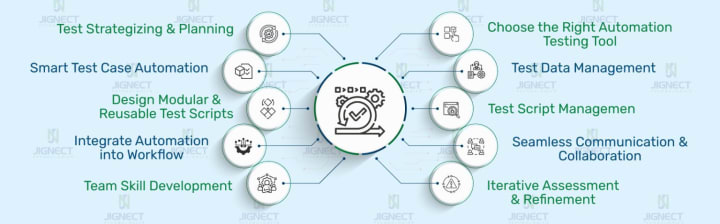
- Test Strategizing & Planning
- Choose the Right Automation Testing Tool
- Smart Test Case Automation
- Test Data Management
- Test Script Management
- Design Modular & Reusable Test Scripts
- Integrate Automation into Workflow
- Seamless Communication & Collaboration
- Team Skill Development
- Iterative Assessment & Refinement
Challenges & Key Considerations for Retail Businesses While Implementing Automation Testing

While the benefits of automation testing are many, some aspects need to be considered by retail businesses before moving ahead with the implementation.
- Initial Setup Costs
- Test Script Preservation & Updates
- Integrating Manual & Automated Testing
- Data-Driven Testing
- Cross-Platform Testing
- Third-Party Integration
Why Choose JigNect Technologies for Automation Testing of Your Retail Business?
In summary, the significance of a robust automation testing strategy that is efficacious and covers crucial software components cannot be overstated. JigNect Technologies recognizes its importance and is dedicated to helping you channel its capabilities and ensure the release of successful retail software that drives success and prosperity. We are a rapidly advancing software testing and QA services company that can help you seamlessly bridge the gap to automation testing, ensuring a smooth adoption and the best outcomes. Consider us your partner, and let us help you reach new heights of success via dependable, high-performing software applications.
Contact with JigNect Technologies today to talk about your testing needs and find out how our experience as an automation testing company can be of assistance.
About the Creator
Jignect Technologies
At JigNect Technologies, we believe that software testing is an art, a science, and a passion. Our team of experts combines years of experience, cutting-edge technology.
Keep reading
More stories from Jignect Technologies and writers in Humans and other communities.
Top Reasons Why You Need Automated Accessibility Testing
What is Accessibility Testing? Accessibility testing refers to the process of meticulously evaluating and assessing a software product or application to ensure compliance with government accessibility laws and that it provides equal access to all users, including those with impairments, without barriers impeding their experiences.
By Jignect Technologiesabout a year ago in FYI
Autonomy Is The Real Privilege
Good morning, freedom-seekers! Today we’re gonna be looking at autonomy. A strange word, I know; one many would probably look at blankly and run away from on sight. We’re gonna figure out what it actually means, consider how it’s achieved, and decipher just how deeply most of us are tangled up in dependence without realising it.
By That ‘Freedom’ Guy6 days ago in Humans
8 Quiet Patterns Showing How You Handle Responsibility.
Responsibility shows through patterns, not speeches. Organizational research focuses on quiet behaviors because they predict performance and trust over time. You reveal how you handle responsibility through repetition. Others notice even when nothing goes wrong. These patterns shape reputation, advancement, and reliability.
By Wilson Igbasi3 days ago in Humans




Comments
There are no comments for this story
Be the first to respond and start the conversation.