

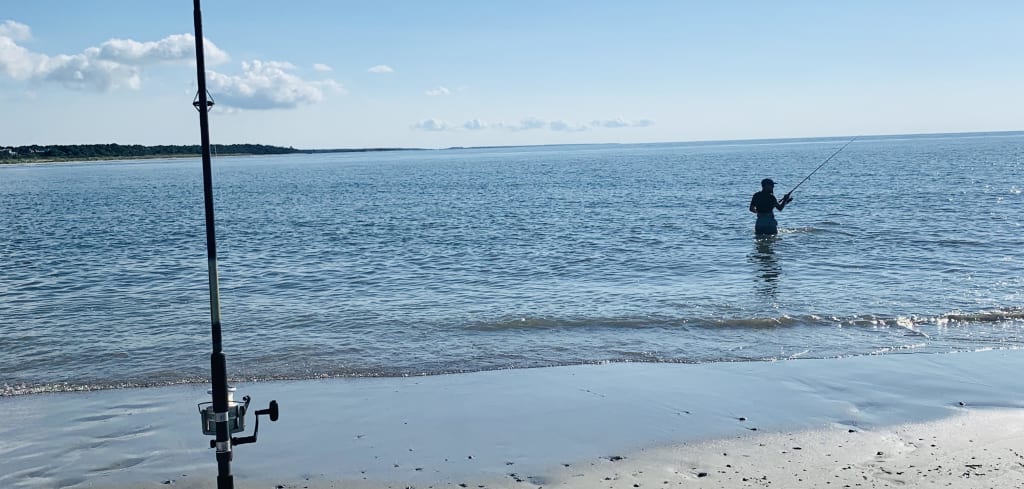
A man and a woman walked down from the beachhead toward the surf. The man carried with him a light pack slung over his shoulder and a blanket under his arm. The woman, a beer in each hand. They were dressed in light clothing and their bare feet left gentle cursive in the sand behind them.
Ahead, the sky was purple wax burning at the bottom. The ocean sounded muted, as if heard through a wall, and over it came the come-and-go laughter of two children flying a kite with their father. He stopped and watched them for a moment, the son and daughter caught in erratic orbit around the man, joyful little moons. Above them the kite whipped brilliantly. Further down the beach he could make out the boardwalk, its struts crisscrossing like the legs of huddled sandpipers.
“Is this spot ok?” he said to the woman.
She smiled and nodded.
They laid out the blanket and sat before the breeze could pick it up. It smelled everywhere of salt, cut horizontal by the occasional burst of lemon and garlic from the restaurant down the way. From the bag, the man first took out a small clay jar. He placed it gently in the sand in front of the blanket. Next, he removed a small black notebook and a piece of graphite. He held these up to her.
“Do you mind?” he asked.
Again she smiled and rubbed his back. “Whatever you need to do,” she said.
He began to sketch the surf, tried to capture the way the wind and the water moved together. He wanted, above all, an honest version of what was before him. It was a way of confirming that the day--this day--was happening. They were quiet for a long time while he made soft scratches on the paper. When he finished, he placed the notebook and the graphite back in the bag.
“Are you ok?” she asked.
He leaned back, then forward to stretch his legs. He said, “Yes. I’m sorry. It’s been a long time since I’ve been here.”
She handed him one of the beers. “Tell me about it,” she said. “If you’re up for it.”
He looked at the jar and then out again at the water. “We moved here when I was 9 or 10. My father was sent here by the Navy. It was tough, at the beginning. We were surviving, but the loneliness of a new place eats at everyone. My mother lost something. I’d never seen her nervous, or bored for that matter, in my life. Eventually I met Jack, the neighbor’s kid. He was my age.”
She nodded, urged him on.
So he unraveled. He struggled with what home was now, defining the boundaries of what he wanted to protect. But he yielded. The place was still one of terminal prettiness. Each snapshot stretched in a broad and infinite sunset strung with gems out across the town, collecting dust in blue and green. The afternoons announced themselves with the heat of memory, long summers spent searching for ghosts amid the alien dunes, sand half on fire with drought. Whirring like tops, he and Jack traversed motley old shipwrecks, out past tide pools they bottled in amethyst like reserves for rapture. Stomped through their kingdom like some latterday Titans letting off steam. In the low light of evening, a mother, or sometimes both, came calling from the porch--voice like a coat of paint. They returned then and molted their day clothes, two staggering storms of dark blue, confusing the Morse code syntax of lightning bugs for constellations skewed from native order.
“It sounds wonderful,” she said.
“You know,” he said. “Looking back now it feels different. I can sympathize with my parents. They pulled off a balancing act I don’t think I’d be up to. But if you gave me a book full of possible childhoods and told me I could start with one again, I’d say, ‘Put me back here. You know the spot.’”
And he meant it. The place disarmed him with openness and stitched up his irony, made earnest into something other than a slur. It would forever remain not yet a dreamwork, not yet Chernobyl.
He watched her look around again with new eyes, saw she was trying to understand the place as he did.
“I remember one day we sat out on that pier.” He pointed to the boardwalk. “We used to go there all the time and do that thing you do with your elbow to truckers. To get them to honk their horns on the highway? And we’d do that for hours in the direction of the shipping lane, way out there on the horizon. There was no way they could see us, but every once in a while a horn would go off. Even at that distance it was deafening. You couldn’t hear anything except your own heartbeat in your ear and the echo, blasting around the sky like a chromatic bass note. Anyways, we’re jumping up and down at the end of the pier and Jack says he sees something down on the sand near one of the struts. So we loop our bikes around and have a look.”
He pulled the notebook back out of the backpack and held it up.
“It was a little booklet just like this,” he said. “I have no idea how he saw it. It was full of names and numbers inside.”
“Like codes? You think it was a spy’s or something?”
“I think it was probably a bookie’s. But to us, the most interesting part of it was actually folded up inside the back cover. There was a cashier's check inside for twenty-thousand dollars. And two hundred and sixty-eight dollars, cash.”
“That amount exactly?”
“I will never forget that number as long as I live.”
“Why that number?” she asked.
He paused to watch the family bring the kite down. The father rolled everything and tucked it away into a narrow bag. The children scurried back toward the beachhead and they were alone.
“Well--to us, at that age, it was a fortune. I think it was more money than either of us had ever seen in one place.”
“And what did you do with all of your treasure?”
“Well, we gave the check to my mother. I have no idea what she did with it. And we ate free ice cream the entire summer,” he said. He shrugged his shoulders. “Can you blame us?”
She laughed “Not at all,” she said. “And what about when you were older? Did the place lose its luster at all?”
“We didn’t see each other much after graduating. Then he was down bad for a few years and--well, you know. Anyways, when it was at its worst we’d come out here and yell at the ocean.”
“What do you mean?”
“We’d come down and just unload. Just scream about every complaint, every point of stress, every way we thought that life had done us wrong.”
“Did people think you were crazy?”
“Well, maybe. We mostly only did it at night though.”
“Like wolves howling.”
He nodded. “It was cathartic, you know? The ocean to us--to him--was like a therapist, or a good parent. It would take all the abuse you could give it and would just keep coming back.”
It had grown dark and cooler. Behind them, a weak chittering deepened in the dunes where the night birds were bribing bugs out of the beachgrass. Car engines echoed out along the highway and somewhere a stereo was playing cumbia. Above, he felt the drafty vacancy of the sky, the immortal blankness between stars.
“Are you ready?” she asked.
They stood and he dusted his pants off, picked up the jar. They walked down to the surf and stopped at its edge. The water chilled his toes, sent a shiver up his body still warm from the sun.
“Do you want to say anything? Yell at the ocean?”
He shook his head. He said, “I was thinking about this the other day and I kept remembering the first time I burned my hand when I was very small. It was the worst pain I’d ever felt in my life. The first time you get your heartbroken, it is the most heartbreak you’ve ever felt, right? Eventually, though, it all accumulates into one big gesture of pain, or love. And so I don’t think I need to do anything. I think this is just a part of friendship and a favor to a friend.”
She nodded and stepped back, gave him some space. He took the lid off the jar and set it gently on the ground. He reached into the jar and took a scoop of what felt like sand but wasn’t into his hands and let it gently fall into the water. He repeated this movement until the jar was empty, then retrieved the lid. He put his arm around her and they walked back to the blanket, packed it away.
In the car, they sat in the muffled dark for a few minutes before leaving. He saw the future play out on the windshield like a movie: The morning would come sunny-side up, pop its yolk, forget its horizon. This homecoming would be looked back on as a wandering of sorts. He would go back to his life, leading outward into the bright spin of things. Our separate routes. Each atom of the quiet beginning to learn what it will ripen into.
About the Creator
Keep reading
More stories from writers in Humans and other communities.
Autonomy Is The Real Privilege
Good morning, freedom-seekers! Today we’re gonna be looking at autonomy. A strange word, I know; one many would probably look at blankly and run away from on sight. We’re gonna figure out what it actually means, consider how it’s achieved, and decipher just how deeply most of us are tangled up in dependence without realising it.
By That ‘Freedom’ Guy5 days ago in Humans




Comments
There are no comments for this story
Be the first to respond and start the conversation.