

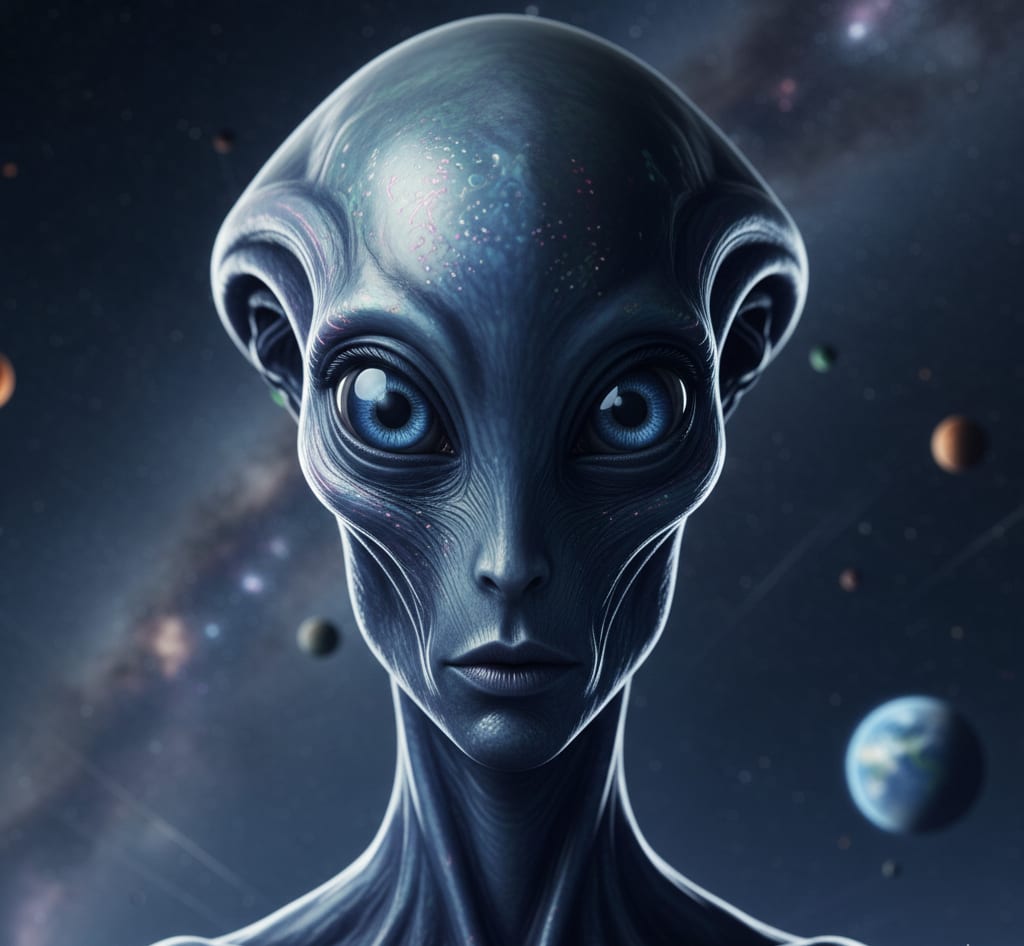
Since the earliest days of civilization, humanity has looked toward the night sky and wondered about our place in the cosmos. Billions of stars ignite the Milky Way, each with the potential to host worlds where life might flourish. Yet despite this overwhelming abundance, every search for signals beyond Earth has returned only silence.
This raises a profound question:
Is life extraordinarily rare, or simply hidden from our view?
Modern cosmology collides with biology in a striking way. On a physical scale, humankind is almost insignificant. But paradoxically, that very insignificance might make us exceptionally valuable. Some researchers argue that the number of technological civilizations in a galaxy like ours could average one or maybe just us. Amid hundreds of billions of stars and perhaps trillions of planets, we may be the only conscious observers.
Our galaxy contains between 100 and 400 billion stars, accompanied by an even larger number of planets. Recent studies suggest that up to 60 billion of these worlds may lie within habitable zones, where conditions could support liquid water and potentially life. The basic ingredients for biology appear widespread across the universe, yet no evidence of another civilization has ever been found.
This absence is the essence of the Fermi Paradox.
The paradox asks why, with so much time and so many opportunities for life to arise and evolve, no civilization has made itself visible. Even conservative estimates imply that advanced societies should have emerged long before us and left detectable traces.
Some scientists explore the idea of self-replicating probes. Von Neumann machines that could spread across the galaxy by reproducing themselves from raw materials found on planets and asteroids. If even one civilization created such machines hundreds of millions of years ago, the Milky Way should be filled with them.
And yet…
we see none.
No probes. No structures. No signals. Nothing.
Either no one ever built them...
or they’re far more advanced than we can comprehend, perhaps so small or so well-hidden that we simply cannot perceive them.
This silence suggests either that no one has attempted such expansion, or that such technologies are far beyond our ability to identify. It is possible that advanced artifacts could be far smaller, more efficient, or more subtle than anything we can currently imagine.
Another explanation considers the lifetimes of civilizations. Technological societies might be brief flashes on the cosmic timeline, rising quickly and disappearing just as fast due to self-inflicted damage or natural catastrophes. Industrialization alters a planet’s climate. Mastery of nuclear physics opens the door to self-destruction. These challenges may be universal, and many civilizations may simply fail to overcome them.
This idea forms the Great Filter; a barrier that most life cannot cross.
It could lie in the distant past, in the difficult leap from simple to complex organisms. Or it could lie ahead, in the phase we are entering now, looming, unforgiving, and deadly..
Some theories suggest that advanced civilizations exist but choose not to interact with younger societies, similar to a cosmic “zoo.” If so, they remain extraordinarily well hidden despite our growing observational abilities.
Updated versions of the Drake Equation now lean toward a sobering possibility: that detectable civilizations may be exceedingly rare, and that humanity might currently be the only one in the Milky Way.
The truth is, we simply don’t know.
We might be one of many.
We might be the first.
Or tragically, we might be the last...
With so little data, the safest assumption is that we should act as though we are alone. Our decisions environmental, political, and technological may determine whether the only known conscious species in our galaxy survives long enough to explore the stars.
The Great Filter stands as both a warning and a motivation. If civilizations typically fail to navigate their most dangerous era, then humanity must avoid becoming another silent statistic. If we truly are the only awakening intelligence in this vast galaxy, our extinction would extinguish an entire chapter of cosmic awareness.
Perhaps other civilizations hide themselves, or perhaps complex life itself is far rarer than our imaginations have long believed.
For now, Earth remains the only known cradle of consciousness. And until we learn otherwise, the responsibility of preserving that light rests with us.
For now, all we know is this:
The cosmos is vast.
We are small.
And the future of intelligent life in our galaxy may depend entirely on what we choose to do next... So let us protect our only home..
About the Creator
Sakuni Bandara
Just Another average girl !
Keep reading
More stories from Sakuni Bandara and writers in Humans and other communities.
How Accurate Interstellar Really Is?
When Interstellar hit theaters in 2014, it didn’t just entertain audiences , it rewired our brains. Christopher Nolan didn’t want another sci-fi fantasy. He wanted a film where space looked like space, where gravity behaved like gravity, and where black holes appeared the way the universe actually paints them. And standing behind him was Nobel Prize winning physicist Kip Thorne, whose job was to keep the movie grounded in real physics…at least, as real as physics allows when you’re folding spacetime like origami.
By Sakuni Bandara3 months ago in Futurism
A Historic Declaration
We the People of the Husbands of the United States of America, in Order to form a more perfect Union, and I mean you...with me...establish Justice, insure domestic Tranquility, provide for the common defence, promote the general Welfare, and secure the Blessings of Liberty to ourselves, after Puberty, do ordain and establish this Declaration of Co-Dependence.
By Gerard DiLeo4 days ago in Humans


Comments
There are no comments for this story
Be the first to respond and start the conversation.