

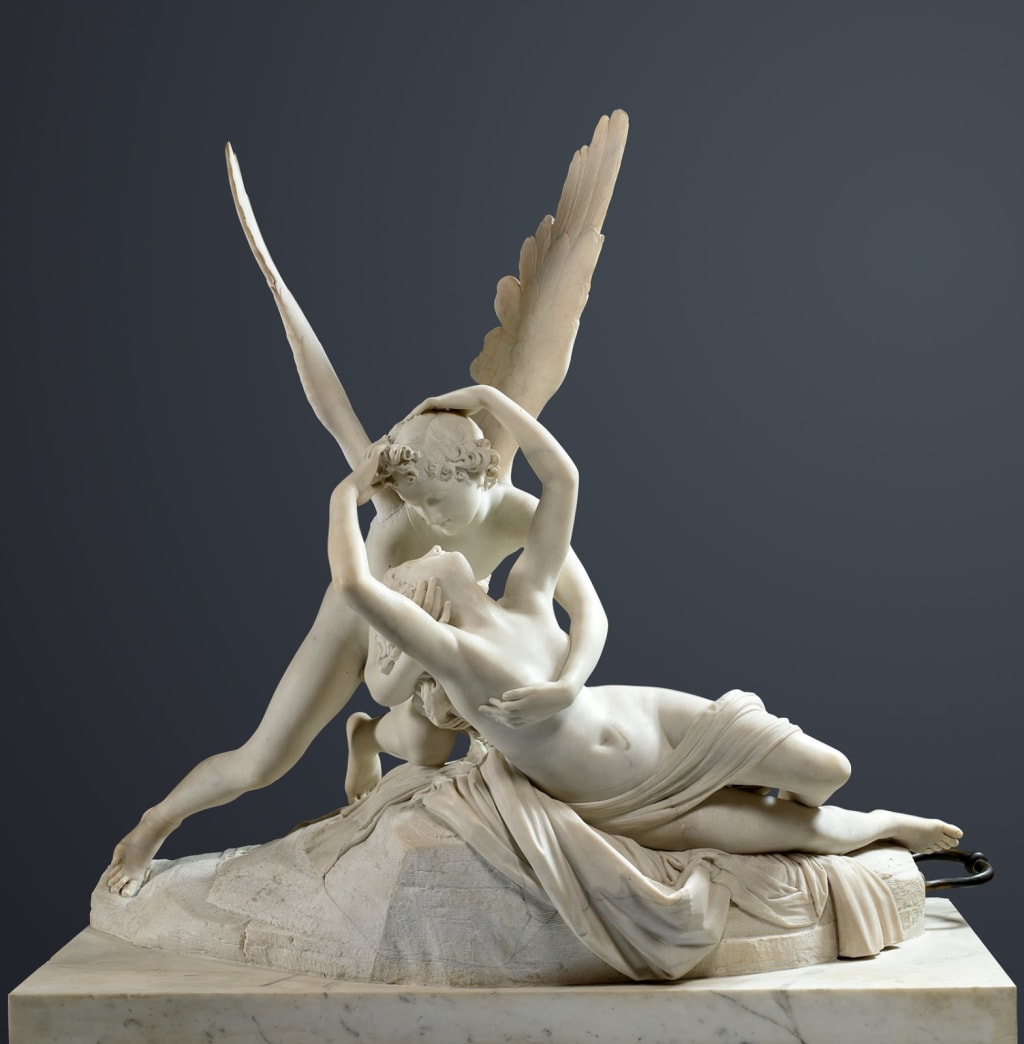
A good many years ago there lived in Italy a little boy whose name was
Antonio Canova. He lived with his grandfather, for his own father was
dead. His grandfather was a stone-cutter, and he was very poor.
Antonio was a puny lad, and not strong enough to work. He did not care
to play with the other boys of the town. But he liked to go with his
grandfather to the stone-yard. While the old man was busy, cutting and
trimming the great blocks of stone, the lad would play among the chips.
Sometimes he would make a little statue of soft clay; sometimes he
would take hammer and chisel, and try to cut a statue from a piece of
rock. He showed so much skill that his grandfather was delighted.
"The boy will be a sculptor some day," he said.
Then when they went home in the evening, the grandmother would say,
"What have you been doing today, my little sculptor?"
And she would take him upon her lap and sing to him, or tell him stories
that filled his mind with pictures of wonderful and beautiful things. And
the next day, when he went back to the stone-yard, he would try to make
some of those pictures in stone or clay.
There lived in the same town a rich man who was called the Count.
Sometimes the Count would have a grand dinner, and his rich friends
from other towns would come to visit him. Then Antonio's grandfather
would go up to the Count's house to help with the work in the kitchen; for
he was a fine cook as well as a good stone-cutter.
It happened one day that Antonio went with his grandfather to the
Count's great house. Some people from the city were coming, and there
was to be a grand feast. The boy could not cook, and he was not old
enough to wait on the table; but he could wash the pans and kettles, and
as he was smart and quick, he could help in many other ways.
All went well until it was time to spread the table for dinner. Then there
was a crash in the dining room, and a man rushed into the kitchen with
some pieces of marble in his hands. He was pale, and trembling with
fright.
"What shall I do? What shall I do?" he cried. "I have broken the statue
that was to stand at the center of the table. I cannot make the table look
pretty without the statue. What will the Count say?"
And now all the other servants were in trouble. Was the dinner to be a
failure after all? For everything depended on having the table nicely
arranged. The Count would be very angry.
"Ah, what shall we do?" they all asked.
Then little Antonio Canova left his pans and kettles, and went up to the
man who had caused the trouble.
"If you had another statue, could you arrange the table?" he asked.
"Certainly," said the man; "that is, if the statue were of the right length
and height."
"Will you let me try to make one?" asked Antonio "Perhaps I can make
something that will do."
The man laughed.
"Nonsense!" he cried. "Who are you, that you talk of making statues on
an hour's notice?"
"I am Antonio Canova," said the lad.
"Let the boy try what he can do," said the servants, who knew him.
And so, since nothing else could be done, the man allowed him to try.
On the kitchen table there was a large square lump of yellow butter. Two
hundred pounds the lump weighed, and it had just come in, fresh and
clean, from the dairy on the mountain. With a kitchen knife in his hand,
Antonio began to cut and carve this butter. In a few minutes he had
molded it into the shape of a crouching lion; and all the servants crowded
around to see it.
"How beautiful!" they cried. "It is a great deal prettier than the statue
that was broken."
When it was finished, the man carried it to its place.
"The table will be handsomer by half than I ever hoped to make it," he
said.
When the Count and his friends came in to dinner, the first thing they saw
was the yellow lion.
"What a beautiful work of art!" they cried. "None but a very great artist
could ever carve such a figure; and how odd that he should choose to
make it of butter!" And then they asked the Count to tell them the name
of the artist.
"Truly, my friends," he said, "this is as much of a surprise to me as to
you." And then he called to his head servant, and asked him where he
had found so wonderful a statue.
"It was carved only an hour ago by a little boy in the kitchen," said the
servant.
This made the Count's friends wonder still more; and the Count bade the
servant call the boy into the room.
"My lad," he said, "you have done a piece of work of which the greatest
artists would be proud. What is your name, and who is your teacher?"
"My name is Antonio Canova," said the boy, "and I have had no teacher
but my grandfather the stonecutter."
By this time all the guests had crowded around Antonio. There were
famous artists among them, and they knew that the lad was a genius.
They could not say enough in praise of his work; and when at last they
sat down at the table, nothing would please them but that Antonio should
have a seat with them; and the dinner was made a feast in his honor.
The very next day the Count sent for Antonio to come and live with him.
The best artists in the land were employed to teach him the art in which
he had shown so much skill; but now, instead of carving butter, he
chiseled marble. In a few years, Antonio Canova became known as one of
the greatest sculptors in the world.
THANK YOU.....
About the Creator
krishn muraree
Manager of Global Institutions
|| CEH || Computer Expert ||
|| IT Department || Programmer ||
Keep reading
More stories from krishn muraree and writers in Humans and other communities.
Autonomy Is The Real Privilege
Good morning, freedom-seekers! Today we’re gonna be looking at autonomy. A strange word, I know; one many would probably look at blankly and run away from on sight. We’re gonna figure out what it actually means, consider how it’s achieved, and decipher just how deeply most of us are tangled up in dependence without realising it.
By That ‘Freedom’ Guy5 days ago in Humans
The Hidden Valentine part 1
The First Message The lab was quiet at 2:13 AM, a time when even the fluorescent lights seemed to pause their buzzing, as if they were holding their breath. Maya stood alone beside the server bank, the only sound the faint hum of cooling fans and the soft click of her own heartbeat.
By Ahmed aldeabella3 days ago in Humans




Comments
There are no comments for this story
Be the first to respond and start the conversation.