
Active Listening
Active Listening Skills for College Students

INTRODUCTION
Active listening is a skill needed by all to effectively receive and understand information, but this skill is especially used by students in the classroom. Active listening is important for future student success in every career field they could consider going into. It is the basis of communication and the most effective form of communication considering the alts.
WHAT IS ACTIVE LISTENING?
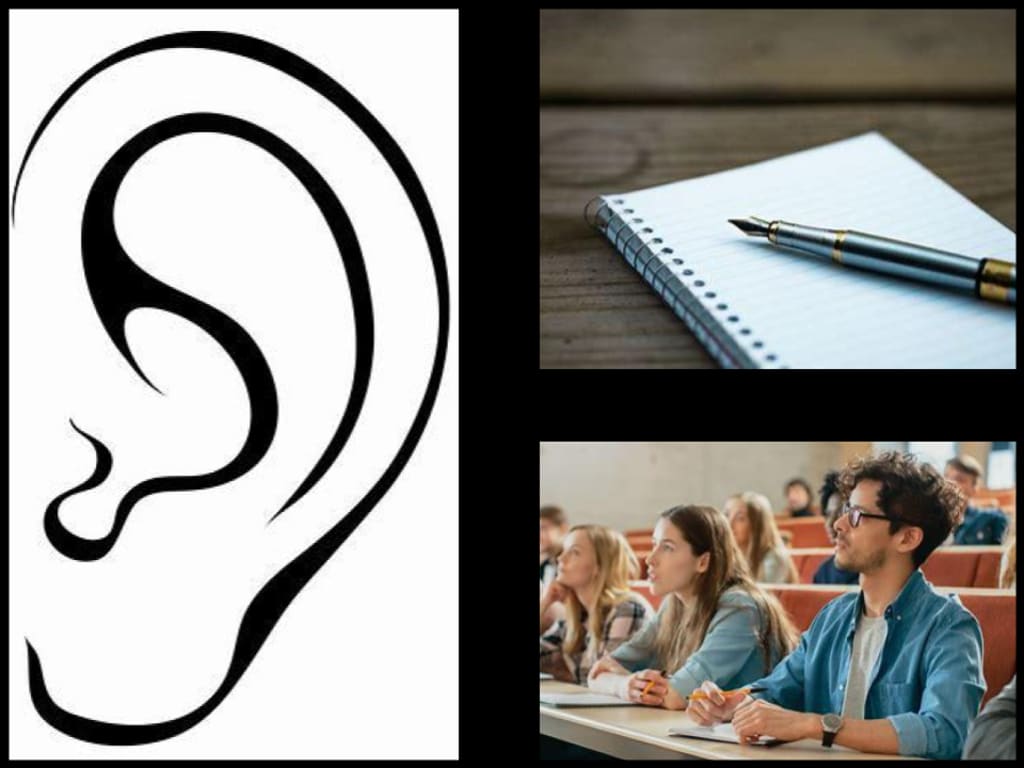
Active Listening is the act of hearing what a person is trying to say, thinking about what exactly they mean, and then responding in a meaningful manner. Doing active listening in this fashion provides a wonderful way for students to process the information provided in a classroom setting. Thinking about the information before responding gives the student time to think of a meaningful question or input that helps further the education of all.
METHODS FOR ACTIVE LISTENING
There are many methods to succeed in active listening. One of such is eye contact. You want to make eye contact with whoever may be speaking, whether that is the teacher or another student. Eye contact is important because not only will a student pay more attention and limit distractions from the speaker, but the right amount of eye contact will also give the speaker more confidence allowing what they are saying to become more clear. But what is the right amount of eye contact? The right amount of eye contact is described as not too little as to only be glancing, but not too much as to be staring right through the speakers soul.

Another great method to practice active listening is note taking. Note taking helps students pay attention by, again, limiting distractions. It is also proven that note taking, or writing something important down, helps you remember the information better. Note taking is also a great reference for studying later on. This, and many other great methods, are wonderful tools for active listening. This video has lots of tips on active listening methods!
NON-VERBAL COMMUNICATION
A big part of active listening is noticing non-verbal cues. Non-verbal cues can come in many shapes and forms. We already talked about one of the non-verbal cues when we mentioned eye contact. Eye contact, hand movement, and facial expressions. According to the team at helpstudy.com, and the team at london image institute, about ninety three percent of communication is considered non-verbal.
One of the most prominent non-verbal cues of communication are facial expressions. You can tell what emotion people are feeling by the emotion plastered on their face. This could be any range of happy to excited to sad to disappointed. Often times you can tell if a person is mad by the lack of a smile and a furrowed brow. If someone is very infuriated, their face may even turn another color like red or blue!
Another huge part of non-verbal communication is a person's posture. If a person is open and excited to talk about their topic, they will be more open and moving more. If a person is closed off and hunched over, they are far less likely to want to talk and are probaly not excited to be there. As an active listener, it is the student's job to dissect and inspect the body language of the listener to ensure that they are recieving the best possible information from the speaker.
CONCLUSION
There are many available resources for students regarding information on active listening. Students should try their best to be an active listener throughout their academic career. This will be the best route to engaging and retaining in a classroom. With this information, students are sure sure to become great active listeners!
About the Creator
Lex T. Barnett
She is enthused with worlds of fantasy to a point where it hinges on obsession. A hopeless romantiic at the best of times and a sobbing mess at the worst.
Keep reading
More stories from Lex T. Barnett and writers in Humans and other communities.
Your Personal Relationships:
In social penetration theory, relationships move through a scale of layers determining where you stand and how intimately you may know a person. We can call these layers the Onion Model. We call it this, because like an onion, whenever you pull back a layer, there is another one waiting to be explored. As people, we all have layers that make up our identities.
By Lex T. Barnett3 years ago in Humans
Autonomy Is The Real Privilege
Good morning, freedom-seekers! Today we’re gonna be looking at autonomy. A strange word, I know; one many would probably look at blankly and run away from on sight. We’re gonna figure out what it actually means, consider how it’s achieved, and decipher just how deeply most of us are tangled up in dependence without realising it.
By That ‘Freedom’ Guy6 days ago in Humans




Comments
There are no comments for this story
Be the first to respond and start the conversation.