
A Most Extraordinary Friendship
His Holiness the Dalai Lama, Archbishop Desmond Tutu and Douglas Abrams wrote this book
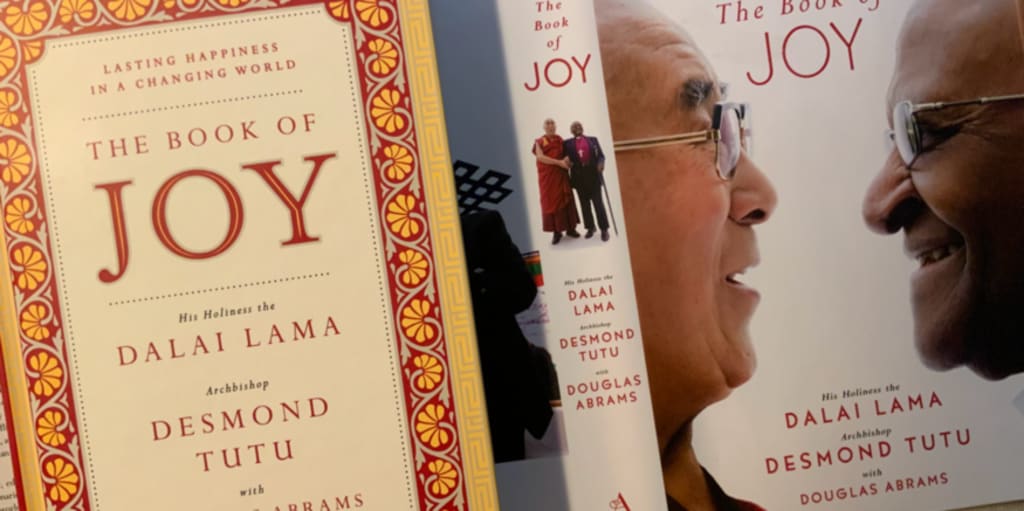
His Holiness the Dalai Lama, Archbishop Desmond Tutu and Douglas Abrams wrote this book. This book was written by three faiths: Christianity, Buddism and Judaism.
This book was perfect for me. It feels like my beliefs have been shaken by the events of the last two years, including the global pandemic. I hope this book will help me to find peace in my beliefs and help me move forward. Is it possible to find joy amid such a global health crisis?
Below is a brief overview of the first section of reading, along with key ideas and comments. This text is dense and complex with many ideas to consider. Unfortunately, I am unable to cover all the details of this article and the copyright prohibits me from quoting.
The Nature of True Joy (from Day 1).
This book is the result of a five-day meeting between two revered religious leaders. The Dalai Lama comes from the non-theistic Tibetan Buddhist faith. Archbishop Desmond Tutu comes from the monotheistic Anglican Christian faith. Both men share a common bond of friendship that they show in unexpected ways, such as kisses on the cheek, holding hands and warm embraces. Douglas Abrams is a Jew.
Why are you not morose?
This section focuses on the hardships both men have experienced.
Considered the Bodhisattva Of Compassion's reincarnation, the Dalai Lama was taken at two years old from his family to be raised in Potala Palace. He would go on to become the spiritual and political leader for Tibet. He fled Tibet after the Communist China invaded Tibet. Bishop Desmond Tutu was born in South Africa, which was divided by Apartheid, a system of discrimination and segregation that led to a deep division. It seems impossible for these men to be happy after suffering so much. Yet, it is not impossible.
After sharing his views on the sufferings of people all over the globe, including in Tibet, the Dalai Lama encouraged us not to be too narrow-minded about our pain, as we are not the only ones. There are many others who suffer, sometimes much more than us. He stated that it is possible to take a step back and reduce our anxiety about our own suffering.
The Dalai Lama's words were reinforced by Archbishop Tutu's own words. He also used questions to create a new perspective. It is our natural instinct to ask the question, "How can I escape?" It is a better question, however: How can this be used as a positive thing?
It is impossible to be beautiful without suffering
At the time of these conversations, Archbishop Tutu was fighting prostate cancer and dealing with physical pain. This experience was used by him to show how turning inward is harmful. He could still find joy in the care of medical staff, even during painful procedures.
He stressed that how we deal with hardships and other negative situations can greatly influence the person we become. If we react to these situations with anger, it is likely that we will lash out at others. The Dalai Lama explained this in a succinct manner. Self-centered thinking leads to more suffering.
Are You Ready to Give Up Pleasure?
This section focuses on the distinction between joy and happiness. These words are not synonymous, even though they have been used in this manner.
The Dalai Lama was the best to speak on the topic of pleasure and happiness. He considers sensual pleasures a hindrance to his enlightenment as a Buddhist monk and has since renounced them.
The two religious leaders had a lively and funny exchange about sex. The Dalai Lama then used this conversation to compare happiness that is based on joy and pleasure with a deeper level that is based upon love, compassion and generosity.
Our greatest joy
The next section was where Archbishop Tutu has the most to offer after introducing us the Zulu people in South Africa to the African philosophy called "ubuntu". Douglas Abrams, the narrator of this story, defines it as the idea that a person can be defined as a person by other people.
Archbishop Tutu gives the example of having only a small amount of bread. He stated that sharing bread is good for him. Sharing is key to a joyful life, as we were taught as children.
Summary of the first session of discussion
The discussion ended with a discussion about the opportunities available to be more self-directed and more others-directed in our lives. It is a paradox that helping others helps us the most. Many members of the book group were unfamiliar with the philosophy of Ubuntutu and wanted to know more.
The greatest lesson was the many similarities between these two great spiritual leaders. It was not contradictory. Although neither spiritual leader has mentioned the joy of having chickens in your yard, I feel that it will soon.
Their extraordinary friendship was a key factor in their unity of thought, feeling and thought. They gave us an even deeper appreciation of the deeper truths behind experiencing lasting happiness, joy, and peace.
About the Creator
Keep reading
More stories from Sergio Castellanos and writers in Humans and other communities.
These are the 10 things you should avoid if you want love that lasts.
1. Do not neglect your friendships Perhaps you are dating your soulmate. One-hundred percent of the time, you know that the man or women you are with is "the one." But they may not be the only one. Your extended family includes your friends. Even if you have found the one you will spend the rest of the life with, your friends deserve your love and attention. You will have your ups and downs with your partner, but your friends will be there for you in times of need. They will listen to your problems, and remind you that you can get through them. Your friends will understand you and help you navigate the challenges of building and maintaining long-term relationships. Your mental health and your relationship depend on your friendships.
By Sergio Castellanos4 years ago in Humans
Kindred Spirits vs Soulmates: Key Emotional Differences.
The terms “kindred spirit” and “soulmate” are often used interchangeably, but they describe fundamentally different kinds of connections. Both are meaningful, but the emotional dynamics, depth, and purpose of each connection vary. Understanding these distinctions helps you recognize the nature of your relationships and navigate them with clarity, emotional balance, and intention.
By Wilson Igbasi6 days ago in Humans



Comments
There are no comments for this story
Be the first to respond and start the conversation.