
A Cartography of Becoming
Mapping what loss taught me about becoming whole
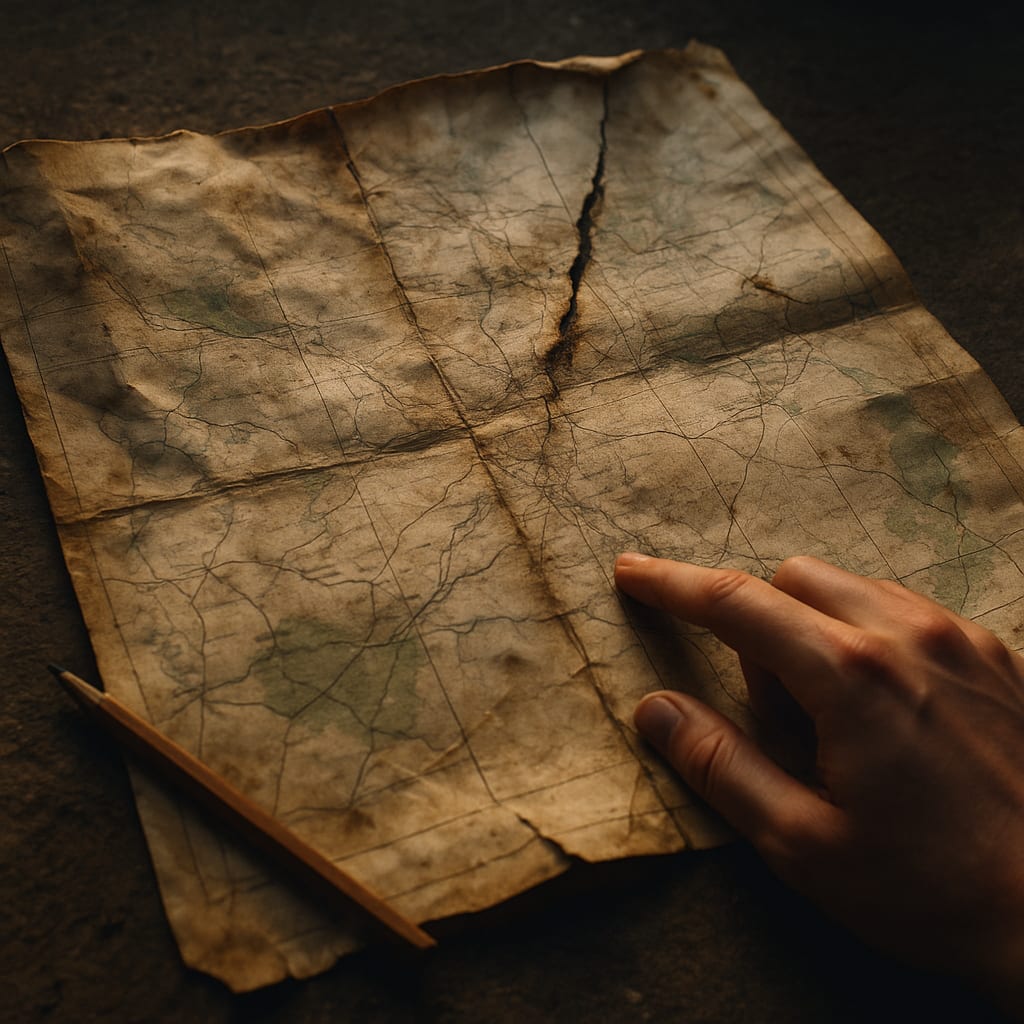
We all carry maps, whether we realize it or not. Some are straightforward: the neighborhoods we grew up in, the routes to our favorite coffee shops, the big moments we counted down to. Other maps exist under the surface, invisible but stubborn—etched by memories, heartaches, and the times life knocked us sideways.
Funny how the maps themselves get worn out. My own has creases from being folded and shoved into pockets, literal and otherwise. There are stains, too—coffee rings, blood, or tears. The detours and dead ends aren’t just mistakes; they’re the places where my life twisted in ways I never saw coming.
I never set out to chart any of this. I was just living. But then grief crashed into my world and started redrawing everything. The first marker was Shannon, my brother’s girlfriend. She was only twenty-one. Her death didn’t arrive quietly—it was more like a thunderstorm that showed up when the sky was clear. I was twenty then, still trying to figure out who I was, and suddenly, she was gone. That loss left a line on my map—faint, but it never faded. It shifted something in me, and I realized the ground could drop away at any second.
After that, I found myself moving toward the pain, not away from it. I became the one holding my brother together, even when I wasn’t sure I could hold myself up. I don’t regret it. I loved him, and I loved Shannon, and love is messy. But looking back, I can see how my own path bent around his grief. I started to disappear a little, bit by bit.
Things kept shifting. I lost pets—four dogs, each with their own quirks and muddy paw prints. My Grandmama passed. Then my dad. Each loss drew new lines, making my twenties feel like a landscape I didn’t recognize anymore. But nothing split me open like Dad’s death. It was as if the world shook, and I couldn’t tell what was standing or what was just rubble.
When he died, I remember feeling like I couldn’t breathe. There was this heavy quiet afterwards, like the world was holding its breath. About a month later, I sat in my Park City office, eating a sad desk salad, and opened his will. The email was cold—just legalese and a line that basically erased my brother and me from his story. I kept staring at the screen, hoping for an explanation that wasn’t coming. It was a clean break, right through everything I thought was unbreakable.
I tried to make sense of it, telling myself it was just money, or maybe someone else had influenced him. But none of that patched the cracks. Grief isn’t a straight road; it’s more like wandering through a city with no street signs.
When I heard about the last day of his life—a cheap motel, a drive to see his mother who wasn’t home—I wondered if he was searching for something too. A way back, maybe. I’ll never know. That question’s still there, like an empty spot on the map.
Grief is learning to live on fault lines, I guess. You find ways to walk, even when the ground feels like it might split again.But not every loss leaves you in ruins.
When Papou died, it was different. The grief felt softer, rounder. I missed him, but it didn’t tear me apart. For the first time, I realized that not all endings destroy you. Some give you room to grow, to plant something new. I held onto that.
After all these losses, I looked ahead and just saw blank space. I kept moving anyway, hoping I’d stumble back into myself. But grief doesn’t let you go backwards. You circle around until your steps start making a new path.
There were months—maybe years—when I lived in the canyon, quiet and hollowed out. I went to work, smiled at the right times, answered “I’m fine” even when I wasn’t. On the outside, I looked okay, but inside, the dust hadn’t settled.
I used to think pushing through meant I was strong. Just keep moving, keep checking off boxes. But honestly, I was just tired. There’s a difference between surviving and living. It took me a long time to see that.
Everything started changing when I finally let myself stop. I noticed sunlight on the kitchen counter, the clack of my dog’s nails on the floor, the way my partner’s laugh made mornings brighter. I started climbing again—real mountains, and the ones inside me. Boxing, skiing, biking, writing, just moving my body and my heart. Each thing felt like a small vote for staying alive.
Somewhere in there, I stopped searching for the old me. I began listening for the person I was turning into. Grief, I learned, is both the map and the hand drawing it. It makes you find your way by feel, not by certainty.
Forgiveness came slow, like a river wearing down stone. It wasn’t about pretending nothing happened. It was about letting go of what couldn’t be fixed. The pain settled in, but it wasn’t as sharp. It became part of me.
Studying death work was like finding a hidden road. Becoming a death doula gave me words for what I’d already lived through. I saw how grief looks different everywhere, how laughter and mourning sometimes show up together, how love sticks around even when the person doesn’t.
Losing my brother Chris changed the shape of everything again.
This time, I didn’t try to label it. I just stood there as the ground shifted. After all the other losses, I thought I knew grief’s tricks, but this was different. It was quiet, slow, the kind of pain that folds in on itself.
Some days, I still feel like I’m digging out from the wreckage. Part of me is growing, and part of me is still missing. I don’t know where this will lead. The map’s a mess here, nothing but guesses and glimmers. But even now, I can feel something new pushing up through the cracks. Maybe it’s love that refuses to leave. Maybe it’s hope, or maybe just the stubbornness to keep moving. I’m not sure.
Even when everything falls apart, life keeps going. The map keeps changing. I don’t expect the ground to stay the same anymore. I know now that steadiness isn’t about things not moving; it’s about learning to walk while the world rearranges itself beneath your feet.I doubt the map will ever be finished.There will always be new hills, new cracks, new places where the light surprises me. But I know how to find my way now—not by looking for answers, but by following what feels real.
These days, I choose what brings me alive: writing, making things, helping others find their own words for loss. I say yes to what grounds me, no to what doesn’t. I walk slower, pay attention, and let wonder live where fear used to be.
Grief’s still there, but it’s not everything. It’s just the earth I grow from. I used to think healing meant getting over it, climbing some mountain and never looking back. Now I know it’s more about learning to live here, in the wild country of loss and love, letting it all belong.
Losing so much has made me want to be here, to love fiercely and honestly. To light a lamp for myself, and maybe for someone else still lost in the dark. The map isn’t perfect—creased, messy, a little damp from the storms. But it’s mine. And even as parts crumble, I can see green things growing in the cracks, proof that becoming is the real journey.
About the Creator
Keep reading
More stories from writers in Humans and other communities.
How Astrology Explains Twin Flame Attraction and Repeated Separation Cycles.
Twin flame relationships are intense, transformative, and often confusing. Unlike typical romantic connections, twin flames are said to mirror each other’s deepest fears, desires, and unhealed wounds. Many people in such relationships experience a cycle of union, separation, and reunion that seems endless. Astrology offers a framework to understand why these magnetic connections exist and why they can be so turbulent.
By Wilson Igbasi6 days ago in Humans



Comments
There are no comments for this story
Be the first to respond and start the conversation.