
(4) Unequal Enforcement
When Law Ceases to Be Unilateral and Becomes a Tool of Control


- The Requirement of Unilateral Law -
Law only functions as law when it is applied unilaterally. This does not mean identically or blindly, but reciprocally and predictably. A unilateral legal system is one in which rules bind all parties regardless of status, wealth, or position, and where increased power brings increased exposure rather than exemption. When this condition holds, law operates as a shared boundary that constrains behavior and stabilizes cooperation. People may disagree with outcomes, but they can anticipate them. That predictability is what allows trust to exist even in imperfect systems.
Once unilateral enforcement breaks down, law undergoes a functional transformation. It stops being a boundary and becomes an instrument. Rules still exist, procedures are still followed, and legitimacy is still claimed, but application becomes conditional. Who you are begins to matter more than what you did. Enforcement becomes selective, delayed, or negotiable for some, while remaining rigid and immediate for others. At that point, law no longer governs society as a whole. It governs different classes differently, and the fiction of neutrality begins to collapse.
- How Selective Enforcement Emerges -
Selective enforcement does not usually arise from explicit exemption. It emerges through discretion layered on top of complexity. Prosecutorial judgment, regulatory interpretation, settlement authority, and procedural delay all introduce flexibility into enforcement. In principle, these mechanisms exist to allow fairness in complex cases. In practice, they become the channels through which power avoids consequence. The more resources, status, and institutional access an individual or organization has, the more leverage they possess within these discretionary spaces.
Over time, this flexibility hardens into pattern. Enforcement against low-status actors becomes faster, harsher, and more standardized because it is efficient and low-risk. Enforcement against high-status actors becomes slower, softer, and more negotiated because it is costly, disruptive, and politically dangerous. This asymmetry is not an accident. It is a survival adaptation of the system. Once elite insulation exists, equal enforcement becomes destabilizing. Selectivity becomes necessary to preserve the structure that protects those at the top.
- The Two-Tier Legal Reality -
When enforcement diverges consistently, society splits into two legal realities. One is a rules-based system for the many, where compliance is mandatory, punishment is swift, and discretion is minimal. The other is a managed system for the few, where violations are contextualized, consequences are deferred, and accountability is converted into administrative cost. Both realities operate simultaneously under the same legal code, but they do not function the same way.
This bifurcation produces a quiet but profound shift in social understanding. Ordinary people begin to recognize that law is not something they participate in equally, but something applied to them. Elites, meanwhile, come to experience law as a navigable environment rather than a binding constraint. This divergence erodes the moral authority of legal institutions. When people see that outcomes depend on position rather than conduct, obedience becomes transactional rather than principled, and legitimacy decays from the inside.
- Why Law Becomes Directional -
Once enforcement is unequal, the law inevitably feels directional. It appears to flow downward, applied with force against those who lack protection, while flowing around those who possess it. Compliance is demanded from the public, but reciprocity is absent. Minor infractions receive disproportionate attention, while systemic harms disappear into process. The coercive apparatus of the state remains intact, but its orientation shifts.
This is the moment when people begin to describe the law not as protection, but as pressure. Not as justice, but as management. This perception is often dismissed as emotional or conspiratorial, yet it follows directly from observable enforcement patterns. When rules are enforced against one class and negotiated with another, the law ceases to function as a neutral system. It becomes a mechanism for maintaining hierarchy under the appearance of order.
- Why This Destroys Trust Without Open Oppression -
Unequal enforcement is uniquely corrosive because it does not require overt tyranny to function. Elections can still occur. Rights can still be proclaimed. Courts can still operate. Yet trust erodes because lived experience contradicts official claims. People are told the system is fair while repeatedly observing that fairness is conditional. This dissonance is more destabilizing than open repression because it undermines belief without providing a clear enemy.
As trust collapses, cooperation declines. People comply out of fear rather than conviction. They disengage where they can and resist where they must. Cynicism spreads not because people reject law, but because law has rejected reciprocity. A system that relies increasingly on coercion to maintain order while insisting it remains legitimate is not stable. It is brittle.
- Why Unequal Enforcement Is Not a Bug -
It is tempting to treat unequal enforcement as a flaw that can be corrected through better oversight or ethical reform. That misreads the structure. Once power is insulated and consequence decoupled, unequal enforcement becomes necessary. It is not a deviation from the system’s logic. It is the system’s logic. Equal enforcement would reintroduce risk at the top, which the structure has evolved to avoid.
This is why appeals to fairness alone fail. Moral language cannot override incentive architecture. A system that depends on selective enforcement for stability will resist reform that threatens that selectivity. Attempts to restore unilateral law are framed as unrealistic, dangerous, or destabilizing not because they are wrong, but because they are incompatible with the existing power arrangement.
- What This Means for Legitimacy -
Legitimacy does not disappear when laws are broken. It disappears when laws are applied asymmetrically. People will tolerate imperfection, inefficiency, and even corruption longer than they will tolerate a system that pretends to be neutral while operating hierarchically. Once unilateral enforcement is gone, legitimacy becomes performative. Authority persists, but belief does not.
At that stage, the system is no longer sustained by shared consent. It is sustained by inertia, dependency, and fear of disruption. That condition can persist for a long time, but it does not self-correct. Without structural change, unequal enforcement deepens, resentment accumulates, and stability becomes increasingly artificial.
- The Line That Cannot Be Crossed -
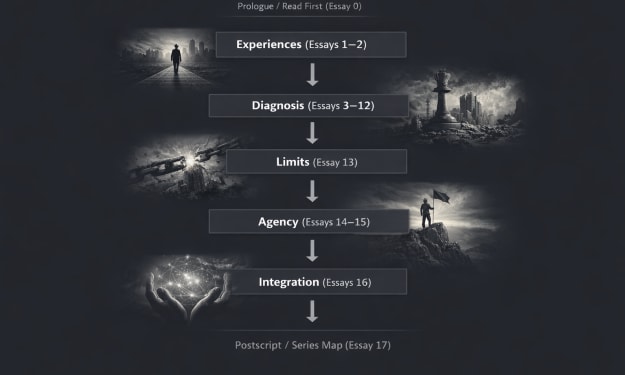
If the previous essay showed how authority detached from consequence produces insulation, this essay shows where that process becomes visible to everyone. Unequal enforcement is the point at which abstraction collapses into experience. People may not articulate the structure, but they feel the result. They know the rules are not the same for everyone, and once that knowledge becomes widespread, the system cannot rely on legitimacy alone.
Law can survive disagreement. It cannot survive partiality. When enforcement ceases to be unilateral, the system has already crossed the most dangerous line it can cross without acknowledging it. What follows is not collapse by outrage, but erosion by recognition.
About the Creator
Peter Thwing - Host of the FST Podcast
Peter unites intellect, wisdom, curiosity, and empathy —
Writing at the crossroads of faith, philosophy, and freedom —
Confronting confusion with clarity —
Guiding readers toward courage, conviction, and renewal —
With love, grace, and truth.
Keep reading
More stories from Peter Thwing - Host of the FST Podcast and writers in Humans and other communities.
(3) Authority Without Consequence
- The Moment Authority Became Untethered - Every functioning system of governance relies on a constraint so fundamental it often goes unnoticed until it disappears: authority must be exposed to consequence. When those who make decisions experience the downstream effects of those decisions personally, power is naturally disciplined by risk. That discipline does not require virtue or foresight. It operates mechanically. Decisions that produce harm are abandoned because they injure the decision-maker, and decisions that succeed are reinforced because they reward restraint. Modern political systems did not lose this constraint through a single reform or moral collapse. They lost it gradually, through delegation, bureaucratic layering, procedural complexity, and the normalization of distance between action and outcome, until authority could be exercised without meaningful exposure to its effects.
By Peter Thwing - Host of the FST Podcast2 months ago in Humans
Memento Mori
Life is not short. I’ll explain: we feel like it’s short because time passes by quickly. And if it isn’t, on hindsight, it did. But when we think we have quantified it quite well, we don’t, really. It happens to me. It happent to everyone. It’s human, actually. Because time is beyond our full comprehension.
By Maya Or Tzura day ago in Humans



Comments
There are no comments for this story
Be the first to respond and start the conversation.