
Whispers in the Snow: A Real Horror Story from Kashmir
A chilling tale from the valleys where beauty and darkness walk hand in hand

Kashmir—often called “Paradise on Earth”—is known for its snowcapped mountains, serene lakes, and blooming tulips. But beneath this breathtaking beauty lies a land shaped by centuries of mystery, war, and whispers of the supernatural. While many stories from the region speak of its political tensions or poetic charm, some tales drift far into the shadows. This is one such story—based on chilling accounts whispered in the villages and passed down in hushed voices. A real horror story from Kashmir, it’s a reminder that not all that’s beautiful is safe.
---
The Forgotten Village of Gurez
Nestled near the Line of Control, in the remote region of Gurez, lies a small village surrounded by towering mountains and endless snow. The village, known to locals as Darwan, does not appear on most maps. Even seasoned Kashmiris have never heard of it. Cut off for half the year due to snow, Darwan is a place suspended in time.
In the early 1990s, during a particularly harsh winter, a young schoolteacher named Faheem Ahmad was posted to Darwan. He was in his late twenties, unmarried, and enthusiastic about bringing education to remote areas. The government had offered incentives for teachers willing to work in far-flung villages. Faheem, idealistic and fearless, accepted the posting eagerly.
---
The Arrival
Faheem arrived just before the first snowfall. The villagers welcomed him with quiet smiles and warm bread, but something felt off. He noticed that people rarely stayed outside after sunset. Doors were bolted with thick chains, windows were covered with black cloth, and children were warned not to look out after dark.
Curious, Faheem asked about it. Most villagers dismissed his questions. “It’s just the cold,” one said. Another whispered, “There are old stories. Don’t pay them any mind.” But the tension in their eyes betrayed them.
The school building was a small, wooden structure at the edge of the forest. By day, it was cheerful—children eager to learn, Faheem excited to teach. But by night, the forest seemed to breathe. And then the knocking began.
---
The Knock
It started in the second week. Always around 2:00 AM. A slow, steady knock on his door—three times, then silence. Faheem would rush to the door and find no one. Thinking it was a prank, he asked the village elders. Their reaction was troubling.
“Do not open the door at night,” the oldest elder warned. “No matter what you hear. Do not respond.”
Faheem laughed it off. But the knocks grew louder, more insistent. One night, he swore he heard a child’s voice calling his name: “Faheem... open... it’s cold...”
Terrified, he stayed awake with a lantern by his bed. The wind howled like a wounded animal. The knocking returned, followed by scratching at the walls.
---
The Forest Speaks
During the day, he explored the forest behind the school, hoping to find signs of animals. What he found instead were strange markings on trees—ancient symbols, unfamiliar even to local villagers. One old woman told him they were “seals,” placed long ago to keep something trapped.
That night, the village experienced a blackout. In total darkness, Faheem heard footsteps on his roof. Not the scampering of animals—these were heavy, deliberate steps. Then a scream—sharp and cut off, like someone falling into a deep well.
When morning came, one of the children from his class was missing.
---
The Disappearance
The villagers gathered in silence. No one spoke of the missing child. No search parties were formed. It was as though the boy had never existed.
Faheem was furious. He confronted the village headman, demanding answers. The old man, tears in his eyes, finally spoke.
“A long time ago, this village was cursed,” he began. “A woman accused of witchcraft was executed by the river. As she died, she swore vengeance—not just on the ones who killed her, but their children’s children. Every winter, when the snow buries us, she returns to take one.”
He paused, then said something that chilled Faheem more than any wind: “She knocks first. Always.”
---
The Final Night
Faheem, torn between disbelief and growing fear, decided to leave. He wrote to the district office requesting a transfer. But heavy snowfall had blocked all routes. He was trapped.
The last night he spent in Darwan was the coldest the village had seen in years. Wind rattled the windows like bones. At exactly 2:00 AM, the knocking came—louder than ever. Then the door creaked open, by itself.
He saw her.
Pale, soaked in black water, eyes like empty wells. She stood at the threshold, mouth moving silently. Faheem tried to move, to scream—but his body was frozen. She raised a bony hand and pointed at him.
And then everything went dark.
---
The Aftermath
Weeks later, when the snow melted, a relief team arrived. They found the village mostly abandoned—only a few terrified elders remained. Faheem was gone. The schoolhouse was empty. His belongings were still there, untouched.
Only one thing was out of place: on the door of the school, burned into the wood, were three symbols—the same ones found in the forest.
Faheem was never found. No body. No trace.
---
Whispers Continue
Today, few speak of Darwan. The village, if it ever existed, is lost to time or buried under new maps. But in the colder corners of Kashmir, travelers tell stories around the fire. Of a schoolteacher who vanished. Of a forest that murmurs in a language no one dares translate. And of three knocks in the night.
Those who listen say you should never respond—no matter what you hear.
Because some doors, once opened, can never be closed again.
---
Final Thoughts
Kashmir is not just a land of beauty—it’s a place of deep history, ancient belief, and whispered horrors. Whether Faheem’s story is truth or legend, it stands as a chilling reminder that some places carry memories too old and too dark to ever fade. And in the cold silence of snowy nights, not all footsteps are human.
Would you answer the knock?
About the Creator
Keep reading
More stories from Farhan Rafid and writers in Horror and other communities.
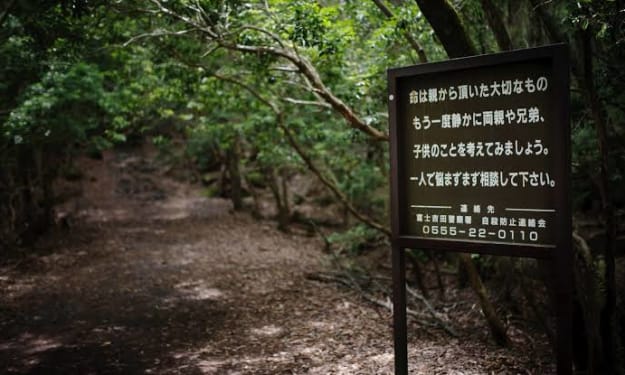
"Aokigahara: Japan’s Haunted Suicide Forest and Its Dark Secrets"
Japan’s Aokigahara Forest, often called the "Suicide Forest," is one of the most infamous natural locations in the world—not for its beauty or wildlife, but for the chilling stories and dark history that cling to its ancient trees. Nestled at the northwest base of Mount Fuji, this dense forest spans over 35 square kilometers and is both mesmerizing and terrifying. To many, it is a place of silence, mystery, and unexplainable dread.
By Farhan Rafid10 months ago in Horror



Comments
There are no comments for this story
Be the first to respond and start the conversation.