
Unseen movie review 2023
"Unseen: A Review of Blumhouse's Latest Low-Budget Thriller"

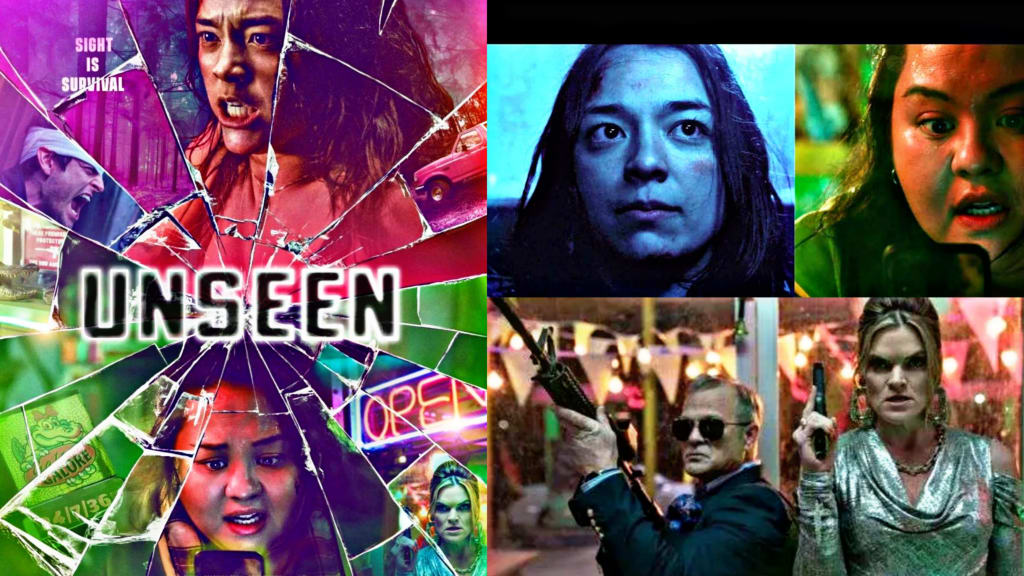
In Yoko Okumura's latest film, "Unseen," viewers are introduced to Emily (played by Midori Francis), a Japanese-American woman who is kidnapped and held captive. Her only hope of escape lies with a stranger named Sam (Jolene Purdy) who helps her navigate her way out using mobile video calling. Despite the committed performances of Francis and Purdy, the contrast between their characters and the campy, deranged supporting characters of Carol (Missi Pyle) and Charlie (Michael Patrick Lane) is outrageous. The plot revolves around white American stalkers whose identities center around entitlement and a desire to kill Emily and Sam.
Blumhouse Productions, known for its thriller and horror films such as "Get Out," "Paranormal Activity," and "M3GAN," adds "Unseen" to its list of productions. This low-budget entry can be categorized under their subgenres of "the horror of whiteness" or "the horror of Karens and Connors." The film's joy comes from seeing repressed characters eventually win, but the absurdity of it all makes it difficult to watch. As Charlie chokes and chastises Emily, yelling, "sing for me," it raises questions about whether this is the "warm welcome" that viewers were looking for during Women's History Month.
The film's futuristic aspect of a video call saving both characters is its hook and insight. However, it disguises a relatively generic and inconsistent plot with scattershot hot-button issues used instead of character development. The survival thriller is filled with scary Americanisms like "rednecks" and malfunctioning slushie machines, but nothing produces thrills, insight, or even laughs. At one point, Sam's anticlimactic comeback is "eat all the Williams Sonoma cheese you want." Nickelback's "Burn It to the Ground" plays, and viewers may wish for a more possible outcome. The characters, sets, and premise should burn.
Ultimately, the film highlights the unreliability of American police when it comes to saving non-white citizens and their reliability to arrest individuals in the name of saving a Karen. The responsibility of a basic moral code is placed on Asian communities, and the film does not explore the theme of white Americans' aloofness. The teetering between human morals and saving raging whiteness is not the nuance or duality audiences actually want to face. Blumhouse loves to play with this idea, but it does not add up to anything. The film shows that, as a non-white American, it does not matter if you are a successful doctor or a poor gas station worker. Whiteness reigns and is relentless unless you have a phone to make video calls to random people that vaguely resemble you.
In conclusion, "Unseen" is a film that should live up to its title. While the futuristic aspect of a video call saving characters is intriguing, the plot is generic and inconsistent, and the characters lack depth. The film's themes of the unreliability of American police and the responsibility of a basic moral code being placed on Asian communities are not explored fully. "Unseen" may be categorized under Blumhouse's subgenres of "the horror of whiteness" or "the horror of Karens and Connors," but it falls short in producing thrills, insight, or even laughs.
Other type review for subscribers in below
Yoko Okumura’s "Unseen" hit theaters today, ahead of an MGM+ release in May. The film features Emily (Midori Francis) who is kidnapped and must escape her captor with the help of a stranger named Sam (Jolene Purdy) through mobile video calling. Despite committed performances from Francis and Purdy, the supporting characters, Carol (Missi Pyle) and Charlie (Michael Patrick Lane), are campily deranged and outlandish throughout the film. This contrast is magnified when the successful Japanese-American character and the depressed, poor Japanese-American character face white American stalkers whose entire identities center on entitlement and a desire to kill them.
Blumhouse Productions is known for its thriller/horror films such as "Get Out," "Paranormal Activity," and most recently, "M3GAN." "Unseen" could be categorized under their sometimes subgenres of “the horror of whiteness” or “the horror of Karens and Connors.” However, despite the joy of seeing repressed characters eventually win, the absurdity of it all makes the film difficult to watch. As Charlie yells, “sing for me,” while choking and chastising Emily, who is shackled, one may question if this is the “warm welcome” into Women’s History Month they were looking for.
While the futuristic aspect of video calling is the movie's hook, it disguises a relatively generic, inconsistent plot with scattershot hot-button issues used instead of well-developed characters. This redundant survival thriller is filled with Americanisms like “rednecks” and malfunctioning slushie machines, but nothing produces thrills, insight, or even laughs. “Eat all the Williams Sonoma cheese you want” is Sam's anticlimactic comeback at one point. Nickelback’s “Burn It to the Ground” then plays, and one may find themselves wishing for a more possible outcome. The characters, sets, and premise should burn. Ultimately, the audience witnesses the unreliability of American police when it comes to saving non-white citizens and the reliability of them to arrest you in the name of saving a Karen. The responsibility of a basic moral code is placed on Asian communities, and in contrast, makes white Americans’ aloofness another of the film's many unexplored themes.
The teetering between human morals and saving raging whiteness is not the nuance or duality audiences want to face. It is not a reality to tease or promote, but Blumhouse loves to play with this idea even when it doesn't really add up to anything. The film shows that as a non-white American, it does not matter if you are a successful doctor or a poor gas station worker. Whiteness reigns and is relentless unless you have a phone to make video calls to random people that vaguely resemble you.
In conclusion, "Unseen" should live up to its title. While the futuristic aspect of video calling adds an interesting element to the film, it ultimately disguises a generic, inconsistent plot with underdeveloped characters. The absurdity of the movie's hot-button issues makes it difficult to watch, and the teetering between human morals and saving raging whiteness is not the nuance or duality audiences want to see. Instead, the responsibility of a basic moral code is placed on Asian communities, making white Americans’ aloofness another of the film's many unexplored themes. As a non-white American, it does not matter if you are a successful doctor or a poor gas station worker. Whiteness reigns and is relentless unless you have a phone to make video calls to random people that vaguely resemble you.
About the Creator
Kiruthigaran Mohan
art writing...
Keep reading
More stories from Kiruthigaran Mohan and writers in Horror and other communities.
Smile movie review 2022 old released best horror movie
When future horror historians write about the 2010s, they'll likely associate the decade with trauma metaphors, much as the '80s are synonymous with slasher flicks. Paramount's latest wide-release horror movie, "Smile," which hits theaters on the cusp of a new decade, is no exception. The film follows Dr. Rose Cotter (Sosie Bacon), who is plagued by a demon or evil spirit that feeds on trauma and is spread by it. The creature specifically preys on those who have witnessed someone else's gruesome and bloody suicide, like Laura (Caitlin Stasey), a PhD student who Rose meets in the psychiatric emergency ward where she works. Laura explains that the entity has been following her ever since she saw her professor bludgeon himself to death with a hammer. At the end of the scene, Laura turns to Rose with a psychotic grin and slits her own throat.
By Kiruthigaran Mohan3 years ago in Horror



Comments
There are no comments for this story
Be the first to respond and start the conversation.