
"They're Coming to Get You, Barbra!"
Anxiety, Apocalypse and Night of the Living Dead (1968)


It is generally held that there are three great taboos of human existence: incest, necrophilia, and cannibalism. (Note: When we say "taboos," we mean of course those acts to which most people feel instinctive physical and moral revulsion. Murder is not really in the same league; for, killing can and is often morally justified, but the other acts--save perhaps for cannibalism, out of absolute necessity to survive--NEVER can.)
George Romero's 1968 cult horror classic Night of the Living Dead, incredibly enough, manages to violate ALL of these three, and tosses in matricide to boot. (It is further interesting to note that the crime of matricide was considered so heinous by the ancient Romans that even a people as decadent and seemingly bereft of moral scruples as they could not quite fathom it. They had a special method of execution for those so convicted. To wit: they sewed the doomed offender into a leather sack with a monkey and a snake and then tossed the whole in the river. As the water began to seep in, the animals would go into a frenzy, with the result being an almost inconceivable death for the condemned individual.)
The film has been remade so many times, imitated so often and spawned several increasingly popular sequels in its own right, that, to lay out the details of the plot seems almost absurdly redundant. Most already have seen the picture or its modern variants enough times to already KNOW Night. It has crossed over into our cultural subconscious. But, at any rate, a quick synopsis.
Barbra (Judith O'Dea) and brother Johnny (Russell Streiner) are out for a trip, to "place a wreath on their father's grave" (in actuality, a small cross with flowers). In the cemetery, Johnny tries to scare Barbra, telling her, "They're coming to get you!" Wandering in the distance is a strange man (Bill Hinzman) with a stiff gait. Barbra walks away from Johnny in disgust, passing the strange man. He attacks her suddenly, and Johnny races forward to defend his sister. Struggling with the man, Johnny falls and hits his head against a gravestone. So exits Johnny. For the time being.
Barbra runs, the weird, stiff-legged man in pursuit. A weird bolt of lightning has illuminated his face for us (the radio was fuzzy, earlier, and the newscaster observed they were "knocked out" by freak weather conditions).
Barbra makes it to the car, where she locks herself in. The shuffling monster-man breaks the window with a rock. Barbra releases the brake, and the car goes coasting down a hill, where it bumps into a tree.
She runs, making it to a secluded, nearby farmhouse. All inside is dark and painted by shadow, as in a noir film thriller from a few decades back. At the top of a staircase, she finds a body. Badly decomposed, there is no explanation as to how long it has been there, or what the cause of death might have been. Blood drips down from where it lies, though, as Barbra later gets a drop or two on her hand.
(Barbara seems to be now completely traumatized. The director, the late George Romero, gives us a visual metaphor of her precarious mental state when he has her look through a mirrored, wind-up curio that plays a tinkling melody. The image reveals her looking through the mirrored surfaces into an internal world, her mind reflected in multiple ways; i.e. a mind that is entering a sort of funhouse.)
Cut to the chase.
Barbra is soon joined by the redoubtable Ben (Duane Jones), a black man that pulls up when his truck has run out of gas. He goes in with her, asking her if she knows how to unlock the gas pump outside. She seems virtually catatonic, and he slowly begins the process of breaking up the furniture, looking for hammer and nails to board the windows and doors against the ever-encroaching zombie horde outside.
He speaks to Barbra, who is largely silent, about his experiences escaping the reanimated dead "things" thus far. She slowly begins to tell him of the cemetery and Johnny, at one point violently demanding that they, "have to go out and get Johnny!" Ben tells her that her brother is dead, an assertion she violently rejects. He slaps her silly as she crumples to the couch, passing out while asking, as if in despair, "What's happening?"
Ben goes outside. The living dead have used stones to smash out his truck headlights. He sets a huge chair on fire and rolls it out to the yard. He finds out the things are afraid of fire.

It is not long before people emerge from the cellar, Harry and Helen Cooper (Karl Hardman and Marilyn Eastman) and a young, unmarried couple, Tom and Judy (Keith Wayne and Judith Ridley). Immediately, Ben and Harry take a dislike to each other, Ben noting that the four stayed hidden in the cellar even though they could hear Barbra screaming. Harry gives the audience the inroad into understanding his character when he selfishly observes, "We luck into a safe place, and you're telling us we have to risk our lives just because someone might need help?"
Harry demands everyone get "down in the cellar, where it's safe!" Ben resists that idea, and Tom and Judy begin to agree with him. Harry storms down to the cellar angrily, and Tom and Ben begin to work together to board up the doors and windows. Harry's wife is not pleased with the situation, and his sick daughter (who has been bitten on the arm by one of the zombies) is lying down there with them. "They have a radio and you locked us in down here! What did it say?"
Tom and Ben have to fend off the slow-moving, shuffling zombie horde at the window, severing and smashing their hands and fingers as they try to reach into the house through the spaces between the boarded-up windows. (These fights between the living and dead are graphic, as is the whole movie; it was explicit in a way that earlier horror films were not. Although not employing the splattering full-color gore proffered by H.G. Lewis in such dubious classics as Blood Feast, there is still enough visceral impact in Night's scenes of mutilation and anthropophagy to make even modern audiences queasy.)
They find a television, and a newscaster fills them in on the fact that the dead are coming back to life to feed on the living. Not in the sense of a polite, Eastern European noble in a dark suit and cloak who politely drinks the blood of sleeping Victorian spinsters, either; we mean they literally want to batten on human flesh.
It is suspected that a returning space satellite carrying a "strange form of radiation" may be responsible for the "epidemic of murder" that is now "sweeping the nation." Here, it is suggested that the scope is national, if not international. Apocalyptic. There is an uncomfortable memory in most persons of Biblical verses alluding to the dead rising from their graves.
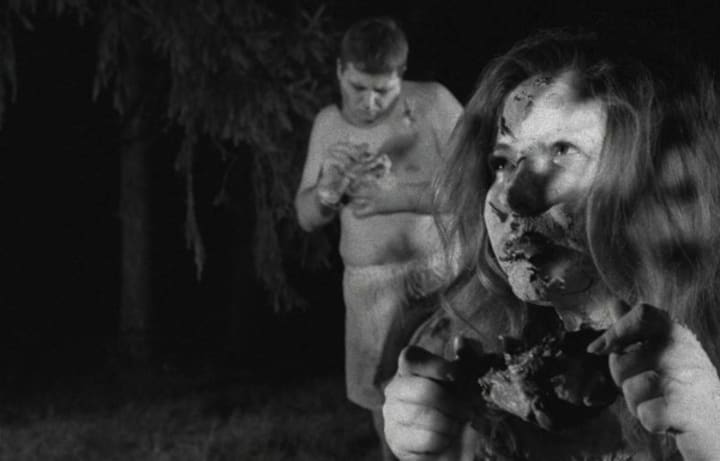
Ben, Judy, and Tom go out to try and gas up Ben's truck since they've found the key that may unlock the curious gas pump outside. They could then ride to one of the "rescue stations" the government has set up. Unfortunately, during their attempt, a melee ensues with the zombies, and a torch Ben is carrying manages to light the truck afire. Tom jumps in the cab in a heroic effort to drive the burning truck away from the pump. Judy is in the truck with him when it explodes.

This is simply like being offered barbecue for the milling throngs of reanimated dead, and the next scenes, shrouded in darkness, depict a bedlam of inarticulate, monstrous individuals snacking on what appears to be organs and intestines--the remains of Tom and Judy. (The background score is a heavy, synthesized pulsing throb, giving an eerie, inhuman vibe to the ensuing scenes of carnage.)
Harry attempts to keep Ben from reentering the house. Ben finally gains entrance and beats the holy hell out of Harry. Finally, the siege seems to end as the electricity goes out. The zombies surround and overwhelm the survivors inside the farmhouse, pushing their way in. Ben shoots Harry with the rifle Harry has previously wanted (wanted because "two people are dead already because of that guy!"), or so he tells his wife Helen.
Downstairs, Harry's daughter Karen (Kyra Schon, Karl Hardman's real-life daughter) has died and returned as a zombie. In a scene worthy of Hitchcock, she murders her mother using a garden trowel, hitting a hanging light bulb with her hand and sending shadows spinning across the wall. Helen's face is photographed in a crook, her chest and the wall behind covered in thick blood, which photographed black. Her dying expression is a rictus of shocked agony, her wails, and screams echoing across the soundtrack as disembodied, piercing shrieks.
Thus the taboo of matricide is also transgressed.
Incest and necrophilia, a two-headed serpent of perversion, is a taboo violated in a single scene: the neurotic Barbra, during the zombies' final assault on the farmhouse, ends her life by being pulled through the broken-in boards of the window--by the corpse of her own brother Johnny! The implication here, that Johnny will consume sister Barbra's flesh, taking her inside of himself in a final act of union forbidden them under the normal circumstances of a sane and moral universe, is a horrific, if ironic, blackly humorous final twist.

Ben decamps to the cellar, finally--it is, at last, really the only safe place as the living dead shuffle through the farmhouse on a mindless, hungry pathway of destruction.
Miraculously, in the morning, he awakes, no dead having managed to penetrate the basement. He goes upstairs.
Bands of deadly yokels--white men with dogs and rifles--are roaming the countryside, deputized by sheriff Conan McClelland (George Kosana) to shoot the zombies in the head and kill them. He tells a TV reporter played by Bill "Chilly Billy" Cardille (a popular Pittsburgh TV horror host at the time) that, "they're dead...they're all messed up!"
The white redneck posse with their dogs and guns evoke uncomfortable memories of the images of the era--images of racial strife. Ben, going to the window, is mistaken for the living dead.
Ben is shot and killed. "Okay, that's it, another one for the fire!" exclaims the fat, stupid country sheriff. The last scenes, as the end credits roll, depict men tossing the dead upon a pile, using hooks and other implements, etc. The images are still shots, evoking the stark brutality of actual crime scene photographs.
At the very end, for those who wait through the credits for some reason without exiting the theater, there is a final action shot, a live film of the bonfire upon which Ben's dead body has been thrown.
"You know Whitey had to go and kill him!"
George Romero told an amusing story, in the Night of the Living Dead Film Book, about slipping in to see the movie with an audience that was largely black. The audience loved the picture, up until the time that Ben got shot. It was then that one outraged woman said, "You know whitey had to go and kill him!"
Indeed, the cultural subtext of Night of the Living Dead seems to mean different things to different people. To some, it is an apocalyptic nightmare, borrowed straight from the horrific visions of John the Revelator. ("And the dead shall rise and walk the earth.")
To others, it is a necrophilous paen to our obsession with death and our fear of decay, dissolution; our own sense of mortality. Still, others may see it as what it was intended to be: a cheap, exploitive cinematic nightmare, a drive-in roller coaster of a film that was made solely in the interest of reaping a profit, and knocked itself clean out of the cinematic ballpark.

The subtext, however, the unintended, unconscious allegory of Night, can be read thusly: as a cold war era fever dream of our worst societal fears and impulses, our paranoia concerning imminent racial integration, the perceived communist threat, Soviet expansionism, the decline of religion and the cultural war pitted between the Haves and Have-Nots. One commentator once quipped that zombie movies were, in effect, "third world horror films"; in other words, fear of the subsuming of civilized, urbane society under a tidal wave of unchecked birth and immigration from the shuffling, hungry, impoverished hordes.
Stripped of their lives, their "souls" taken from them, reanimated with nothing but insatiable hunger, the living dead slowly, inexorably, lay siege to a beautiful home, one that must be slowly dismantled and destroyed; boarded up, to protect the last vestiges of the American Dream hunkering within; the normal middle-aged and young couple, as represented by Harry and Helen and Tom and Judy. The Present and the Future; the only outliers being the take-charge black man, Ben, and the neurotic Barbra.
If they are the third couple, then what might the film be saying about that particular pairing? Is it playing on racial fears of replacement? Harry is the intolerant, unreasonable white man, determined to hide in the cellar (the representation of the primal Id, the subconscious place where our fears and terrors lurk), and Ben is the undisputed competent leader, doing his best to preserve all of their lives, playing against stereotype, and, in effect, threatening the Harrys of the world. The seedy and dirty, unlovely shuffling hordes of dead flesh outside are all indisputably white, rural types--the sorts of contemporary racists that, at the time, filled the ranks of the Ku Klux Klan. Coming from an era when, a short time earlier, the threat of lynchings was still prevalent, the change-up in racial dynamic in the plot of Night must have been jarring.
Of course, a few years before, many had been building "bomb shelters" in their cellars--in fear of atomic war with the Soviet enemy. Harry is a holdover from an earlier era, but the dead themselves are convenient stand-ins, an allegory for what happens when your friends and neighbors, the "common folk," lose their very souls to the propaganda of communist class envy; they slowly and mindlessly lay siege and finally plunder the American Homestead. Inside, a black man, who, playing against type, seems on some level to threaten the WASP order that has come before (as represented by Harry), is trying to board up the home against the encroaching Sovietized, communist future; but it is finally a gesture of futility, and he is overrun. Or maybe it is an allegory of a creeping, FASCIST future, or the fascist impulse in common American life?)
In the cellar, Harry's daughter, who has been bitten by the cursed creatures, rises up as one of them (indoctrinated), to slay her own mother--in a fashion the members of the Manson Family must have readily understood.
Youth and the future rising up against the bourgeois White establishment--THESE are the fears, the subtext which can easily be discerned; as well as fears of the rising tide of Third World birth and the looming, perceived threat of racial integration to the old WASP order; this is the subconscious terror invoked by this cinematic tour-de-force, this cultural fastball aimed at the heart of ordinary 1968 America.
Barbra, also, neurotic, indelibly linked, and finally killed and devoured by her own brother, seems to hint at something neurotic and weak and finally perverse in the WASP American Ideal. Perhaps perversity and incest are hidden behind the well-trimmed hedges and white picket fences of suburban USA? Is that the ironic horror behind the horror of her final scene?
In the aftermath of the final zombie attack, the sheriff and his posse, all of them white yokels with shotguns and dogs, quietly go about the countryside doing "mopping up" exercises; i.e. shooting everything that moves and isn't alive. The men and their dogs, as well as the brutal, stupid country sheriff, as has previously been observed, may recall the civil rights marches wherein dogs were called out on the protestors; Sherrif McClelland is a convenient cinematic stand-in or allegory for Bull Connor. The ensuing, casual brutality prefigures the nightly news footage of an increasingly war-weary world, who would soon be shocked by the mages being beamed home from the bloody battlefields of Vietnam. (Later films, such as Wes Craven's seminal masterpiece Last House on the Left, and Tobe Hooper's groundbreaking The Texas Chainsaw Massacre, would also be belched forth from the collective, American subconscious, minds revolted by the shocking and seemingly senseless real-world violence in Southeast Asia.)
Ben, the only resourceful, level-headed character in the whole film, the only truly sympathetic one, a black man, is mistaken for a zombie and is killed. He is tossed atop a bonfire like something from a pagan sacrifice, a ritualistic "purge" to atone for the sins of the Dead, as well as the living. The Apocalypse, we take it, has been averted.
For now. But, soon night falls again. And the dead will rise.
They rise.
***
Night of the Living Dead is in the public domain and can be viewed in its entirety for free on YouTube.
About the Creator
Tom Baker
Author of Haunted Indianapolis, Indiana Ghost Folklore, Midwest Maniacs, Midwest UFOs and Beyond, Scary Urban Legends, 50 Famous Fables and Folk Tales, and Notorious Crimes of the Upper Midwest.: http://tombakerbooks.weebly.com
The Night Everyone in the Town Heard the Same Whisper
The town of Blackridge was the kind of place people forgot about. It was small, quiet, and surrounded by thick forests that seemed to stretch forever. The road leading into town curved through miles of tall pine trees before finally opening to a handful of streets, a small school, a diner, and an old town square with a clock tower that had stood there for nearly a century.
By imtiazalam5 days ago in Horror


Comments
There are no comments for this story
Be the first to respond and start the conversation.