
Meshes
"Meshes of the Afternoon" and "The Witch's Cradle" by Maya Deren (1943)

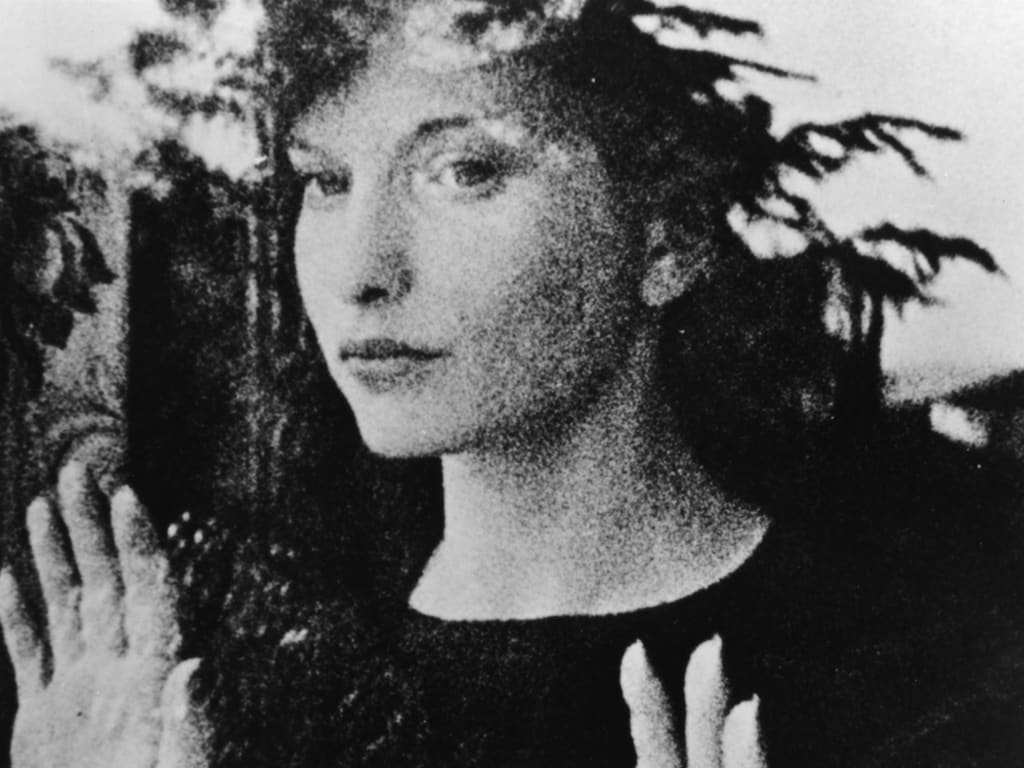
Maya is a word used primarily by Hindus and Buddhists to denote the world of "illusion"; the false world of physical suffering, where "existence is pain." Beyond this, this illusion that keeps us chained to Samsara, the "Wheel of Rebirth," is "Moksha," a state of being reabsorbed into the "All"; or, to be somehow beyond suffering, because beyond desire. (Moksha is called by Buddhists "Nirvana"). In other words, the dissolution of the illusion of impermanent, transitory, and tormenting physical existence.
Maya Deren chose her professional name aptly. Born as "Eleanora Derenkowska" during the 1917 Bolshevik Revolution, her Jewish family fled the blood-dimmed tide of pogroms and revolt for the United States, where they relocated to Syracuse. Her father was a psychiatrist at an institute for the "feeble-minded"; her sister studied in France. Maya became an ardent socialist and studied journalism. It was not long, after marrying, divorcing, moving to Los Angeles, and marrying again (to partner Alexander Hammid), that she progressed from her writing career to one of exploring reality in the limitless expanse of the motion picture camera.
Meshes of the Afternoon (1943)
"This film is concerned with the interior experiences of an individual. It does not record an event which could be witnessed by other persons." --Maya Deren
The result, or at least, one of the results, was the eerie and hallucinatory short film "Meshes of the Afternoon" (1943), a film starring Deren herself as the dreaming protagonist. Beginning with a long arm depositing a single large flower on a walkway, in what we assume is a park, the film progresses to Deren chasing a weird, hooded figure with a mirrored face.
She seems to become separated from her sleeping form, which is still reposing in a chair next to a record player (a metaphor, perhaps, for the playing of memories or dreams in the turntable of the sleeping mind), but returns at seeming intervals to float, like a discorporate spirit, above her own body.
The woman is becomes divided unto herself and sees a key (which she ejects from between her lips) turn into a flower, and then a knife. Quite striking scenes of her being teleported up and down her stairs (the fabric of this reality is malleable), and of several clones of herself sitting around a table, holding the knife with a black hand, are unsettling, opening up the possibility that the woman may be suffering from the madness of split personality.
The Man, played by Alexander, comes in, leading the woman back to the bedroom. She sees him bend over, in quite the same manner she formerly saw the hooded figure bend over and place the knife beneath her pillow. We next see the mirror (the face of the hooded phantom?) falling to the wet earth. The Man comes back in to discover the form of his formerly sleeping wife, but now she is dead. We assume she has been murdered. Or, perhaps, she has committed suicide out of frustration with her fractured, "multiple" selves.
Deren directs with a surrealistic sensibility that is incomparable, trading upon the idea of spiritual distance and the world of shifting, internal perspectives to tell a story of someone having an internal experience, a "cut-up" of the perceptual self. Outside of herself, in a disembodied state, she can "see" things as they truly are; and as they truly are is disembodied. Her husband is a hooded figure reflecting at her from the cowl of his Reaper's robe; the "flower" of his love becomes a knife, a killing blade. She incorporates this into herself; at one point, her phantasmal image enters the room in an attempt to kill her sleeping form. The phonograph, the "recording" spins backward (a classic occult trope), letting us know this is the world of the unconscious, the dream-world; but, also, that this is communication reversed; that, perhaps, the message being conveyed here is hidden in the recording of the subconscious that the phonograph serves an allegory for.
The "key" to understanding is ejected from her mouth. It transforms in her hands, finally becoming the knife. She trades this among several "selves"; her ending is presumed suicide.
The "key" opened up the doorway of death. Was it the husband that drove her to it, the "flower" of his love transforming into the knife of his murderous passion? Was it really suicide, or perhaps the final denouement is murder? We are left to wonder.
The film is freely available to watch on YouTube:
The Witch's Cradle (1943)
Another, more puzzling short film completed by Deren the same year, "The Witch's Cradle," covers similar arcane territory as "Meshes". Here, though, the experience seems less internal; or, at least, we are lead to believe so. A young woman (Pajoritta Matta) seems to be casting a spell to kill a man (Marcel Duchamp); we see a string (obviously being lead by a fishing line) twist its way around his body. The image of a beating heart that stops is followed by the image of the man with the string ("ligature" in magical folklore) twisted around his fingers. The young woman is the spellcaster; why, specifically, she wants him dead is anyone's guess.
She quickly seems to get caught in the "web" of her own design, as a pentagram appears on her head, building blocks fly away from her (again, obviously pulled with a fishing line, which may be part of the joke), and a cloak or cloth flies up from the floor toward her hands. She wanders around a space that looks as if it is a huge empty art gallery (it, in point of fact, was), while mystic and inscrutably arcane symbols fly through the air. Formerly, she has sat beneath what looks like pipes and a ballon structure (the workings of her victim's heart, we take it).
A wheel construction turns by itself, seeming to be out of her control. There are long (long!) lingering shots of what look to be modern art sculptures. The film gradually disappears in a kind of futile boredom of itself; the last shots disappear into a place we take is the ceiling. It seems, though, covered in matchstick formations, and crisscrossed by ropes, as if it were the top of a circus tent, ready and waiting for a family of trapeze artists. The metaphor of the film is, perhaps, that of a wrongdoer being trapped, or caught in the spider's web of their own infamous designs. However, we aren't sure, as there are seeming pieces missing and the plot is simply abandoned; a weird, inscrutable intellectual cryptogram.
"The Witch's Cradle" is also freely available to view on YouTube:
The short films of Maya Deren are weird, mystic, hallucinatory experiences. They are also stark, evocative, casting a surrealistic spell the viewer cannot easily dismiss. That she was interested in Afro-Caribbean magic and witchcraft until her untimely death at the age of forty-three seems par for the course. She might be termed a feminist forerunner of Kenneth Anger, but this might be overstating things.
About the Creator
Tom Baker
Author of Haunted Indianapolis, Indiana Ghost Folklore, Midwest Maniacs, Midwest UFOs and Beyond, Scary Urban Legends, 50 Famous Fables and Folk Tales, and Notorious Crimes of the Upper Midwest.: http://tombakerbooks.weebly.com
The Sound in the Darkness
On the outskirts of a small, forgotten town, there stood an abandoned mansion that everyone avoided. Its windows were shattered, and the paint peeled away like dried skin. Locals whispered that at night, strange sounds emerged from inside—voices, footsteps, and sometimes laughter—but no one dared enter to confirm.
By Reflective Stories2 days ago in Horror
Hottest in the Office
Dear Rafi, You’re very distracting to work around. For the first second I saw you the other day, I thought you were some type of executive. It took a moment to realize no, you were just the new guy, dressed up for the job he wants. Be still, my heart.
By Gabriel Shames4 days ago in Pride


Comments
There are no comments for this story
Be the first to respond and start the conversation.