
The Whispers Beneath the Floorboards
Some secrets should never be unearthed.

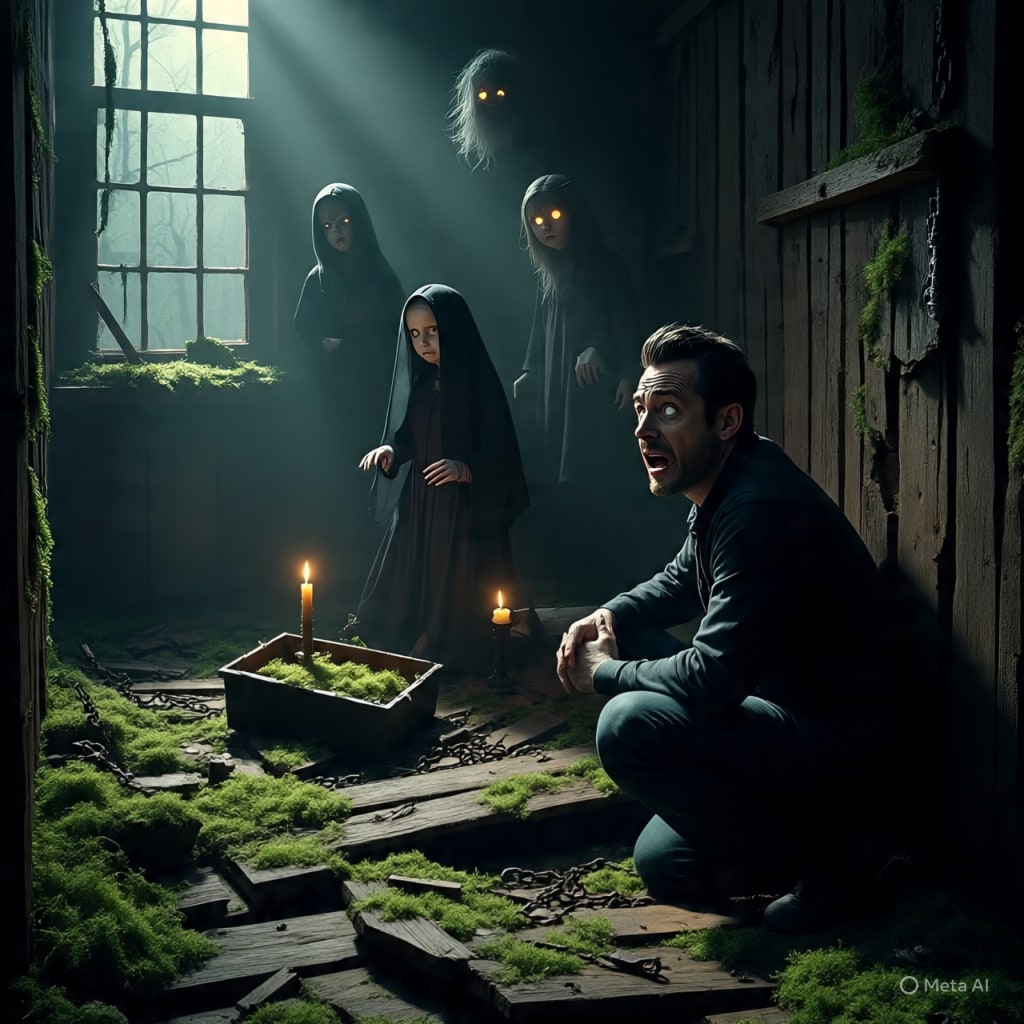
The village of Darnwood had always been an eerie place, wrapped in perpetual fog and silence that clung to its crooked cottages like a curse. Few dared to stay there long, and those who did often carried hollow eyes and voices that trembled. Among them was Arthur Gray, a middle-aged man recently widowed and desperate for solitude. He purchased an old, rotting house at the edge of the forest — a place the villagers called Hollow House.
They warned him, of course. “Things live beneath,” old Marnie at the bakery whispered with eyes glazed in dread. “You’ll hear them scratching. Don’t answer them.”
Arthur, lost in grief, only chuckled. Ghost stories didn’t scare a man who had watched cancer drain his wife’s life away, day by agonizing day.
The house groaned as if alive. Floorboards creaked even when no one walked. Cold drafts snuck through sealed windows. And then, there were the whispers.
It began on the third night.
He was reading by lantern light — the electricity had failed again — when he heard it: a soft, rhythmic tap-tap-tap beneath the wooden floor. He paused. It continued, more insistent. Then came the whisper, faint but clear.
“Arthur…”
He froze. The voice was soft, broken — like a child weeping in the dark. He leaned down, pressing his ear to the floor.
“Arthur… I’m cold… so cold…”
He jerked back, heart pounding. Was someone beneath the floorboards?
He tore at the wooden planks with a crowbar, desperate to uncover the source. But there was nothing beneath except earth and the old, crumbling stone foundation.
The next day, the villagers avoided him. No one spoke when he passed. Even Marnie shuttered her windows as he approached.
That night, the voice returned.
This time, it wasn’t just whispers. It sang. A lullaby, broken and warped, coming from beneath his bed. The lyrics were wrong — words twisted into nonsense, but the melody was familiar. His wife used to hum it in her final days.
“Who’s there?” Arthur demanded, voice cracking.
“Join us…” the voices echoed in chorus now — dozens of them. “It’s warmer down here…”
He smashed the floor again, ripping out plank after plank, deeper into madness. Dirt filled the room. Fingernails shredded. Still, nothing.
And then he found the trapdoor.
It was hidden beneath a false section of flooring near the fireplace. Thick chains wrapped around it, sealed with rusted iron. A smell seeped out — old, rotting, alive. The chains rattled when he touched them, though he hadn’t yet pulled.
That night, he dreamed of a woman in black, her face covered in a veil of crawling insects. She hovered over him, whispering in his dead wife’s voice.
“You opened the house. Now the house opens you.”
He awoke screaming.
In the morning, Arthur found bloody footprints leading from the trapdoor to the edge of his bed. Muddy handprints clawed the walls. The whispering never stopped. It came from the kettle, from the attic, from behind the mirrors.
Then came the scratching.
At first gentle. Then furious. Desperate. Something was beneath the floor — many things. The boards bent upward. Nails popped from the wood. And that voice — that same pitiful whimper — called his name over and over.
One final night, Arthur gave in. He unchained the trapdoor and opened it.
The darkness beneath pulsed like a living wound. The smell hit him — rot and sorrow, soaked in blood. He saw eyes staring back. Dozens. Hundreds.
And then — fingers. Long. Broken. Bone-thin. They reached for him, not with violence, but need.
“Cold… so cold…”
The first hand touched his cheek, tender as a mother’s touch. Another grasped his wrist. A child’s voice whispered, “Don’t leave us alone again.”
And Arthur, mad with grief and guilt, whispered back, “I won’t.”
He stepped down.
The trapdoor slammed shut behind him.
They found the house weeks later, the front door wide open. No sign of Arthur, but every floorboard had been pulled up. Scratch marks — deep and jagged — covered every wall.
The villagers sealed the house with bricks and prayers. They never spoke of Arthur again.
But on foggy nights, if you press your ear to the ground, you might still hear the lullaby, drifting up from the dark:
“Come sleep, come sleep, beneath the floor,
The cold will hurt your bones no more…”
And if you’re very unlucky, the house might learn your name too.
About the Creator
Keep reading
More stories from Muhammad Bilal and writers in Horror and other communities.
Whispers in the Grain
The village of Blackreed was surrounded by endless farmland, its golden fields stretching to the horizon. It had been a good harvest year—too good. The wheat grew twice as tall, heavy and thick, but it came with a strange price: birds stopped flying over the village, dogs refused to enter the fields, and a low humming sound could be heard at night, like wind whispering secrets through the stalks.
By Muhammad Bilal7 months ago in Horror
Staying sane in the insane world.
”It is no measure of health to be well adjusted to a profoundly sick society.” Jiddu Krishnamurti This quote has been one of my favourites since the moment I first laid my eyes on it. To me, it cuts right through the fog of the illusion of normality that permeates our lives. And since I am someone who has never felt (well) adjusted to this society, Krishnamurti’s words gifted me with the realisation that there isn’t anything inherently wrong with me.
By Eva Smittea day ago in Humans



Comments
There are no comments for this story
Be the first to respond and start the conversation.