
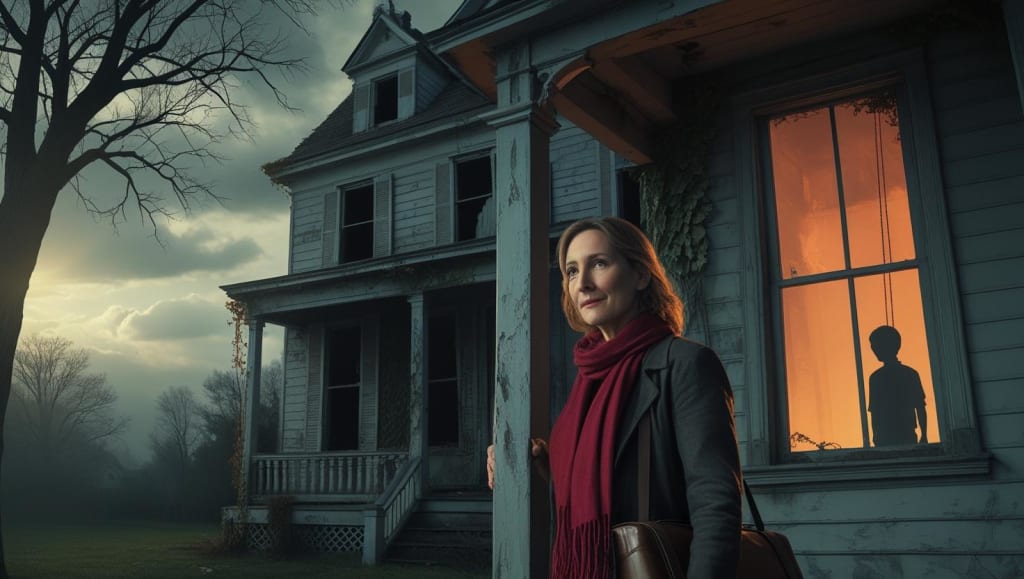
No one had lived in the old Whitlock house for nearly forty years. Perched like a vulture at the edge of town, its windows were clouded with time, its porch sagging under the weight of memory and decay. Children whispered about it in the schoolyard, dared each other to touch the door, and swore they saw shadows moving even when the wind was still.
But Mara Whitlock knew better.
She had lived there once. Long ago. When the halls still echoed with laughter, and the walls hadn't yet begun to whisper.
She told herself she’d never come back. She had promised that to herself—and to them. Yet there she was, suitcase in hand, standing at the gate as the rusted hinges cried out like an old wound being reopened.
Mara was 42 now. A failed marriage, a failed novel, and the slow death of her mother had left her hollow. When the lawyer mentioned the house was still in her name, something inside her—something bitter and unresolved—told her it was time.
The front door creaked open before she touched it.
She froze.
“Hello?”
Silence. Dust motes hung like memories in the air, and the scent of old wood and older secrets filled her lungs.
She stepped in.
The wallpaper still bore the faded daisies her mother loved. The staircase, worn smooth at the edges, beckoned with a quiet, dangerous kind of nostalgia. Her father’s coat still hung by the door, though he had vanished when she was twelve, and her mother never spoke of him again.
Room by room, she wandered. The dining room with the crooked chandelier, the library where she first read Poe and cried herself to sleep, the attic door still shut tight—just as it had been since that night.
She avoided it. For now.
Mara stayed in her old room. The bed was smaller than she remembered, and the air colder. That first night, the house whispered. Faint creaks. Breathless murmurs. The sound of footsteps halting at her door.
She told herself it was just wind and wood settling.
On the second night, she heard the lullaby.
It came softly, almost lovingly, drifting through the hallway like a memory trying to be remembered. Her mother’s voice—off-key and trembling—singing the same tune she used to hum when Mara was sick. But her mother had died last year. In a hospital three states away.
Still, Mara opened the door.
The hallway was empty.
Only the attic door was ajar now.
By the third night, Mara stopped pretending. The house was alive.
But not haunted in the way the stories said. No. It didn’t want to harm her. It wanted something else.
Recognition.
Closure.
Maybe… an apology.
That night, she stood before the attic, keys trembling in her hand. She hadn't been up there since she was thirteen. Since the night her brother, Samuel, vanished.
Everyone said he ran away. That the fight between him and their mother had been too much. That he packed a bag and never looked back.
But Mara remembered things differently. She remembered her mother screaming that night. Remembered the attic door slamming shut. Remembered the silence that followed.
The attic was colder than the rest of the house. Dust clung to every surface like ash. Boxes were stacked neatly in corners, untouched for decades. But in the middle of the room sat a chair.
And on the chair—
A boy’s sweater. Faded. Torn.
Samuel’s.
And beneath the floorboards—something knocked.
Mara dropped to her knees, pried them open. What she found wasn’t a body, nor a monster.
It was a journal. Samuel’s.
The final entry read:
“I saw her again. The one in the mirror. She says she’s our real mother. That the one downstairs is pretending. She says she’ll make it stop if I stay quiet. I don’t know what’s real anymore. But I’m afraid of what’s pretending to be her.”
Mara’s breath hitched. She remembered now—the coldness in her mother’s eyes. The way her reflection once smirked when she didn’t. How her dreams twisted into nightmares the year before Samuel disappeared.
This house wasn’t haunted.
It was possessed.
Not by ghosts, but by echoes. Imprints. Fractured moments trapped like flies in amber.
It hadn’t forgotten who left.
Because no one ever truly left. Not while the house still remembered.
Mara stood, holding the journal close, and whispered, “I’m sorry, Sam. I left you here.”
The walls groaned.
The window creaked open on its own, letting in a warm gust of wind.
And just for a second, Mara saw her brother standing in the corner. Young. Smiling. Free.
Then he was gone.
The next morning, she packed her bags. But before she left, she nailed the attic door shut and left the journal on the kitchen table—open, facing upward.
So the house would remember.
But no longer wait.
About the Creator
Keep reading
More stories from umais khan and writers in Horror and other communities.
"Scream 7" (2026): Running out of Fresh Screams
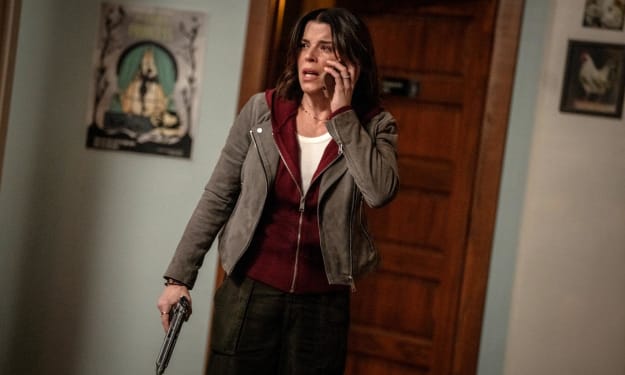
This is the seventh time we’ve had a Ghostface crisis. Scream 7 is the latest edition of the Scream franchise. Sydney Prescott and her family are under attack by another anonymous killer dressed in a Ghostface costume. While having issues with her daughter, Tatum, they run from the bloody murders, trying to determine who is behind it all.
By Marielle Sabbag6 days ago in Horror
The Politics of Playing Dress-Up
Well, to start off I'd like to say a happy world book day to all who celebrate. I know I haven't really posted anything on my socials about it but I'm not a jubilant kind of person. I lay low most of the time. Let's start off with a popular anecdote from the vaults...
By Annie Kapur2 days ago in Geeks



Comments (1)
I like this story