
Whispers from the Window
An elderly woman writes poems to her late husband every morning and places them on her window
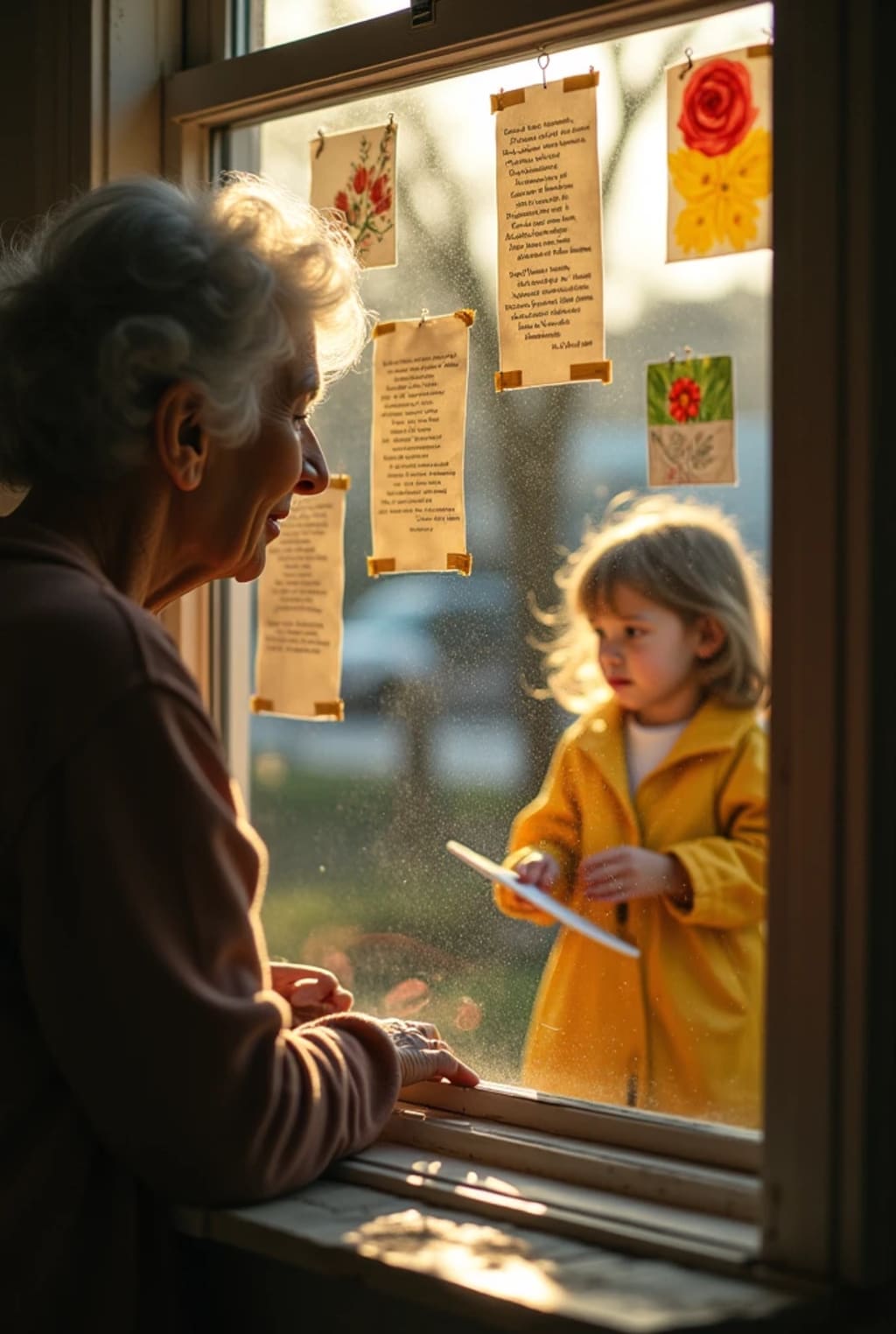
Every morning, just as the sun began to climb above the rooftops, Eleanor folded a piece of soft cream paper in half, took out her favorite fountain pen, and began to write.
The poems were short—rarely more than a dozen lines. Some were memories, half-lost in the golden fog of time. Some were conversations she imagined having. Others were nothing more than her heart aching in ink. But every one of them ended the same way:
“I miss you, George. Always. — Ellie.”
When she was finished, she stood slowly, gripping the edges of the table to balance her fragile bones, and walked to the bay window in her small kitchen. The same window where he used to read the newspaper. Where he used to whistle. Where he would wave at the neighbors while sipping coffee.
She gently pressed the paper to the glass and smoothed a single strip of clear tape over the top. Then she stood back and looked at it—just for a moment. Like she expected him to read it. Like maybe, if the wind was kind and the light was just right, the words would float up into the sky and find him.
She had been doing this every day since George died, nearly two years ago. The neighbors noticed, of course. At first, they whispered about it. Then they smiled. Then they stopped altogether, letting the poems become part of the neighborhood like the ivy on the fences or the cracked sidewalk under the sycamore trees.
But someone did more than notice.
Across the street, behind the curtain of a small, red-brick house, a little girl named Sophie watched Eleanor every morning. At seven years old, she didn't fully understand what it meant to lose someone you love. But she knew what lonely looked like. Her parents worked long hours. Her house was quiet most days, and she often sat by the window with her coloring books, peeking across the street.
One day, Sophie waited until Eleanor had gone back inside, then tiptoed over, stood on tiptoe, and read the paper.
It was a poem about dandelions. George used to pick them for Eleanor on their walks, calling them "sunlight's little surprises." It made Sophie smile. The next morning, she came back with a drawing—a messy but enthusiastic bouquet of yellow flowers—and stuck it just under Eleanor's poem.
Eleanor found it an hour later.
She smiled, then cried, and then smiled again.
The next day, her poem was about a child’s laughter, and how it echoed brighter than bells. She left a note with it: “Thank you for the flowers, dear friend.”
From then on, the window became a kind of quiet conversation. Eleanor’s poems continued, but now they were sometimes answered with drawings, or notes written in wobbly pencil letters.
“George sounds nice.”
“I like your poem today.”
“Can I write one too?”
One morning in early spring, Eleanor taped a slightly longer poem than usual to the window. It was about growing older, and how the world sometimes feels like a garden at dusk—still beautiful, but fading at the edges.
When Sophie came that day, she didn’t leave a drawing. Instead, she knocked.
Eleanor opened the door slowly, surprised. Sophie stood there in a yellow raincoat, her hair slightly messy, holding a small notebook.
“Hi,” she said. “I wrote a poem too. I didn’t know where to put it.”
Eleanor’s heart melted like butter in a warm pan. She reached out, took the notebook gently, and read the child’s careful words.
It was a poem about rain. And flowers. And hope.
“Would you like to tape it to the window with me?” Eleanor asked.
Sophie nodded.
And so they did—one hand old and soft, the other small and eager. Two generations connected by love, by poetry, and by one clear windowpane.
From that day on, the poems continued—but now, some were written in crayon. The neighbors didn’t just smile anymore; they stopped to read. Some even added poems of their own. The window became a wall of words, a mosaic of memory and hope.
And every single one still ended with the same soft truth:
“I miss you, George. Always. — Ellie.”
But now, Eleanor wasn’t alone.
About the Creator
Keep reading
More stories from umais khan and writers in Poets and other communities.
She chose the begin again
Asha sat by the window of her tiny rented apartment, watching the droplets race each other down the glass like they were in a hurry to escape the sky. The apartment smelled faintly of paint and loneliness — she had moved in two weeks ago and still hadn’t unpacked the boxes. Her coffee had gone cold on the table, but she hadn’t noticed. She wasn’t thirsty. She wasn’t anything.
By umais khan7 months ago in Blush
me, me, me
when i read back my poetry it screams “me, me, me” on my screen in bold letters and i can’t shut it up — most days, i cannot make any other words out; i want to throttle a thousand versions of the me gone by, i want to throw myself from a figurative balcony, i want to sink a sword into every pen i’ve held
By angela hepworth8 days ago in Poets
Review of 'Man on the Run'
My wife and I saw Man on the Run, a nearly 2-hour documentary on Amazon Prime, about Wings, Paul McCartney's group that flew around the world from shortly after The Beatles broke up in early 1970 to shortly after John Lennon was murdered at the end of 1980, making a Beatles reunion forever impossible.
By Paul Levinson5 days ago in Beat


Comments
There are no comments for this story
Be the first to respond and start the conversation.