
THE HOTEL THAT KEPT A SCORE
The Cecil Hotel Death Spiral — A Real Place Where Tragedy Repeated Itself


In downtown Los Angeles, a few blocks from where the city sells its dreams in neon and billboards, stands a building that never learned how to forget. From the outside, the Cecil Hotel looks like a relic—tall, symmetrical, unimpressive in a way that makes it easy to miss. Thousands of people have walked past it without noticing. Thousands more have slept inside it without knowing its history.
And then there are those who knew.
For nearly a century, the Cecil Hotel has been linked to an abnormal number of deaths—suicides, violent crimes, overdoses, unexplained falls, and one haunting incident that turned a forgotten hotel into a global obsession.
This is not a story about ghosts.
It’s a story about patterns, neglect, and what happens when human despair is allowed to stack up floor by floor.
A PROMISING BEGINNING THAT DIDN’T LAST
The Cecil Hotel opened in 1924, built during a time when Los Angeles believed it was becoming the next great American city. The hotel was meant to attract businessmen, travelers, and middle-class guests. It was elegant for its time, with a marble lobby and polished floors.
Then the Great Depression arrived.
The neighborhood surrounding the Cecil deteriorated rapidly. What was once a hopeful district became part of what is now known as Skid Row—an area defined by homelessness, addiction, and untreated mental illness. The Cecil adapted, but not in a good way. It shifted from short-term stays to long-term residents. Rent was cheap. Oversight was minimal.
The hotel became a place people went when they had nowhere else to go.
And often, nowhere left to run.
DEATHS WITHOUT HEADLINES
By the 1930s, deaths began to accumulate.
Guests jumped from windows. Some were found in their rooms after overdoses. Others died under circumstances that were never fully explained. Newspapers recorded these events briefly, then moved on. No single death stood out. That was the problem.
There were too many.
Over the decades, the Cecil became linked to some of the most notorious figures in American crime history. Serial killers such as Richard Ramirez (the Night Stalker) reportedly stayed there. Jack Unterweger, an Austrian serial killer, also lived at the hotel while committing murders in Los Angeles.
This wasn’t coincidence—it was opportunity.
The Cecil offered anonymity. No one asked questions. No one paid attention.
It was the perfect place to disappear in plain sight.
A SYSTEM THAT FAILED QUIETLY
What makes the Cecil Hotel truly disturbing is not just the number of deaths, but how normal they became.
Management changed hands repeatedly. Safety measures were inconsistent. Windows that should have been secured weren’t. Stairwells were accessible. Rooftop access was poorly monitored.
Guests with severe mental health issues were housed alongside tourists. Long-term residents lived next to short-term visitors. There was no unified responsibility for care, safety, or intervention.
In effect, the hotel became a pressure chamber for human suffering.
And pressure eventually breaks things.
THE ELEVATOR VIDEO THAT STOPPED THE WORLD
In 2013, the Cecil Hotel entered global consciousness because of one woman: Elisa Lam.
Elisa was a 21-year-old Canadian student traveling alone. She checked into the Cecil during a solo trip through California. Within days, she vanished.
Weeks later, hotel guests complained of low water pressure and strange-tasting water. Maintenance workers checked the rooftop water tanks.
Inside one of them, they found Elisa’s body.
What transformed this tragedy into an international obsession was a video released by police: surveillance footage from a hotel elevator, recorded shortly before Elisa disappeared.
In the footage, Elisa behaves strangely. She presses multiple buttons. Steps in and out of the elevator. Hides in the corner. Gestures with her hands as if speaking to someone who isn’t there.
The doors refuse to close.
The internet exploded.
THEORIES, FEAR, AND MISINFORMATION
Almost immediately, theories took over.
Some claimed Elisa was being followed. Others suggested paranormal involvement. Conspiracy theories accused the hotel of covering up murder. Online sleuths analyzed her movements frame by frame, turning speculation into certainty without evidence.
The truth, revealed later, was quieter—and more tragic.
Elisa had a history of bipolar disorder. She had stopped taking her medication. The elevator behavior was consistent with a severe psychological episode. Investigators concluded her death was an accidental drowning, caused by disorientation and untreated mental illness.
But the damage was done.
The Cecil Hotel was no longer just a troubled building.
It was a symbol.
WHY THE CECIL FEELS DIFFERENT
Many places have dark histories. Few feel as heavy as the Cecil.
That’s because the Cecil wasn’t the site of a single catastrophe. It was the site of accumulation. Year after year, tragedy layered itself into the building’s identity.
Each death didn’t shock the system—it normalized the next one.
There’s a concept in psychology known as institutional neglect: when suffering becomes routine, and responsibility dissolves because no one event demands reform.
The Cecil is a case study in that failure.
RENAMING A PROBLEM DOESN’T SOLVE IT
In later years, the hotel was rebranded as Stay on Main, an attempt to separate the building from its reputation. The name changed. The walls were repainted. The history stayed.
Deaths continued.
Rebranding didn’t address the core issues: inadequate mental health support, unsafe building design, and a neighborhood overwhelmed by poverty and addiction.
You can rename a place.
You cannot rename its consequences.
PARANORMAL OR PATTERN?
Some visitors claim the Cecil is haunted. They report feelings of dread, sudden mood changes, and unexplained noises. Paranormal investigators have conducted sessions there, recording strange sounds and anomalies.
Skeptics argue something simpler—and arguably more disturbing.
Places shaped by extreme human emotion often feel wrong because our brains pick up on subtle cues: neglect, decay, silence where activity should be. Fear doesn’t require ghosts. It requires context.
And the Cecil has too much of it.
THE END OF AN ERA, NOT THE STORY
In recent years, the Cecil Hotel has been closed for renovation and redevelopment. The goal is to convert it into supportive housing. A humane idea. A necessary one.
Whether it will succeed is another question.
Because the Cecil Hotel isn’t just bricks and floors. It’s a record of how a city handled—or failed to handle—its most vulnerable people.
You can repair walls.
You can install better locks.
But the weight of nearly a century of death doesn’t disappear easily.
WHY THIS STORY WON’T LET GO
The Cecil Hotel Death Spiral frightens people not because it’s mysterious, but because it’s understandable.
Every tragedy has a cause. Every cause was ignored. Every warning was visible.
And yet, nothing stopped it.
The elevator video didn’t create the horror. It simply forced the world to look at a place it had ignored for decades.
In the end, the Cecil Hotel stands as a reminder of something uncomfortable:
Sometimes the scariest places aren’t cursed.
They’re neglected.
And neglect, left alone long enough, becomes deadly.
The doors close.
The building remains.
And the city moves on—
hoping this time, someone is paying attention.
About the Creator
The Insight Ledger
Writing about what moves us, breaks us, and makes us human — psychology, love, fear, and the endless maze of thought.
Keep reading
More stories from The Insight Ledger and writers in Horror and other communities.
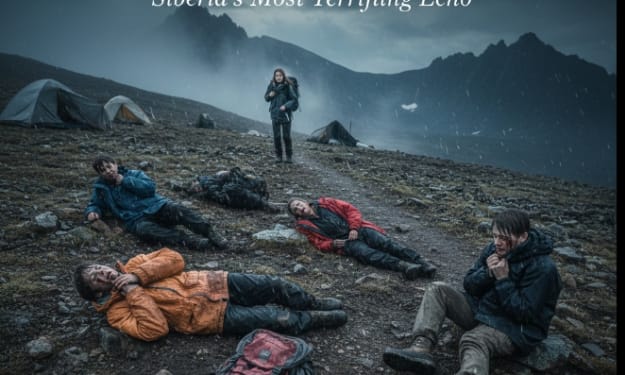
The Khamar-Daban Incident: Siberia’s Most Terrifying Echo
In the summer of 1993, a group of seven experienced hikers set out to conquer the Khamar-Daban mountain range in Buryatia, Russia. They were led by Lyudmila Korovina, a master hiking instructor known for her toughness and survival skills. They weren't amateurs; they were prepared for the harsh Siberian wilderness. Yet, within days, six of them would be dead in a manner so gruesome and sudden that it defies medical explanation. The lone survivor, Valentina Utochenko, would later tell a tale of madness, bleeding eyes, and a mountain that seemed to turn against them in an instant. 1. The Expedition: A Journey into the Clouds The group consisted of Lyudmila (41) and six students in their late teens and early twenties. Their plan was ambitious but well within their capabilities. The weather was initially clear, and the group was in high spirits as they began their ascent. By August 4th, the weather turned. A massive storm hit, bringing freezing rain and sleet. Despite the conditions, the group decided to set up camp on a barren, exposed slope rather than seeking the shelter of the nearby forest. It was a strange decision for an experienced leader like Lyudmila, and it would be the last decision they ever made together. 2. The Day the Horror Began On the morning of August 5th, as the group prepared to move, the nightmare unfolded with terrifying speed. According to Valentina, the first to fall was Aleksander. He suddenly began to scream, his ears started bleeding, and he collapsed, frothing at the mouth. What followed was a scene of pure chaos: Lyudmila ran to help him, but as she held him, she too began to bleed from her eyes and nose. She collapsed on top of him. Tatyana was the next. She began banging her head against the rocks, seemingly in a fit of madness, before falling silent. Denis, Viktoriya, and Timur all exhibited the same terrifying symptoms: clutching their throats, gasping for air, and bleeding from their facial orifices. In a matter of minutes, the mountainside was littered with the bodies of Valentina’s friends. 3. The Lone Survivor’s Flight Valentina, seeing her friends die in such a horrific manner, realized that if she stayed, she would be next. She grabbed her backpack and ran. She spent the next several days wandering the mountains alone, terrified that whatever "force" had killed her friends was following her. She eventually found a river and followed it down until she was rescued by a group of kayakers. When they found her, she was covered in dried blood and was so traumatized she could barely speak. 4. The Official Investigation: Frustrating Silence When rescue teams finally reached the site, they found the bodies exactly where Valentina had described. The autopsies were baffling. The official cause of death for all six was listed as hypothermia. However, this explanation was met with extreme skepticism. Hypothermia does not cause people to bleed from their eyes or ears, nor does it cause healthy young adults to die in a matter of minutes simultaneously. Furthermore, the group had warm clothing and supplies; they weren't simply "cold"—they were struck down by something biological or chemical. 5. The Theories: What Killed the Hikers? A. Infrasound (The "Voice of the Sea") A popular scientific theory suggests that the shape of the mountains and the high winds during the storm created "infrasound"—sound waves below the frequency of human hearing. Infrasound at certain frequencies can cause extreme panic, internal organ damage, and even burst blood vessels. Some believe the "vibrations" literally tore their bodies apart from the inside. B. Toxic Nerve Gas or Chemical Weapons Siberia has a history of secret military testing. Some speculate that the group walked into a "pocket" of nerve gas or a chemical agent that had settled in the valley due to the storm. This would explain the sudden respiratory failure and the bleeding. C. Toxic Algae or Water Contamination Some researchers suggest the group might have consumed water contaminated by a deadly toxin or toxic algae (cyanobacteria) that caused rapid neurological and cardiovascular collapse. 6. The Psychological Shadow Valentina’s testimony is the only window we have into those final moments. Many critics wonder if the "bleeding" was a hallucination caused by extreme stress, but the physical evidence of the bodies—though decomposed by the time they were found—didn't fully rule out her account. The most haunting detail remains the speed of the event. It wasn't a slow death over a freezing night; it was an ambush by an invisible enemy. Conclusion: The Mountains of the Dead The Khamar-Daban incident remains a dark stain on Russian hiking history. It serves as a grim reminder that there are places on this Earth where the environment doesn't just challenge us—it can become actively hostile in ways we don't yet understand. Six people died in the prime of their lives, and the only witness spent the rest of her life trying to forget the sight of her friends clutching their throats on a lonely Siberian slope. The truth, like the hikers, remains buried in the permafrost.
By The Insight Ledger 3 months ago in Horror
"Scream 7" (2026): Running out of Fresh Screams
This is the seventh time we’ve had a Ghostface crisis. Scream 7 is the latest edition of the Scream franchise. Sydney Prescott and her family are under attack by another anonymous killer dressed in a Ghostface costume. While having issues with her daughter, Tatum, they run from the bloody murders, trying to determine who is behind it all.
By Marielle Sabbag5 days ago in Horror



Comments
There are no comments for this story
Be the first to respond and start the conversation.