
The Night My Sleep
App Recorded a Voice That Wasn’t Mine

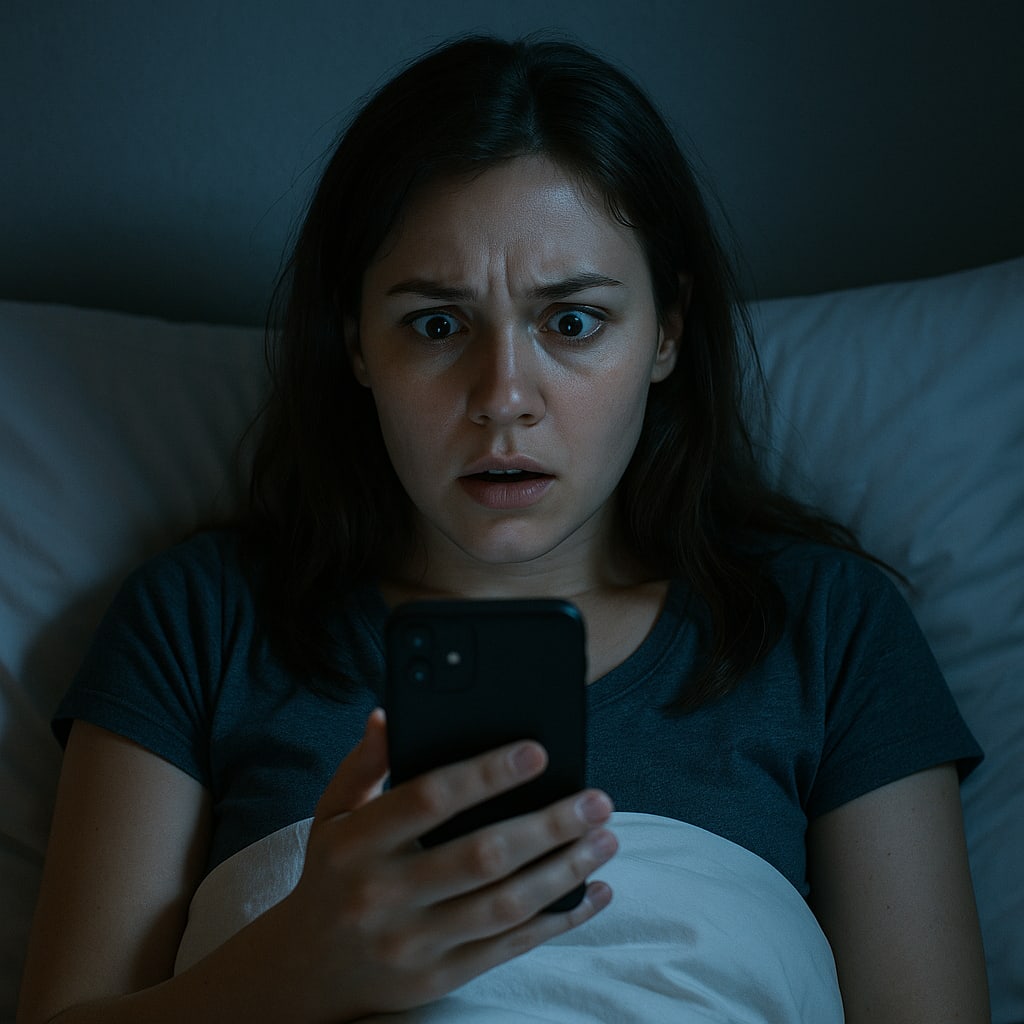
I downloaded a sleep tracker for my anxiety. What it caught at 3:17 a.m. still makes my hands shake when I talk about it.
The night it happened, I almost didn’t check the recording.
I woke up groggy, face stuck to my pillow, phone tangled in the charger cable, that familiar half-guilt of knowing I’d spent too long scrolling before bed.
The notification on my screen was harmless enough:
“You talked in your sleep 4 times last night. Tap to listen.”
That wasn’t unusual. I’d downloaded the app a month earlier because my therapist gently suggested I was “underestimating” how anxious I really was. My sleep had gotten weird—micro-awakenings, vivid dreams, that feeling of waking up already tired.
So the app felt like a compromise. I couldn’t fix my life overnight, but at least I could track how badly it was messing with my sleep.
I wish that’s all it had done.
Why I Started Recording Myself in the Dark
I didn’t buy the premium version at first. I only wanted the basics: start sleep, stop sleep, see the graph, judge myself in the morning.
But the app had this “sleep talking” feature. It uses your microphone to record any sound above a certain volume while you sleep. Snoring, talking, loud creaks, even your partner tossing around.
The first time I turned it on, it was out of morbid curiosity.
What if I say something super embarrassing?
What if I confess my deepest fears in my sleep?
What if I hear myself cry?
Mostly, I wanted proof that something was happening at night I wasn't conscious of.
The early recordings were almost funny. A few mumbled sentences that sounded like half-finished emails. A sleepy “no, no, no” that made zero sense. One clip of me clearly saying, “Tell them I’m not ready” in a tone like I was trying to cancel plans with a salesperson, not a person.
It was unnerving, but in a distant, conceptual way—like reading your own diary from middle school. Cringey, but survivable.
The app made it feel harmless. It had cute icons and little graphs and motivational reminders. It was an app, not an omen.
So I kept using it. Night after night, I’d hit “Start,” toss my phone on the nightstand face-down, and go to sleep, forgetting my own voice was being trapped in tiny digital jars I could open in the morning.
Nothing truly strange happened—until the end of that month.
The Night the Voice on the Recording Didn’t Sound Like Me
I remember the exact date because I screenshotted it: Tuesday, September 13th.
That day had been annoyingly normal. Work. Dishes. Half-hearted cardio. A microwaved dinner. I wasn’t especially stressed, no big fights, no horror movies, nothing out of the ordinary.
I went to bed around midnight, hit “Start Sleep,” and fell asleep surprisingly fast.
The next morning, I saw the notification:
“4 sound events recorded (sleep talking/snoring).”
I tapped it, mostly out of habit.
The first clip was me grumbling something about “passwords.” The second was a loud sigh. The third was definitely me, groaning like my dreams were trying to make me run uphill.
Then there was Clip #4. Time stamp: 03:17 a.m.
Duration: 08 seconds.
I pressed play.
At first, all I heard was the faint rustle of sheets. There was a kind of static hum, that low white noise you only get at night when everything is still.
And then a voice.
Not loud. Not whispery. Just… close. Too close.
It said, clear as day:
“Can you hear me?”
The words went straight through me like ice water.
I paused it instantly. Sat there staring at my phone. Rewound two seconds. I pressed play again.
Same thing. Rustle. Hum. Then:
“Can you hear me?”
Only this time, I noticed something that made my stomach flip.
It didn’t sound like me.
The Moment I Realized I Wasn’t Alone in the Recording
I should explain what my voice sounds like when I sleep talk.
It’s soft, slurry, like my tongue is wrapped in cotton. I trail off. I mumble. Most of the words are half-formed, dragged through exhaustion.
This wasn’t that.
This voice was clear, evenly paced. Calm. Almost… patient. Like whoever it was had said this more than once, and was trying again.
It sounded slightly deeper than me, and flatter, like it had less emotion in it. No drag of tiredness, no sense of consciousness ramping up or down. Just a clean, eight-second question in an otherwise empty night.
I replayed it again, forcing myself to listen all the way through.
Rustle. Hum.
“Can you hear me?”
Silence. Then the clip ends.
Nothing it said was technically threatening. No scream. No weird language. Just that one question.
But my heart was pounding so hard I could feel it in my palms.
It felt like the audio equivalent of looking at a group photo and noticing, for the first time, there’s someone standing in the back you don’t remember being there when the picture was taken.
Rational Explanations, Irrational Fear
My brain did what brains do: scramble for reasons.
I told myself it was probably me. Maybe my voice changes when I’m in deeper sleep. Maybe the microphone warps sound. Maybe I just never heard myself that clearly before.
But even while my mouth formed the logical sentences, my body didn’t believe me.
There’s a very specific kind of fear that doesn’t care about how smart you are. It lives in your spine, not your frontal lobe.
I sat there at my kitchen table with my phone in my hand, the sunlight coming in like it was any other morning, and I felt… watched.
The rational explanations lined up fast:
Maybe I left the TV on, and it captured that.
Maybe my phone picked up a sound from the hallway.
Maybe some glitch mixed in audio from another night.
I checked the obvious stuff first.
The TV had been off. The app said the sound was recorded from my microphone at that exact time. There were no overlapping recordings. No neighbors had been out in the corridor at 3 a.m.
I even tried mimicking the sentence out loud, recording myself in the same spot, at the same distance. I played the two clips back-to-back.
They didn’t match.
My version had little crackles of doubt. A tiny lift at the end, like I was asking a question. The recorded version was more… level. The question dropped flat, like the person already knew the answer.
I told myself I was being dramatic. I put my phone down, made coffee, tried to get dressed for work as if I hadn't heard a stranger in my bedroom asking if I could hear them.
But every time I thought about the clip, it felt like I’d accidentally answered a door I didn’t remember opening.
The Obsession That Came After
That night, I did what any anxious, sleep-deprived person with an internet connection does: I searched for answers.
I typed things like:
“Sleep app recorded voice that wasn’t mine”
“Sleep talking app ghost voice?”
“3:17 a.m. weird recording help”
I landed in corners of the internet I didn’t know existed. Forums full of people sharing grainy screenshots and haunted audio clips. Stories about disembodied whispers, footsteps, names said in the dark.
Some people laughed it off as audio glitches or neighbors.
Some swore they had caught evidence of hauntings.
A handful talked about sleep paralysis, hypnagogic hallucinations, all the things the brain can do when it’s half in a dream and half in the room.
Reading all that didn’t calm me down. It made me feel less alone, but not safer.
Part of me was horrified. Another part was weirdly defensive—like I needed my experience to be special, not just tossed into the “glitch” pile.
Because here’s the thing: when you’re the one who heard the voice, the lines between normal and paranormal stop mattering. What mattered to me was simple:
Something spoke.
I didn’t.
And now it lived on my phone.
The next few nights, I slept with the app off.
No recording. No data. No new evidence.
But turning it off didn’t help. I started waking up around 3 a.m., heart racing, convinced I’d hear that same question right next to my ear. “Can you hear me?”
I hadn’t realized how much safety I’d quietly assigned to the app. As if recording the night meant I had some control over it.
Without the digital witness, the dark felt thicker. Heavy.
Facing the Recording in Therapy
I eventually did the thing I’d been avoiding. I took the audio to my therapist.
I half expected her to laugh, or tell me I needed less TikTok and more fresh air.
Instead, she listened. Twice. Her face stayed neutral, but not dismissive.
When the clip ended, she sat quietly for a second and asked, “What does that voice represent to you?”
Which, to be honest, annoyed me. I wanted a ghost hunter, not a question.
I said something like, “It represents my phone being haunted?”
She smiled for half a second and then said, “Humor is good. But you seem really scared. And also… weirdly drawn to it.”
She was right.
I hated that clip. But I also couldn’t delete it. It felt like deleting an unsolved riddle.
She asked me a series of questions:
What was happening in your life around that time?
Did you feel unheard by anyone?
Is there a part of you that feels like it’s trying to get your attention?
I wanted a practical explanation. Instead, I got a mirror.
Because yes, around that time, I’d been shoving a lot down.
I was avoiding a hard conversation with someone I loved.
I was ignoring how exhausted I really was.
I was downplaying my anxiety as “just tiredness.”
And suddenly, that sentence—“Can you hear me?”—stopped being purely creepy and started sounding like a question my own life was asking me.
Was it literally some repressed version of me speaking out loud at 3:17 a.m.? Probably not.
Was it symbolic? Absolutely.
There was something about having it recorded—objective, undeniable—that forced me to admit I wasn’t okay.
I wasn’t just “bad at sleeping.” I was overwhelmed, and I kept muting myself.
The clip became less “a ghost in my room” and more “a ghost in my life.”
What I Changed After the Night of the Voice
I wish I could say I had some dramatic cinematic moment where I burned sage and deleted the app and woke up cured.
Reality was less glamorous. But it was real.
I did three concrete things:
I changed how I sleep.
I stopped falling asleep with my phone in my hand. No more doomscrolling until my brain gave out. The sleep app could stay, but it no longer sat on my nightstand right next to my face. I moved it across the room.
I listened to myself while I was awake.
The sentence “Can you hear me?” became a kind of check-in. Whenever I felt myself pushing through fatigue or swallowing something I needed to say, I’d ask: Am I actually hearing myself right now? Or am I skipping over my own needs because they’re inconvenient?
I made one hard conversation non-negotiable.
There was a conversation I’d been putting off for months. The kind that you rehearse in the shower and then avoid in real life.
I finally had it. It didn’t go perfectly. It wasn’t tidy. But it was honest. And after, my sleep slowly started to feel less like a battlefield.
I did eventually turn the sleep recordings back on.
There were more mumblings, more weird phrases, lots of snoring. But nothing like that voice. Nothing as clear, nothing that wasn’t obviously me.
Sometimes I wonder if the clip was just a freak coincidence—a sound from the hallway, a weird echo, some algorithm glitch.
Other times, I think it doesn’t matter.
Because whether it came from a neighbor, a glitch, a spirit, or some half-asleep part of my own brain, that eight-second audio did something I clearly hadn’t been doing for myself:
It made me stop.
It made me listen.
It made me ask what exactly I’d been ignoring in the daylight, hoping it would stay quiet in the dark.
The Takeaway I Can’t Shake
I still have the recording. I don’t play it anymore, but I also haven’t deleted it.
Not because I’m trying to prove anything, but because it feels like a turning point in my camera roll. A little marker in time: this is when you finally admitted something was wrong.
The weirdest part is that the question—“Can you hear me?”—has become less about fear and more about attention.
The night it was recorded, it sounded like something outside of me, intruding. Now, when I think about it, it feels like something inside me knocking from the other side of a wall I’d built myself.
Most of us are walking around half-tuned out. We treat our exhaustion like background noise. Our resentment, our loneliness, our panic—they all whisper at us, and we think if we just sleep it off, it’ll disappear.
So we track our steps, our calories, our REM cycles, our screen time. We collect data on our bodies like little scientists studying a stranger.
But the moment that changed me didn’t come from a graph. It came from a sentence. A voice saying what I hadn’t said out loud:
Can you hear me?
Whether you believe in ghosts or glitches or just the brutal honesty of your subconscious, there’s something worth stealing from that question.
Because underneath all the apps and metrics and “self-improvement,” there’s a much simpler test:
When your life tries to talk to you—through your anxiety, your insomnia, your dread of Monday mornings—do you actually hear it?
Or does it have to wait until 3:17 a.m., when the room is dark and your defenses are down, to finally ask for your attention?
I don’t know what, exactly, spoke in that recording. I may never know.
But I do know this:
The scariest voice wasn’t the one on my phone.
It was my own, ignored for so long that it had to borrow the night to get my attention.
And when I finally listened, it didn’t sound like a horror story.
It sounded like a beginning.
About the Creator
abualyaanart
I write thoughtful, experience-driven stories about technology, digital life, and how modern tools quietly shape the way we think, work, and live.
I believe good technology should support life
Abualyaanart
Keep reading
More stories from abualyaanart and writers in Horror and other communities.
"Scream 7" (2026): Running out of Fresh Screams
This is the seventh time we’ve had a Ghostface crisis. Scream 7 is the latest edition of the Scream franchise. Sydney Prescott and her family are under attack by another anonymous killer dressed in a Ghostface costume. While having issues with her daughter, Tatum, they run from the bloody murders, trying to determine who is behind it all.
By Marielle Sabbagabout 23 hours ago in Horror



Comments
There are no comments for this story
Be the first to respond and start the conversation.