
The Dullahan
Ireland's Headless Messenger of Misfortune.

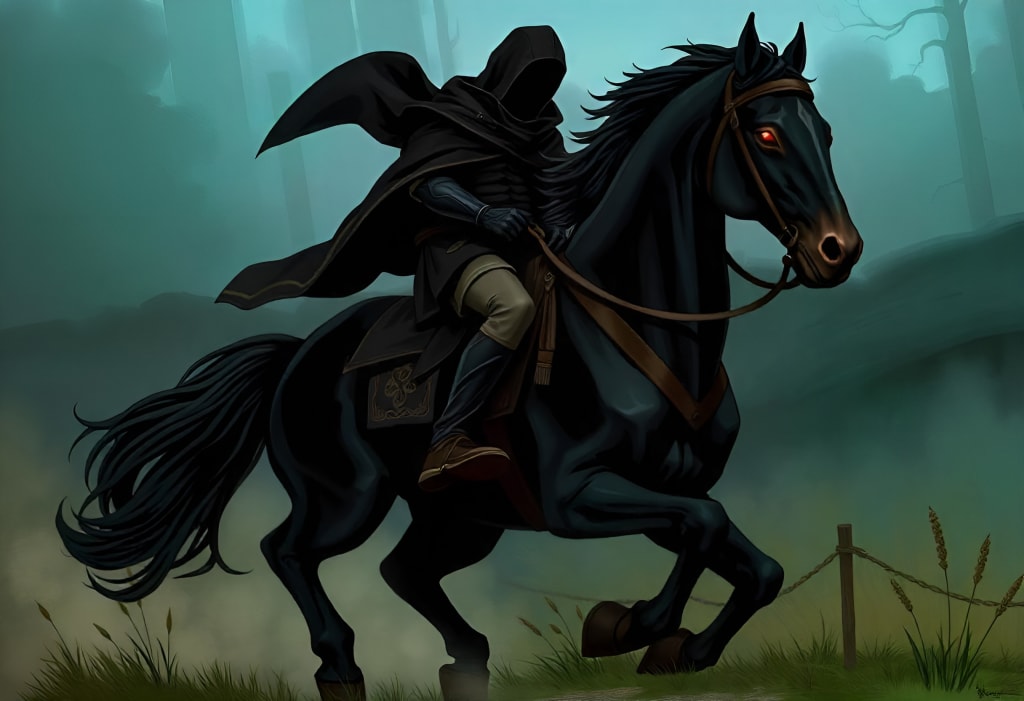
The Dullahan is an intriguing character from Irish folklore, recognized for its unsettling aura and ominous association with death. Frequently illustrated as a headless horseman riding a black steed, this supernatural being has captivated and terrified people for generations. Its narrative weaves together Ireland's vibrant oral traditions with its profound ties to myths and legends. We shall explore the origins, traits, and cultural importance of this spectral figure. The term "Dullahan" is derived from the Irish Dubh-luachair, which translates to "dark or black man." This ghostly figure has its origins in Celtic mythology, particularly linked to the ancient fertility deity Crom Dubh. In pagan traditions, Crom Dubh was revered as a god to whom offerings were made in hopes of securing abundant harvests. However, with the advent of Christianity in Ireland, Crom Dubh was vilified, and the narratives surrounding his worship transformed into darker tales, including those of the Dullahan.
The Dullahan is often regarded as a variant of the banshee or a harbinger of death. Similar to the banshee, its appearance heralds imminent demise, yet its manifestation and demeanor are considerably more frightening. In contrast to the mournful wails of the banshee, the Dullahan is characterized by silence or the resounding, thunderous sound of hooves as it gallops through the night. The Dullahan is characterized as a headless entity, frequently illustrated as riding a pitch-black steed with eyes that burn like glowing embers. In certain interpretations, the horse itself is also headless, further intensifying the horror associated with this legend. The Dullahan holds its own severed head, which emits a ghostly luminescence, illuminating its route through the shadows. This head possesses the grotesque capability of perceiving vast distances, sometimes encompassing the entirety of Ireland, rendering it impossible to escape its watchful gaze.
Typically clad in black, the Dullahan's garments reflect its malevolent intentions. It brandishes a whip crafted from a human spine, a chilling detail that emphasizes its ominous role as a harbinger of souls. In some narratives, the Dullahan is said to traverse in a carriage known as the Coach-a-Bower or Cóiste Bodhar. This carriage, embellished with funeral motifs and drawn by black horses, is believed to serve as the ultimate harbinger of death. The Dullahan, distinct from other supernatural beings, does not bring about death but serves as its herald. It manifests to beckon souls to the afterlife, calling out their names with a deep, resonant voice. The moment a name is uttered, the individual's destiny is irrevocably determined.
A particularly chilling characteristic of the Dullahan is its embodiment of inevitability. Unlike various myths where cleverness or valor may deceive a spirit, the Dullahan remains impervious to traditional methods of evasion. Nonetheless, there exists an intriguing exception: gold. According to folklore, the Dullahan possesses a strong aversion to this valuable metal, and even a modest quantity can compel it to withdraw. The Dullahan embodies the rich narrative heritage of Ireland, intertwining elements of death, the supernatural, and ethical considerations. Its function as a harbinger of death resonates with the universal apprehension surrounding mortality and the enigmatic aspects of existence, while its association with pagan customs highlights Ireland’s profound historical connections to its pre-Christian heritage.
Throughout the years, the Dullahan has influenced a variety of literary works, drawing parallels to the Headless Horseman in Washington Irving’s The Legend of Sleepy Hollow. Although Irving’s story is set in the United States, scholars frequently link the Headless Horseman to Irish immigrants who carried tales of the Dullahan to their new homeland.
In contemporary culture, the Dullahan has appeared in various forms of media, including video games and fantasy literature, reinforcing its status as an emblem of fear and intrigue. Despite these modern interpretations, the original folklore of the Dullahan maintains its uniquely Irish character, illustrating the enduring power of myth to cross boundaries of time and culture.
About the Creator
A História
"Hi. My name is Wellington and I'm a passion for general history. Here, I publish articles on different periods and themes in history, from prehistory to the present day.
Keep reading
More stories from A História and writers in Horror and other communities.
The Grootslang
African folklore offers a wealth of enchanting narratives, brimming with mythical beings and supernatural entities. One such figure is the Grootslang, a fearsome and enigmatic creature believed to inhabit the caves and rivers of South Africa. The legend of this monster has fascinated explorers, historians, and mythology aficionados for generations.
By A Históriaabout a year ago in Horror
"Scream 7" (2026): Running out of Fresh Screams
This is the seventh time we’ve had a Ghostface crisis. Scream 7 is the latest edition of the Scream franchise. Sydney Prescott and her family are under attack by another anonymous killer dressed in a Ghostface costume. While having issues with her daughter, Tatum, they run from the bloody murders, trying to determine who is behind it all.
By Marielle Sabbag5 days ago in Horror
Ranking of Witchcraft Movies From Worst to Best
The Witchcraft franchise, known for its low-budget horror films, has garnered a unique reputation over the years. With a total of 16 films, the series is often critiqued for its inconsistent quality and reliance on softcore elements.
By Ninfa Galeanoabout 10 hours ago in Horror
From ad men to mad men
It's after 2am in the morning when a local police patrol vehicle in Northern New Jersey spots a figure costumed as Quasimodo, The Hunchback of Notre Dame, proceeding southbound on the sidewalk along Lydecker Street. Though the hunchback’s costume stuffing offers added insulation, it's January, and friggin’ freezing. Carefully, the officers slow down, gently question the subject, and offer him a ride home.
By David W. Maury2 days ago in Humor



Comments
There are no comments for this story
Be the first to respond and start the conversation.