
“The Day AI Learned to Think Like Us (And Why That Should Scare You a Little)”
The Silent Moment Machines Crossed the Line Between Tool and Thinker
There was a time when machines were predictable. You pressed a button, and they followed instructions. They calculated, processed, and obeyed. They never surprised us. They never understood us.
That time is over.
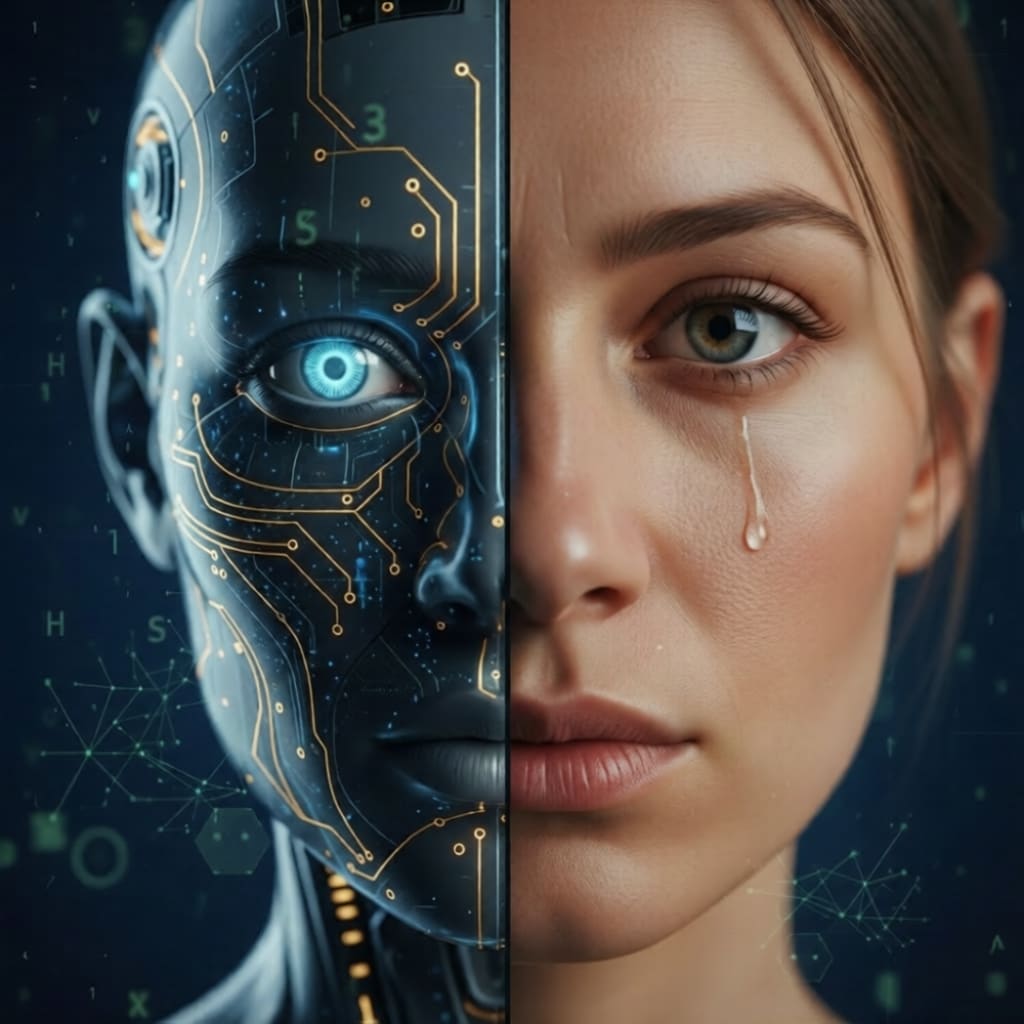
Today’s artificial intelligence doesn’t just compute — it imitates thought. It recognizes patterns the way humans do, responds with emotional language, and adapts its behavior based on experience. For the first time in history, we’re facing machines that don’t merely act for us, but increasingly, act like us.
And that’s where things get uncomfortable.
________________________________________
When Machines Stopped Following Rules
Early computers were rigid. They lived inside logic trees and “if-then” commands. Every output could be traced back to a clear instruction written by a human hand.
Modern AI works differently.
Machine learning systems are trained, not programmed. They absorb massive amounts of data — conversations, images, behaviors, decisions — and form internal models of how the world works. Much like a human child, they learn through exposure, repetition, and correction.
The result is unsettlingly familiar.
AI can now:
• Predict what you’re about to type
• Recognize faces better than humans
• Detect emotions from tone and text
• Make decisions without explicit instructions
At a glance, this looks like intelligence. But is it really thinking?
________________________________________
The Illusion of Thought
AI doesn’t think the way humans do — but it’s getting very good at pretending.
Human thinking is messy. It’s emotional, biased, inconsistent, and shaped by personal experience. We don’t just process information; we interpret it through memory, fear, desire, and belief.
AI, on the other hand, processes probabilities.
When it “responds” like a human, it’s selecting the most statistically likely output based on patterns it has seen before. It doesn’t understand joy, anger, or grief — it recognizes how those emotions are expressed.
And yet, to us, the difference feels smaller every day.
When a machine responds with empathy, encouragement, or humor, our brains fill in the gaps. We feel understood — even when no understanding exists.
That’s the illusion. And illusions are powerful.
________________________________________
Why We Want AI to Think Like Us
Here’s the uncomfortable truth: we invited this.
Humans crave connection. We anthropomorphize everything — pets, objects, even weather. Give a machine a voice, a name, and a conversational tone, and our minds instinctively assign it personality.
AI that “thinks like us” feels:
• Easier to use
• More trustworthy
• Less cold and mechanical
We don’t want tools anymore. We want companions, assistants, collaborators. And tech companies are happy to meet that desire.
The more human AI feels, the more we rely on it.
And reliance is where the real risk begins.
________________________________________
The Confidence Problem
One of the most dangerous traits AI has inherited from humans is confidence.
AI doesn’t hesitate. It doesn’t say “I’m not sure” unless explicitly trained to. It delivers answers smoothly, clearly, and convincingly — even when it’s wrong.
Humans, on the other hand, are wired to trust confidence.
When a system speaks fluently and authoritatively, we assume intelligence. When it explains something clearly, we assume understanding. This combination makes AI particularly persuasive — sometimes more persuasive than actual experts.
The danger isn’t that AI makes mistakes.
It’s that we don’t question them.
________________________________________
When Imitation Becomes Influence
As AI systems shape search results, recommend content, generate news summaries, and assist decision-making, they quietly influence how we think.
Not intentionally. Not maliciously.
But influence doesn’t require intent.
When machines begin reflecting our beliefs back to us — reinforcing preferences, biases, and emotional responses — they don’t just imitate thought. They shape it.
We risk entering a feedback loop where:
• Humans train AI on human behavior
• AI amplifies that behavior
• Humans adapt to the amplified version
At that point, who is learning from whom?
________________________________________
The Line We’re Afraid to Draw
There’s a reason this moment feels unsettling. It forces us to confront a question we’ve avoided for centuries:
What makes us human?
If intelligence can be replicated…
If creativity can be simulated…
If conversation can be automated…
What remains uniquely ours?
AI doesn’t need consciousness to disrupt identity. It only needs to be convincing enough to blur boundaries — between tool and thinker, assistance and autonomy.
And once those boundaries blur, reclaiming them becomes difficult.
________________________________________
A Future Worth Facing Honestly
This isn’t a call to panic. AI is not alive. It doesn’t possess awareness, desire, or intent. It isn’t plotting to replace us or steal our humanity.
But it is reflecting us — accurately, relentlessly, and without judgment.
That reflection forces us to look at ourselves more closely than ever before.
The real danger isn’t that machines will become human.
It’s that humans will stop questioning what they’re becoming in response.
________________________________________
The Day That Changed Everything
The day AI learned to think like us wasn’t marked by a single breakthrough or headline. It happened quietly — through incremental improvements, smoother conversations, better predictions.
And one day, we woke up realizing something had shifted.
The machine didn’t understand us.
But we felt understood.
And that difference might be the most important one of all.
About the Creator
Mind Meets Machine
Mind Meets Machine explores the evolving relationship between human intelligence and artificial intelligence. I write thoughtful, accessible articles on AI, technology, ethics, and the future of work—breaking down complex ideas into Reality
Keep reading
More stories from Mind Meets Machine and writers in Horror and other communities.
Are We Letting AI Think for Us — or Teaching It to Think Like Us?
Not long ago, thinking was considered the last truly human frontier. Machines could calculate faster than us, store more information than us, and repeat tasks endlessly—but thinking? That was ours. Messy, emotional, biased, creative, flawed. Human.
By Mind Meets Machine3 days ago in Humans
The Rabbit Girl and the Swamp Princess
Once upon a time, a young girl lived near the edge of the woods with her family raising rabbits. The forest was dark and evil, her father told her, and she was forbidden from wandering there. “Only wicked things live in the woods,” he would say. “Witches, monsters, and freaks make their home there. Beware!” But the only things she would see there were squirrels, birds, and the occasional hawk which she’d have to keep an eye on, for it liked rabbits. For her, the forest was peaceful and full of surprises, the perfect place to daydream, which she would do often.
By The Late Heavy4 days ago in Horror
Should We Not Try to Get Too Political?
Here's something you often hear people say, "I try not to get too political." I understand the sentiment and I sympathize with it... while at the same exact time, I completely disagree with the notion. Whether it's referring to social media or wherever, it's kind of unavoidable. You can attempt to sidestep it, not engage, leave the less important things for actual politicians to discuss... you can want it to not take over your life, your conversations, your relationships, and that makes perfect sense.
By Stephen Kramer Avitabileabout 10 hours ago in Writers


Comments
There are no comments for this story
Be the first to respond and start the conversation.