
The Cabin on the Lake
A Ghost Story

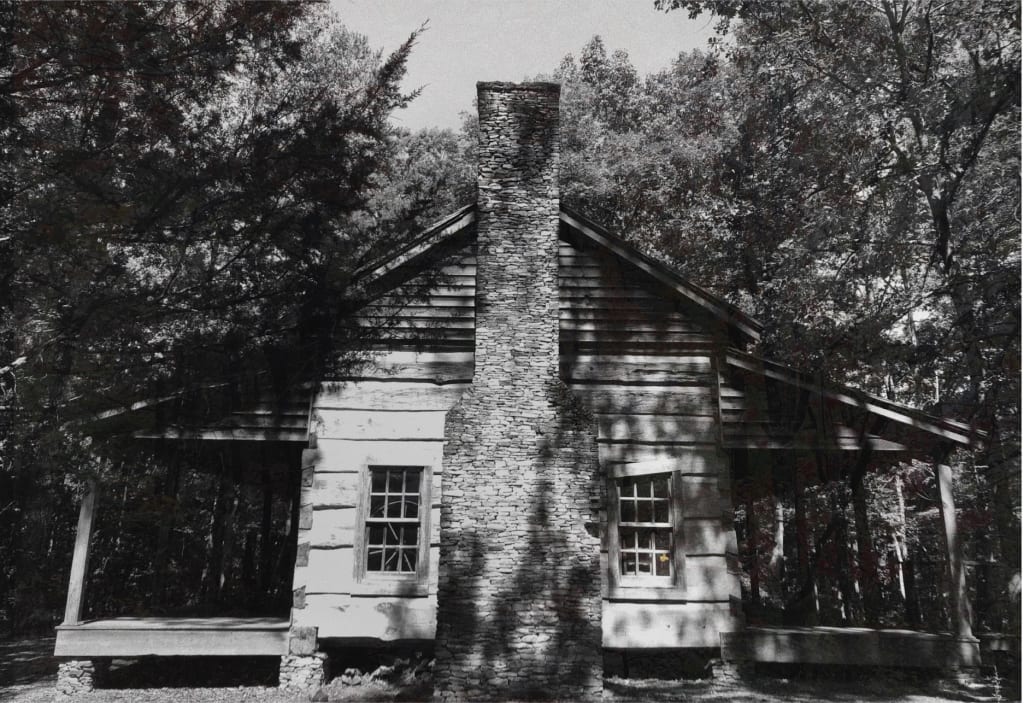
The cabin in the woods had been abandoned for years, but one night, a candle burned in the window.
“It’s a ghost,” Tim whispered.
Ruby scoffed. “It’s not a ghost, dummy. Someone probably bought the cabin, finally, or the guy who owns it came back for a fishing trip.”
“Why are they burning a candle, though?” Tim rejoined indignantly. “If someone just bought it, wouldn’t they get electricity?”
Ruby shrugged. “I dunno. Some people like to keep things primitive. Or maybe it’s one of those fancy lights that’s just supposed to look like a candle.”
Tim eyed the cabin across the lake suspiciously. “Yeah, I guess. It’s kinda weird, though. I’ve never seen that before.”
Tim and Ruby had been coming to camp by this lake for years. Until recently, their granddad usually came with them. Their grandparents lived in a house up the impossibly steep hill behind this spot. They were lucky to live on the end of the lake that was as yet undeveloped—it was just their house, old Mr. Potter’s house next door, and the (apparently formerly) abandoned wood cabin on the far shore.
Camping here was one of the chief adventures of their childhood, yet also warm and comforting in its regularity. They had slept under the stairs here many times, making s’mores, laughing, and listening to their granddad’s stories.
But Tim had never liked that cabin. Something about it gave him the feeling that someone in it was watching him, although tonight was the first time that it had ever shown any sign of life. No, it was more like the cabin was always watching him. It gave him the willies. He asked his big sister why they had to camp right here, directly across from it.
“Because,” Ruby replied, “this is base camp. We always camp here.”
Privately, Ruby wondered if maybe they should move. She had never told Tim, but the cabin gave her the creeps, too—or at least it had since last summer, when Granddad told that story. It was something about its neglected exterior, the shingles covered in moss and lichen, with the cloudy windows that pointed out over the lake like eyes. They gave the impression of a gaze both mournful and menacing.
But this was the site they always came to. Granddad had built a fire pit and cleared the trees, leaving two just right for a hammock. Ruby didn’t like the cabin watching them, but she also didn’t want to go anywhere else without their granddad. Besides, the undergrowth was so dense all around them that she didn’t think that they would find a better spot before dark.
The moon had started chasing the sun out of the sky, and the first stars were appearing overhead. It was early October, and the brilliantly colored leaves fluttered to the ground in the breeze. The siblings bustled about as they finished setting up their campsite and roasting hot dogs for dinner. Neither of them mentioned the cabin again, but both stole glances at it when they thought the other wasn’t looking.
Only when they had settled around a crackling fire, their bellies full of frankfurters and the fixings of s’mores scattered about, did Tim ask, in a hushed voice that betrayed both fear and fascination, “Tell that story that Granddad told us—the one about the cabin.”
“Agh, no! Do you want to have nightmares?” Ruby exclaimed.
“C’mon, sis, please? I’m too scared to tell it but I wanna hear it!”
Ruby gave an exaggerated sigh as she turned her marshmallows. She might as well. The story had already been banging around in her head all evening, ever since they noticed the candle in the cabin window.
“OK, if you’re sure… but don’t wake me up in the middle of the night every time you hear a twig move.”
“Yesss! I won’t, I won’t—I promise,” Tim said, snuggling deeper into the blanket around his shoulders, his eyes alight. The first hints of autumn and the winter to come were making their way across the lake, occasionally brushing against the children’s faces like long and pallid fingers.
Ruby glanced over at the cabin without thinking; the candle, the light, whatever it was, was still there. It was the only light source on the lake, other than their campfire and the reflection of the crescent moon on the water. Another breeze sighed around them; the fire sputtered and Ruby shivered.
She remembered the way her granddad had looked when he told this story last summer. His wide face and thick beard were as imposing as ever, and there was still an undeniable twinkle in his eyes when he laughed, but there had been something in his eyes that hinted that all was not well. He was gone by the first day of September.
Ruby shook off those memories and, with another glance across the lake at the cabin, began the tale:
A very long time ago, a settler in these mountains came to this lake with his family. They found it a beautiful and peaceful place, and the hunting and fishing were fruitful. The Settler decided he would build their home there, for they had wandered for a long time. There was even an old stone chimney standing alone in the clearing by the lake. No one in the area would tell them its provenance, or else they didn’t know. The Settler assumed it must have belonged to a house that was abandoned and lost to a fire. All he knew was that it did not belong to the other few families that lived in and around the valley, nor to anyone in the nearest town, some fifteen miles away. He hoped its former occupants had left of their own accord, and blessed them for leaving behind such a fine, strong chimney.
The family was happy there for a few years. They had plenty of food and the cabin built by the Settler was cozy and sturdy. In the summer, his children swam in the lake, and his wife grew vegetables in a small plot behind the cabin. Then, just before their third winter, the family began to notice strange happenings. One morning in October, they woke to find a dead rabbit on their porch. There was no indication of what had happened to the poor creature or how it came to be there. Fearing disease, the Settler buried it behind the house; he started keeping an extra sharp eye and ear for signs of encroaching wolves or coyotes.
The next week, his wife picked some runner beans. Most of these she canned for the winter, but that evening, the family had some with their supper. Her husband winked fondly at his children before taking his first bite, only to spit the whole mouthful back out. Inside, the beans were blackened and dry, and they carried a sour, bitter flavor. The wife was horrified and the beans were disposed of. She lamented the dozen cans she had prepared that day.
The following week, the Settler could not locate any of his spare bullets as he prepared for a day’s hunting trip. After interrogating all his children, he decided that he must have lost them on his last excursion.
There were dozens of other incidents in the following days. Then the nightmares started. They seemed to affect everyone in the family; by the end of the week, they were all moving about in a trance, their eyes dull and puffy as they went about their chores.
The Settler never asked his wife and children what they dreamed about. He feared the same images that had been haunting his dreams were also menacing his family: a face that was always hidden behind long and tangled hair, belonging to some thing whose grasping fingers reached out towards him, his heart filled with horrible dread as those awful, long fingernails came closer, ever closer, to his face, and, sometimes, a cruel and taunting laugh as they began to claw at him.
Each night it seemed to start with the youngest. He would wake to her harrowing cries, only to see his other children, and finally his wife, start to toss and turn and cry out in their sleep. He would go to comfort the smallest, and she wouldn’t wake, not even when his wife came over to hold her. She was stuck, facing some unknown terror, weakly crying for it to get away from her— until, just as suddenly as it started, it would cease. She would lay under her little quilt, seemingly at peace, until the sun beams hit her tired face.
Very early one morning, after the Settler had succumbed to his exhaustion, he woke with a start. He was groggy, disoriented. Thoughts struggled to move through his brain as though they were floating in molasses. Gradually he remembered: there were no cries last night. He had not woken to find his family tormented by invisible foes—what had roused him? He shivered, though not from any draft. He had the strangest feeling that someone had been beside him, but there was no movement in the cabin. He reached a hand up to his shoulder; he thought he had felt someone there, just now, as he slept.
With a quick glance around the cabin to confirm that no one was awake, he stood and grabbed his gun. He walked outside and saw the morning light beginning to glow behind the trees, on the horizon. The lake was tranquil in the early morning stillness, and the first birdsong that he heard filled him with some small hope. Maybe the nightmares were over.
He headed down to the water’s edge, knelt, and dipped his whole head in. Icy needles pricked his face, his scalp, but he felt better. He rubbed his face and hair vigorously, and had just turned to go back up to the cabin, when the door flew open with a BANG.
His wife was standing there, white as a sheet and with eyes large with panic. She looked around wildly before seeing her husband. She ran to him.
Their smallest child was missing, his wife cried. Her face was mad with hysteria and her hands clutched at her hair as her husband ran into the cabin. It was true; the children were all still asleep, but the youngest was nowhere to be found.
The Settler ran back outside, calling his daughter’s name. His wife had collapsed to her knees—he went to pull her to her feet, she had to stay with the other children while he searched for the little one. She looked up into his face and the most desperate moan escaped from the back of her throat.
“She took her. She took her. She’s gone”
The Settler thought of the nightmares—long, grasping fingers with their horrible dirty nails; the dreadful feeling that something sinister was coming closer. Close enough to touch them…
His hand shot back up to his shoulder. He looked frantically all around—there! Through the trees! Clutching his gun, the Settler shot off into the forest, the sounds of his wife’s cries getting fainter as he pursued her—as he pursued it.
His family waited all day, clutching hands, taking turns combing the woods by their cabin and the lake shore for any sign of the little girl or their father. There were no dreams that night; it was a sleepless house. They waited, alert and awake, ready to jump up as soon as they heard a footfall, watching out the windows…
The Settler returned just after dawn. He did not say a word. He was alone.
The family left the cabin that day. They did not take their belongings. No one knows where they went. The cabin had been abandoned ever since.
Through the years, hikers and hunters would occasionally stumble upon it, but they never lingered. Something about the place made them want to hurry on their way. Maybe it was the heavy sense of loss that still hung in the air; some of them swore they heard a child’s cry, others were sure it was a humorless and taunting laugh, though no one ever answered when they called out, “Who’s there?”
To this day, no one has dared to go inside. The locals say that sometimes, if you are out here alone, you can still hear the daughter, calling for her family, and the evil laughter of whoever or whatever spirited her away.
Tim exhaled suddenly and forcefully, spitting out bits of graham cracker. He hadn’t realized he had been holding his breath.
“But Granddad dared, didn’t he? What happened when he dared?”
Ruby looked up at her brother, her eyes bleary from staring at the fire. She blinked.
“Granddad did go up to the cabin once on a dare. He was about my age. A couple of his friends came with him, but he was the only one brave enough to go up to the door.”
“And…?” Tim asked, expectantly.
Ruby smiled at her brother, “I don’t know, he wouldn’t tell us that part, remember? He said he reached out to knock on the door…” Ruby trailed off dramatically.
Tim inhaled sharply and began holding his breath again. Crickets chirruped. Their tent swished in the breeze. Neither of the children noticed that the candle in the cabin window was no longer burning.
“And… the rest was a story for another time.” Ruby finished lamely.
Tim let out a frustrated sigh, “Aw, man. I bet it was gonna be good, too.”
Ruby smiled at her brother, “Probably. Granddad told the best stories. It would have been exciting, whatever it was.”
Tim looked thoughtfully at the fire as he chewed another s’more, “Do you think he really did it?”
Ruby tilted her head, considering, “I think so—why not? It’s just a ghost story, anyway. And he wasn’t scared of anything.”
“Except for the cabin,” Tim said seriously.
Ruby laughed, “You think he was really scared of the cabin?”
Tim nodded, “I think that’s why he camped here. I think he was watching it.”
Ruby frowned slightly. Or it was watching him, Ruby thought, looking over at it.
“Huh. The candle’s out now.”
Tim quickly turned to look. He gulped, “Oh, geez. Now I wish we’d told a different story, Rube.”
This made Ruby laugh, “You begged me to!”
Tim looked sheepish.
“And you promised not to have nightmares,” she said pointedly.
Tim looked at her with worry.
“You should have told me some of those jokes you’ve been working on instead,” she said, encouragingly.
Tim smiled, “Hah, yeah…”
“C’mon, Tim, it’ll be a good mental breath mint,” she said, winking.
Tim smiled wider, “OK, OK.” He cleared his throat and hummed a quick arpeggio to warm up.
Ruby snorted with laughter.
“Ahem. Knock, knock…”
A twig suddenly snapped behind Ruby. Their heads snapped around to look towards the noise, their eyes straining to see in the darkness.
“Heh, of course, now every branch is going to sound scary,” Tim said weakly.
Ruby swallowed. “Ah, you know what Granddad would say…”
“Just a 300 pound squirrel!” they said in unison.
They laughed again, and the fire suddenly seemed warmer.
Ruby smiled at Tim, “Go on, tell me a few good ones–not knock knock jokes.”
“Haha, ok…” Tim began again. Ruby was trying to listen, but her eyes were drawn back over to the cabin, wondering…
“Ruby?”
She turned back to face her brother, “Sorry, Tim, I was just—” she stopped mid-sentence. Her brother’s face was pale as death and his mouth was hanging open.
“Tim? What’s the matter?”
Tim’s mouth moved to form words that had no sound. His eyes stared in horror past his sister.
“Tim, what the hell?” Ruby said, her voice growing louder with fear.
Tim slowly shook his head, his eyes gaping, his mouth still forming silent words. Just as she began to turn, Ruby felt something clamp down hard on her shoulder. She looked down. There were several long, pale fingers digging their nails into her flesh.
Ruby screamed. A cruel, mirthless laugh rang through the night. Across the lake, inside the empty cabin, the flame on the candle had disappeared with a gasp. Its smoke twisted and writhed up into the dark, stale air.
About the Creator
Sarah Chlapowski
Lover of stories, former teacher, lifelong learner. Trying my hand at bringing some of my own stories into existence.
Keep reading
More stories from writers in Horror and other communities.
Rumors of China's Three Great Zombies
Today, let's talk about those zombie rumors that are engraved in folk memory and are becoming increasingly evil as they spread. This is not a scene that can be solved just by jumping around and sticking a yellow talisman in movies. Each scene carries a real era, location, and scalp tingling details, especially the 1872 incident in Pingxiang, Guangxi, where the government sealed off mountains and burned forests, resulting in heavy casualties. More than a hundred years later, when it comes to it again, it can still make people's necks feel cold. Today, I will slowly tell you about these three zombie rumors from beginning to end.
By Aiden Wang6 days ago in Horror
Book Review: Atmosphere by Taylor Jenkins Reid
I flipped the book over in my hands in the centre of the small airport book shop. Although I had heard promising reviews of Atmosphere by Taylor Jenkins Reid, I hesitated. The synopsis didn’t compel me - I wasn’t much of a space girly. In high school it made me cringe when my peers would talk about the stars.
By sleepy drafts5 days ago in BookClub




Comments