
The Brave Peddler and the Haunted Castle
When courage met the supernatural — one fearless traveler turned a ghost’s curse into a story of redemption.

The Brave Peddler and the Haunted Castle
BY: Ubaid
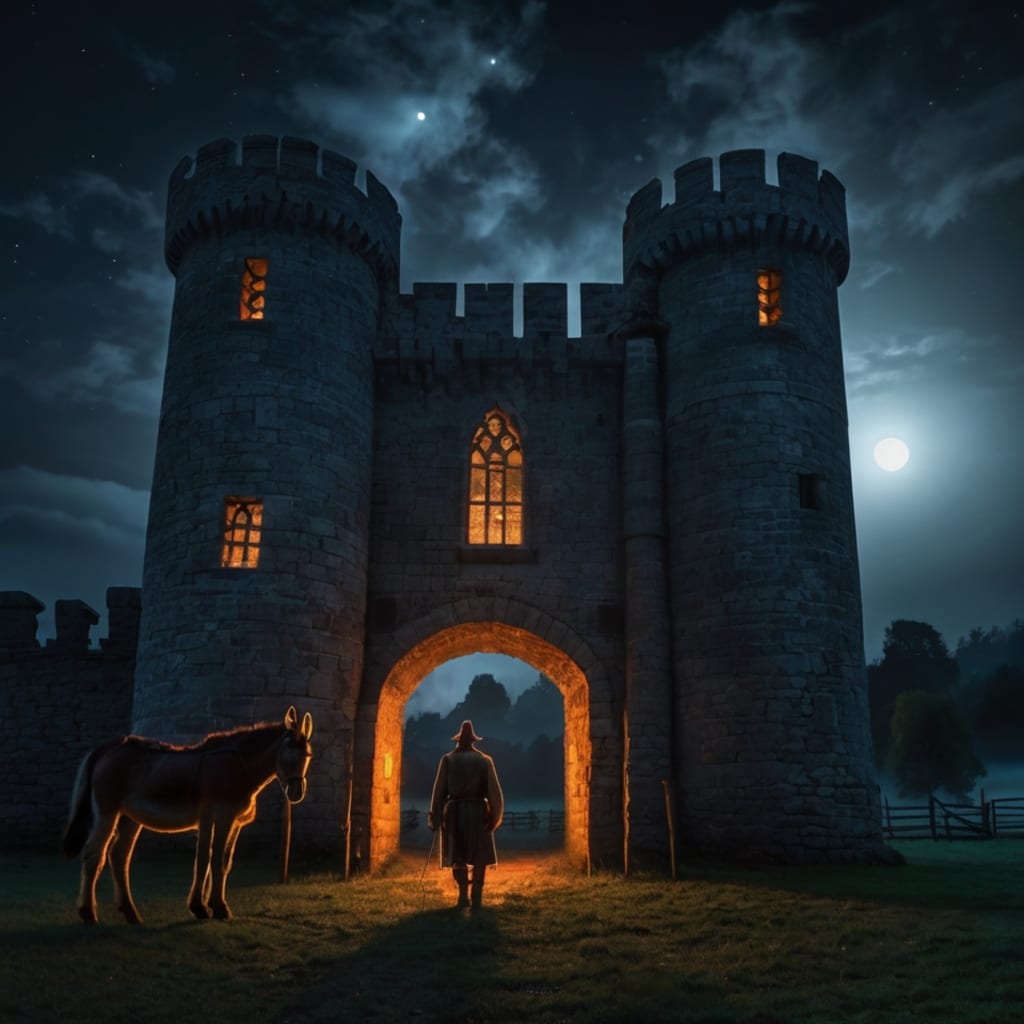
Outside a small village stood an enormous, grey-stoned castle in the middle of a vast, lonely field. No one dared to go near it. Everyone in the village knew the place was haunted. They said no living soul resided within its towering walls, yet on cold, silent nights, faint cries and trembling whispers echoed from its empty halls.
Sometimes, fire would burst from the castle’s chimneys, forming ghostly shapes that danced in the air before vanishing into the dark sky. Many bold adventurers had tried to uncover the mystery of the haunted castle, but by dawn, they were always found lifeless—sitting motionless before the cold fireplace, as if death itself had taken a seat beside them.
One winter morning, a cheerful peddler named Esteban arrived in the nearby village. He was young, lively, and known for his laughter. As he displayed his pots, pans, and other goods in the village square, a few women gathered around to buy from him. Between their shopping and chatter, they began to tell him the eerie tales of the haunted castle.
“On nights like this,” one woman whispered, “flames rise from the chimneys, shaping themselves into spirits. And if you go too close, you can hear a wailing voice crying in pain.”
Esteban’s eyes lit up with curiosity. “Ladies,” he said with a grin, “they call me Esteban the Brave. I fear no man and no ghost—only God above. I’d gladly spend the night in that castle and offer comfort to that poor, restless soul!”
The women stared at him in disbelief. One finally said, “If you can drive that spirit away, the castle’s owner will reward you with a thousand gold coins.”
Esteban burst out laughing. “A thousand gold coins and a good story? Then tonight, the haunted castle shall have company.”
Being fond of good food, Esteban asked the women to tell their husbands to bring him large logs of firewood so he could keep warm through the night. He also requested spiced meat, a large jug of water, a dozen eggs, and a frying pan. The villagers, amused and intrigued, fulfilled his requests eagerly.
When the sun set, Esteban loaded everything onto his donkey and headed toward the castle. The wind howled through the trees, and the drizzle turned into a cold rain. At the castle gate, he tied his donkey near a patch of grass and carried his supplies into the grand, dark hall.
Bats fluttered near the ceiling as he stacked dry wood in the fireplace and lit a fire. Golden flames flickered up the chimney, filling the room with warmth.
“Ah,” Esteban said aloud, rubbing his hands, “fire drives away both cold and fear.”
He placed the frying pan over the fire and began to cook the meat. The smell of roasted spices filled the hall. Just as he lifted the jug to pour himself some water, a weak, trembling voice echoed from the chimney:
> “Oh... I died... I died...”
Esteban calmly swallowed his water and said, “Well, that’s not the best greeting, my friend—but at least it’s better than my donkey’s braying.”
He flipped the meat. Again, the voice came:
> “Oh... I died... I died...”
Ignoring the chill that ran down his spine, Esteban broke an egg onto the pan. The sizzling sound was comforting. Then the voice cried again, this time in distress:
> “Catch me! I’m falling!”
Esteban replied, “Alright, but don’t fall on my frying pan.”
A thud echoed behind him. When he turned, he saw—of all things—a human leg, still clothed in trousers, lying by the fireplace.
“Interesting,” Esteban muttered. “Let’s see what happens next.”
He ate a piece of meat and waited. The storm outside grew stronger, rain battering the windows. The voice came again, more desperate:
> “I’m falling—be careful!”
Another thud. A second leg fell beside the first. Then came the torso, dressed in a blue shirt and brown jacket. One by one, the arms dropped down the chimney.
Esteban looked at the growing pile of body parts, shrugged, and went back to frying another egg.
Finally, the voice warned, “I’m coming down—watch out!” and with a loud crash, the head rolled out onto the floor. It had black hair, hollow eyes, and a pale, dead face.
The scattered limbs began to move and join together. Soon, a complete figure stood before him—the ghost of the castle.
“Good evening,” Esteban said casually. “Would you care for some meat and eggs?”
The ghost shook his head. “No, I no longer need food. But I must tell you—you are the first man to watch me reassemble and yet feel no fear. All others died before I could speak.”
Esteban smiled. “Perhaps they forgot to bring dinner and firewood.”
The ghost’s tone softened. “You can free my soul. In the courtyard stands an old banyan tree. Beneath its roots lie three buried bags—one filled with copper coins, one with silver, and one with gold. I hid them after robbing travelers with my companions. When I buried them, they killed me and tore my body apart. They never found the treasure.”
He paused. “Dig them up. Give the copper to the village temple, the silver to the poor, and keep the gold for yourself. Maybe then my sins will be forgiven.”
Together they went to the courtyard. The donkey brayed wildly at the sight of the ghost. The ghost pointed to the tree. “Dig here.”
Esteban replied, “You dig.”
And so, the ghost dug. Soon all three bags appeared. After making Esteban promise to fulfill his wish, the ghost whispered, “Now remove my clothes; they bind me to this world.”
Esteban did as told. Instantly, the ghost vanished. Only the clothes lay on the ground—empty, lifeless.
Esteban took the treasure back inside, fried one more egg, and slept peacefully by the fire.
The next morning, villagers came expecting to find his corpse. Instead, they saw him smiling and cooking breakfast.
“You’re alive?” one gasped.
“Why wouldn’t I be?” Esteban grinned. “Your meat and eggs kept me good company. Now, I’ll go collect my thousand gold coins—the ghost is gone for good. His clothes are in the courtyard if you need proof.”
He loaded the treasure onto his donkey, collected his reward, gave the copper to the temple, the silver to the poor, and used the gold to build a school for the village children—so they might grow brave and wise, like Esteban the Fearless.
About the Creator
"Scream 7" (2026): Running out of Fresh Screams
This is the seventh time we’ve had a Ghostface crisis. Scream 7 is the latest edition of the Scream franchise. Sydney Prescott and her family are under attack by another anonymous killer dressed in a Ghostface costume. While having issues with her daughter, Tatum, they run from the bloody murders, trying to determine who is behind it all.
By Marielle Sabbag7 days ago in Horror
The Secret Society That Became a Global Conspiracy Legend
The word “Illuminati” instantly evokes images of shadowy meetings, powerful elites, secret handshakes, and hidden symbols controlling the fate of nations. Over time, the idea of the Illuminati has evolved from a short-lived Enlightenment-era society into one of the most famous conspiracy theories in the world. But what is the truth behind this mysterious name, and how did it grow into a global obsession?
By Irshad Abbasi 6 days ago in Horror
The BAFTA Awards
By now, in a stunning departure from recent years, most of the world is aware of what happened at the BAFTA film awards. Social Media Headlines will tell you the bare bones: that John Davidson, a Tourette's Syndrome advocate, shouted a racial slur at two Actors of Colour, Michael B Jordan and Delroy Lindo.
By Natasja Rose5 days ago in Psyche




Comments
There are no comments for this story
Be the first to respond and start the conversation.